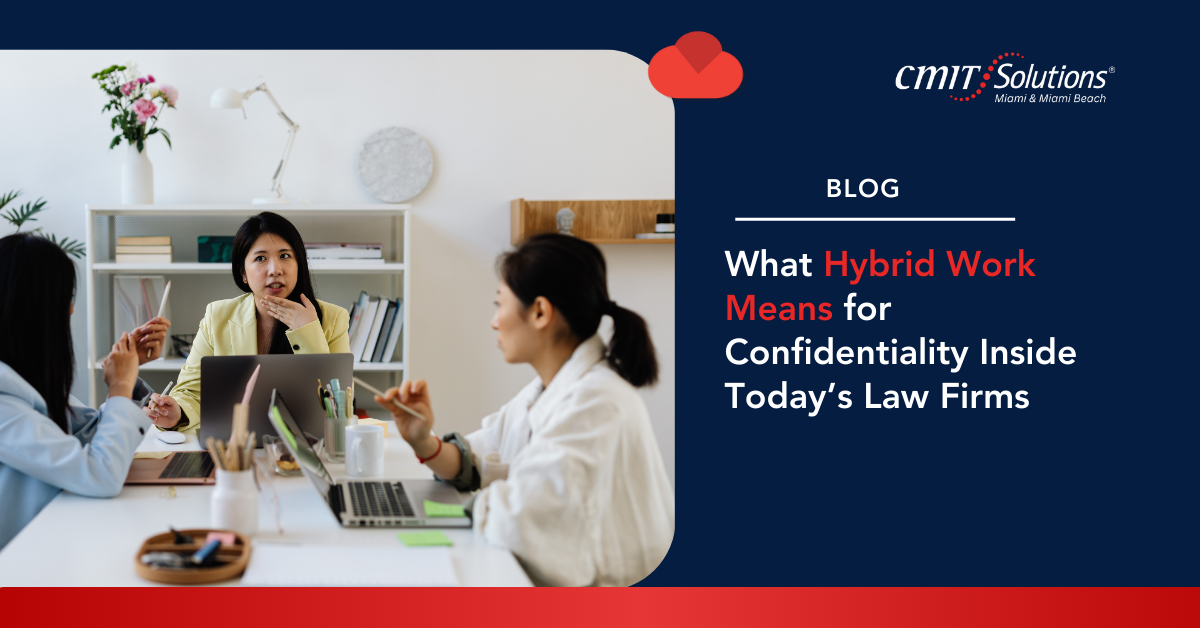
Hybrid work has fundamentally changed how law firms operate. Attorneys now split their time between offices, home workspaces, courtrooms, and client locations. While this flexibility has improved work-life balance and broadened talent pools, it has also introduced new challenges particularly when it comes to maintaining confidentiality.
Confidentiality is the cornerstone of legal practice. Attorney-client privilege, ethical obligations, and professional trust all depend on a firm’s ability to protect sensitive information. Hybrid work does not weaken these responsibilities, but it does complicate how they are upheld. Law firms must now secure data, communications, and workflows across multiple environments without disrupting legal practice.
At CMIT Solutions of Miami & Miami Beach, we help law firms adapt to hybrid work while preserving the confidentiality standards their clients expect. Below are ten critical ways hybrid work is reshaping confidentiality inside today’s law firms and how firms are responding.
Confidentiality No Longer Lives Inside the Office Walls
Traditionally, confidentiality was reinforced by physical boundaries secure offices, controlled file rooms, and in-person conversations. Hybrid work removes those boundaries, extending confidential activity into homes, shared spaces, and remote locations.
Law firms must now assume that sensitive work happens everywhere, not just inside the firm’s office. This requires a shift in mindset from perimeter-based protection to continuous, location-independent security.
Understanding this shift is essential to modern confidentiality.
Key implications of this change include:
- Confidential data accessed outside secured office environments
- Reduced reliance on physical safeguards
- Increased importance of digital controls
- Greater exposure to environmental risks
Home Workspaces Introduce New Confidentiality Risks
Attorneys working from home often share space with family members, roommates, or visitors. Conversations, screens, and documents may be visible or audible in ways that would never occur in a law office.
Forward-thinking firms are addressing these risks through policy, technology, and education rather than assuming home environments are secure by default.
Confidentiality now depends on personal workspace discipline.
Common home-office confidentiality challenges include:
- Conversations overheard by unintended parties
- Screens visible to others in shared spaces
- Printed documents left unsecured
- Use of personal devices for firm work
Device Security Becomes Central to Confidential Practice
Hybrid work increases reliance on laptops, tablets, and mobile devices. Each device becomes an extension of the firm’s confidential environment, making device security a critical component of confidentiality.
Law firms are implementing standardized device controls to ensure sensitive data remains protected regardless of where work occurs.
Devices are now the frontline of confidentiality.
Essential device security measures include:
- Firm-managed security controls on all work devices
- Encryption to protect stored data
- Strong authentication requirements
- Centralized monitoring and management
Secure Access Replaces Physical Control
In a hybrid model, law firms can no longer rely on locked doors and badge access to protect information. Instead, confidentiality depends on who can access systems and data—and under what conditions.
Firms are implementing secure access frameworks that ensure only authorized users can reach sensitive information, regardless of location, supported by stronger identity practices like identity access.
Access control defines confidentiality in hybrid work.
Key access management practices include:
- Role-based permissions aligned with responsibilities
- Secure authentication for remote access
- Regular reviews of user access rights
- Immediate removal of access when roles change

Remote Collaboration Requires New Confidentiality Safeguards
Hybrid work has increased reliance on digital collaboration tools for document sharing, meetings, and communication. While these tools improve efficiency, they also create new pathways for confidential information to be exposed if not properly governed.
Law firms are re-evaluating how collaboration tools are configured and used to ensure confidentiality remains intact, building on secure collaboration principles like smarter collaboration.
Collaboration must be secure by design.
Confidentiality considerations for collaboration include:
- Controlling document sharing and permissions
- Securing virtual meetings and communications
- Preventing unauthorized downloads or forwarding
- Maintaining clear version control of legal documents
Attorney-Client Privilege Must Be Protected Across Locations
Attorney-client privilege does not change in a hybrid environment, but the ways it can be compromised do. Casual conversations, unsecured communications, or unapproved tools can inadvertently expose privileged information.
Law firms are reinforcing privilege awareness and aligning technology usage with ethical obligations.
Privilege protection now extends beyond the office.
Steps firms take to protect privilege include:
- Clear guidelines on approved communication tools
- Policies governing remote discussions of client matters
- Secure handling of privileged documents
- Training focused on real-world hybrid scenarios
Data Storage and Transfer Become More Complex
Hybrid work increases the movement of data between devices, networks, and locations. Traditional assumptions about where data resides no longer apply, increasing the risk of loss or unauthorized access.
Modern law firms are implementing centralized, secure storage models that allow controlled access without local duplication, supported by resilience planning like data backup and recovery.
Control over data movement is essential.
Challenges addressed through modern storage strategies include:
- Preventing local storage of sensitive files
- Reducing reliance on unsecured personal networks
- Maintaining consistent access controls
- Improving visibility into data usage
Human Error Becomes a Greater Confidentiality Threat
Hybrid environments introduce distractions and informal work habits that can increase the likelihood of mistakes. A single misdirected email, unsecured device, or accidental screen share can compromise confidentiality.
Law firms are focusing on reducing human error through process design and education rather than relying solely on technology.
People remain central to confidentiality.
Common hybrid-related errors include:
- Sending documents to incorrect recipients
- Leaving systems unlocked in shared spaces
- Using unapproved applications or devices
- Mishandling printed confidential materials

Consistent Policy Enforcement Is Harder but More Necessary
Hybrid work makes it harder to enforce policies consistently, as attorneys operate across different environments. Without clear, enforceable standards, confidentiality practices can vary widely.
Law firms are updating policies to reflect hybrid realities and ensuring they are actively enforced through technology and oversight, supported by structured governance like it compliance.
Consistency protects both the firm and its clients.
Effective hybrid confidentiality policies include:
- Clear expectations for remote work behavior
- Defined standards for device and data usage
- Enforcement mechanisms tied to technology controls
- Regular reviews and updates
Managed IT Partnerships Help Safeguard Confidentiality
Maintaining confidentiality in a hybrid environment requires ongoing oversight, expertise, and adaptation. Law firms benefit from working with IT partners who understand legal confidentiality requirements and hybrid work realities.
At CMIT Solutions of Miami & Miami Beach, we help law firms design secure hybrid environments that protect sensitive information without disrupting legal practice. Our approach combines proactive monitoring, policy alignment, and strategic guidance, backed by modern service models like managed it services.
The right partner strengthens confidentiality at every level.
Benefits of working with a legal-focused IT partner include:
- Expertise in legal confidentiality and compliance
- Proactive identification of hybrid-related risks
- Ongoing optimization of security controls
- Support for evolving work models
Conclusion: Confidentiality Must Evolve With How Law Firms Work
Hybrid work is no longer a temporary adjustment it is a permanent shift in legal practice. Confidentiality remains non-negotiable, but how it is protected must evolve.
By rethinking access, strengthening controls, educating teams, and partnering with trusted experts like CMIT Solutions of Miami & Miami Beach, law firms can uphold the highest confidentiality standards while embracing the flexibility of hybrid work. In today’s legal environment, protecting confidentiality means protecting it everywhere work happens.