
If you own a business in Manassas City, the toughest conversation you had in the last twelve months was probably your cyber insurance renewal. Carriers are asking harder questions, rates are climbing, and coverage is getting narrower. More importantly, the underwriter is not going to accept “our IT guy handles it” as an answer anymore.
That is the shift shaping the managed IT market in 2026. What used to be a nice-to-have is now the thing keeping your policy in force, your contracts renewable, and your business insurable. Here is what a Manassas City small business should actually expect from a local managed IT provider this year, and what to walk away from if you are not getting it.
Real 24/7 monitoring, not a dashboard nobody checks
The bar has moved. Monitoring means someone is watching your network, your endpoints, and your critical applications around the clock, with alerts triaged by a live human, not just logged to a dashboard that gets reviewed on Monday morning.
Ask any provider you are considering: who is looking at alerts at 2am on a Saturday, and what happens when one turns into an incident? If the answer involves the words “next business day,” you are not getting monitoring, but a report.
A local team you can actually reach
The reason to work with a Manassas-based provider instead of a national help desk is that someone can be onsite the same day when it matters. Server room flooded, ransomware hit, a new office opening in Bristow that needs cabling and setup, none of that gets solved over a chat window.
Local also means the team knows the business community. They know which industries are growing in Prince William County, what the county’s contractor base actually needs for CMMC readiness, and what a Manassas dental practice’s HIPAA obligations look like in practice. Generic support cannot replicate that.
Patching that actually happens
Unpatched systems are still the single most common way small businesses get breached. Your provider should be running a documented patch schedule for operating systems, third-party applications, and firmware, with a monthly report showing what was patched, what failed, and what was deferred.
If your current setup does not produce that report, patching is probably not happening at the cadence you think it is.
Backups that get tested
Every provider claims to do backups, but very few actually test them. A backup that has never been restored is a disaster waiting to happen. The right question to ask is not “do you back us up,” but “when was the last time you restored our data as a test, and what was the result?” A real answer includes a date, a scope, and a recovery time.
Cybersecurity that matches your compliance load
Manassas City has a heavy mix of contractors, healthcare practices, financial firms, and professional services, and each one carries its own compliance obligations. A managed IT provider in 2026 should be able to speak fluently about the frameworks that apply to your business, whether that is HIPAA, PCI DSS, CMMC 2.0, the FTC Safeguards Rule, or state-level rules.
At minimum, the security stack should include endpoint detection and response, email security, multi-factor authentication on every business application, encrypted backup, and documented incident response. Anything less is falling behind what cyber insurance carriers now require at renewal.
Documentation you actually own
If your relationship with your current provider ended tomorrow, could you walk into a new provider with a complete inventory of your systems, licenses, passwords, and network configuration? For most small businesses, the honest answer is no. That is a serious problem. Documentation should be maintained continuously and handed over to you on request, not held hostage as a switching cost.
Straight answers on pricing
Managed IT pricing in Northern Virginia is usually structured per user, per device, or as a bundled monthly fee. What matters is not which model your provider uses, but whether they can clearly tell you what is included, what costs extra, and what triggers a change in billing.
If a provider dodges into a “custom quote” conversation before answering basic scoping questions, that is a signal. Straight pricing is a marker of a mature MSP.
A strategic conversation once a quarter
The best managed IT relationships are not just reactive support. Your provider should sit down with you at least quarterly to review what is working, what is breaking, what is coming up in the next six months, and what the security posture looks like. That conversation is where real value gets built. Ticket volume alone does not tell you if your IT is actually improving.
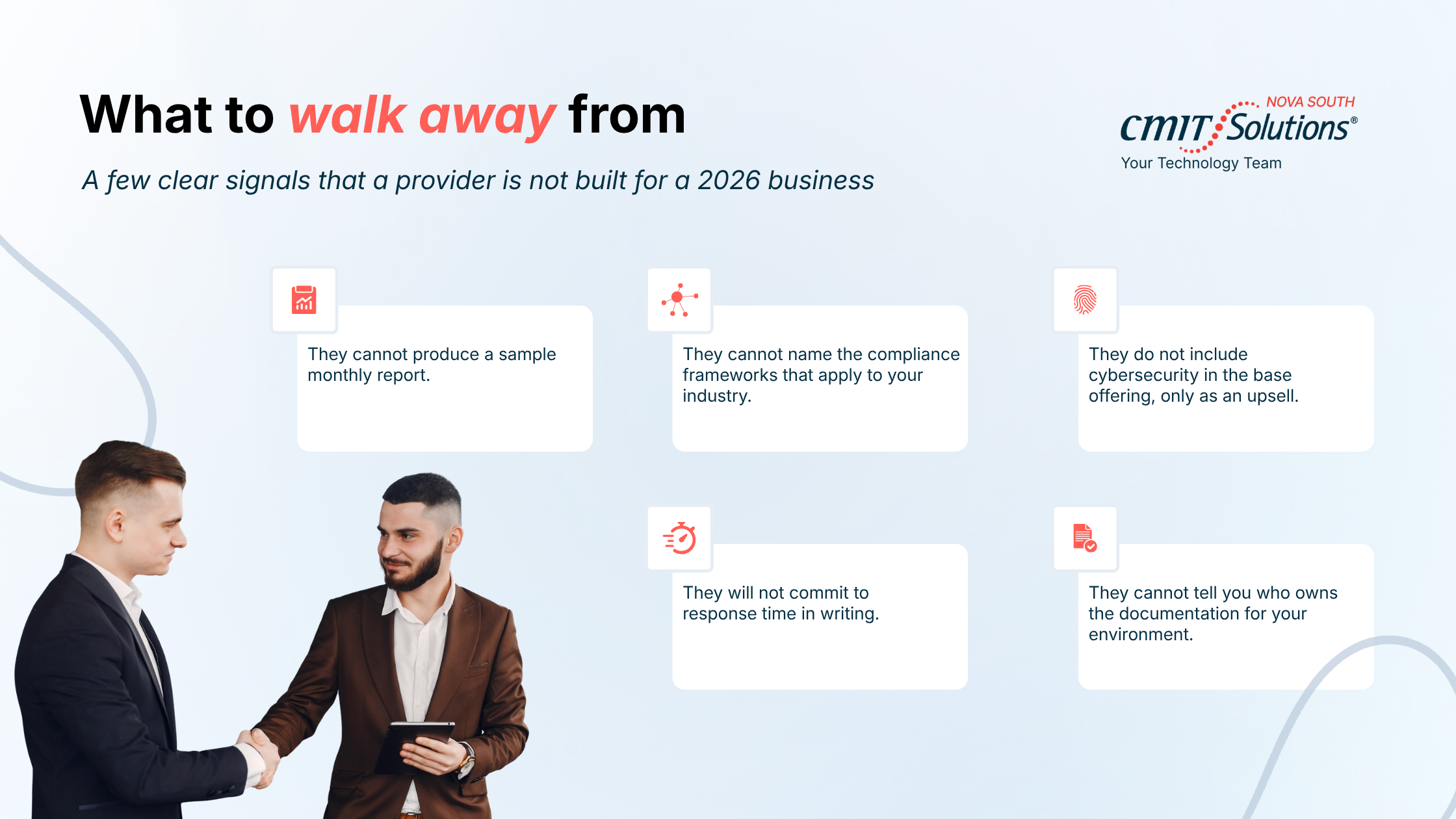
What to walk away from
A few clear signals that a provider is not built for a 2026 business:
- They cannot produce a sample monthly report.
- They cannot name the compliance frameworks that apply to your industry.
- They do not include cybersecurity in the base offering, only as an upsell.
- They will not commit to response time in writing.
- They cannot tell you who owns the documentation for your environment.
Working with a local partner
Every point on the list above is something you should be able to ask a provider about and get a direct answer. Sample monthly report, patch schedule, last tested backup restore, and compliance frameworks they support are a few.
That is the standard we hold ourselves to at CMIT Solutions of NOVA South. Locally operated in Manassas, backed by the CMIT national network of 300+ locations, and led by a team with 20+ years of enterprise IT and security experience across commercial and federal environments.
We work with small and mid-size businesses across Manassas City, Prince William, Fairfax, and Stafford who are done guessing whether their IT is actually keeping up. Call (571) 720-9555 or schedule a call, and we will run through the same checklist against your current setup. No pitch, just an honest read on where you stand.
Frequently Asked Questions
What does a managed IT provider actually do?
A managed IT provider handles ongoing support, monitoring, patching, backup, security, and strategic planning for your technology environment, usually for a fixed monthly fee. It replaces the break-fix model where you only call for help when something is already broken.
How is managed IT different from break-fix?
Break-fix charges you when something goes wrong. Managed IT charges a flat monthly fee to keep things from going wrong in the first place, and to fix them fast when they do. Break-fix rewards a provider for reactive work. Managed IT rewards them for preventing it.
How much does managed IT cost for a small business in Manassas?
It depends on user count, device count, and the depth of security and compliance work bundled in. Pricing is usually a conversation, not a form. What matters more than the number is what the bundle actually includes and whether it covers your compliance obligations.
What should I look for in a Manassas managed IT provider?
Real 24/7 monitoring, a local team you can reach, documented patching, tested backups, cybersecurity that matches your compliance load, ownership of your documentation, and straight answers on pricing.
Can a managed IT provider help with compliance?
Yes, if they know the framework. A provider working with Manassas businesses should be able to speak to HIPAA, PCI DSS, CMMC 2.0, and the FTC Safeguards Rule at a minimum, and produce the documentation those frameworks require.
Do I still need cybersecurity if I have managed IT?
Cybersecurity should be part of your managed IT bundle in 2026, not a separate purchase. If a provider treats it as an add-on, you are paying twice for one job.
What happens to my data if I switch providers?
It should come with you. Complete documentation, passwords, and system inventory should be handed over on request. If a provider will not commit to that up front, treat it as a red flag.