Legacy IT once defined stability and control. Today, it represents risk, cost, and delay.
Traditional servers, manual updates, and ticket-based support cannot keep up with the speed of cloud adoption, cyberattacks, and hybrid work.
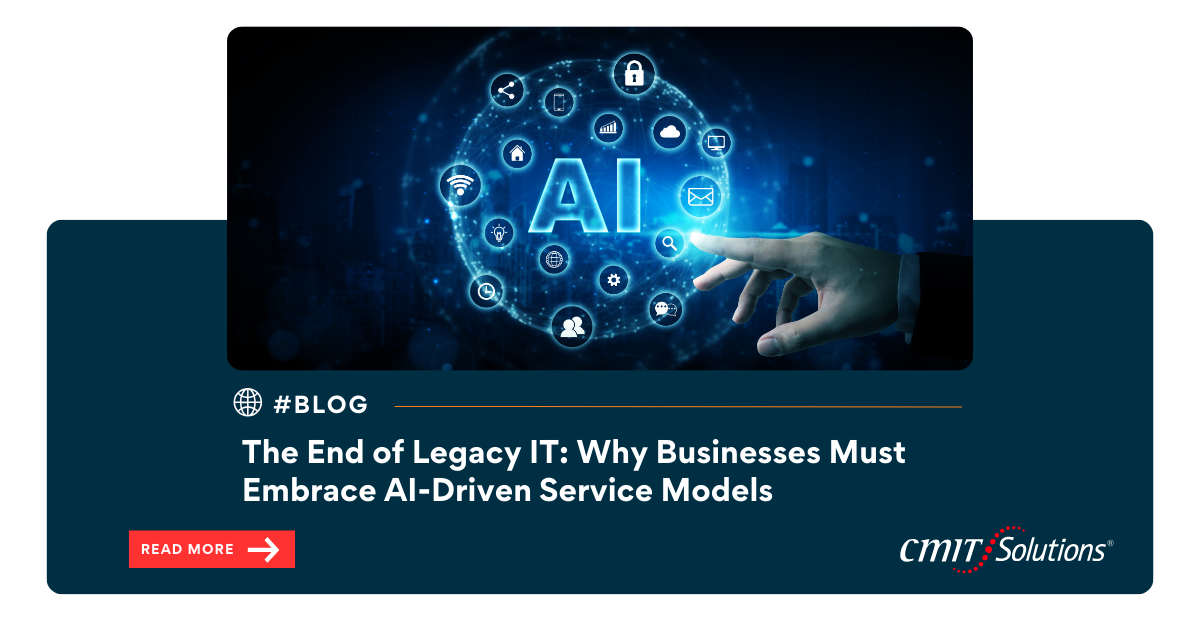
The next era belongs to AI-driven service models—intelligent, automated IT systems that predict and prevent problems while reducing cost and complexity.
Legacy IT and Its Limits
Legacy IT depends on outdated processes that are slow and expensive to maintain:
- Break-fix support – reacting only after systems fail.
- Manual patching – creating long windows of vulnerability.
- Tool sprawl – monitoring, backups, and security scattered across disconnected platforms.
- Costly hardware – servers and storage that require frequent upgrades.
The consequences are:
- Higher downtime and lost productivity.
- Greater exposure to cyber threats.
- Difficulty supporting hybrid workforces.
Modern businesses can’t compete under these conditions, which is why many are turning to managed IT for scalable, modern support.

What Is an AI-Driven Service Model?
An AI-driven model uses machine learning, analytics, and automation to anticipate issues before they occur.
Key capabilities include:
- Predictive monitoring that identifies unusual patterns early, a core feature of proactive IT.
- Automated remediation that patches systems or reconfigures resources without human delay.
- Continuous compliance to meet regulatory standards in real time.
- Self-healing networks for faster recovery and better uptime.
The result is faster operations, stronger security, and lower costs.
Drivers Behind the Shift
Explosive Data Growth
Email, cloud apps, and IoT devices generate massive volumes of data.
Manual oversight can’t keep pace, making data observability essential for accuracy and reliability.
Rising Cyber Threats
Attackers now use automation and AI to exploit weaknesses.
Automated patching and endpoint security are critical to stay ahead of ransomware and phishing attacks.
Hybrid Work
Employees expect secure access from anywhere.
AI-driven networking simplifies remote connections through network management and automated bandwidth optimization.
Compliance Pressure
Industries like healthcare and finance demand continuous oversight.
Automated policy enforcement and audit logs support strict cybersecurity compliance requirements.
How AI-Driven Services Operate
An AI-first environment follows three layers:
- Monitoring – Unified dashboards collect data from endpoints, networks, and cloud resources.
- Automation – Predefined runbooks resolve common incidents automatically.
- Machine learning – Algorithms learn over time to predict failures and optimize capacity.
These functions create an always-on IT backbone that supports growth and innovation.
Why SMBs Need Managed IT
Implementing AI technology requires expertise.
Partnering with a Managed Services Provider (MSP) like CMIT Solutions of Oak Park, Hinsdale & Oak Brook delivers:
- Strategic planning to align IT with business goals.
- 24/7 monitoring as shown in system monitoring.
- Predictable pricing models that reduce capital expense.
- Scalable infrastructure for growth supported by managed IT.
Migration Path to AI-Driven IT
A safe transition involves four phases:
- Assessment – Inventory assets, evaluate risks, and identify compliance needs.
- Stabilization – Apply essential patches and implement core security controls.
- Pilot Projects – Deploy AI monitoring on critical systems to prove value.
- Full Integration – Extend automation to backups, disaster recovery, and cloud performance.
Guidance from experienced providers ensures a smooth migration without disrupting operations, similar to the improvements seen in streamlined IT operations.
Financial and Operational Gains
Businesses adopting AI-driven models experience:
- Lower downtime thanks to predictive analytics and automated fixes.
- Reduced costs by eliminating redundant hardware and manual labor.
- Improved productivity as employees avoid delays and IT staff focus on strategy.
- Optimized cloud spend through intelligent scaling.
These savings mirror the benefits highlighted in downtime reduction studies.
Security and Compliance Advantages
AI strengthens protection by:
- Detecting threats in real time.
- Automatically isolating compromised devices.
- Maintaining detailed logs for audits.
Such practices support industry standards and prepare companies for future regulations, reinforcing the importance of continuous compliance.
Future Outlook
Organizations that modernize now gain:
- Faster innovation cycles with less technical debt.
- Enhanced customer experiences with reliable uptime.
- Better employee retention as IT teams focus on high-value work.
Those clinging to outdated systems face rising costs and escalating cyber risks—while competitors that leverage outsourcing pull ahead.
Conclusion: Move Beyond Legacy IT with CMIT Solutions
The future belongs to businesses that combine automation, intelligence, and expert management.
An AI-driven service model eliminates the weaknesses of legacy IT and positions your organization for growth.
CMIT Solutions of Oak Park, Hinsdale & Oak Brook delivers:
- Predictive monitoring and automated remediation.
- Enterprise-grade security through continuous endpoint protection.
- Optimized performance across cloud and on-premises environments.