Introduction: Why Email Remains the #1 Cyber Threat
Despite decades of security upgrades, email continues to be the most exploited entry point for cybercriminals. According to industry research, over 90% of cyberattacks begin with an email. For local SMBs, phishing emails aren’t just an IT nuisance they’re a daily risk to revenue, compliance, and reputation.
Today, email threats are more convincing than ever. Criminals are leveraging AI generated content, QR code phishing, and multi channel scams that go far beyond traditional spam. To stay protected, businesses must understand what’s emerging and how to counter it with multi layered security strategies like managed IT services.
The Evolution of Phishing: From Spam to Sophistication
In the past, phishing emails were easy to spot—poor grammar, strange formatting, and too good to be true offers gave them away. Today, AI enables criminals to generate flawless emails that mimic legitimate business communications.
What’s changed?
- AI tools now replicate executive writing styles for spear phishing
- Email scams are personalized with real customer or vendor data
- Attackers use QR codes and cloud links to bypass filters
This evolution makes it nearly impossible for employees to distinguish fake from real without cybersecurity awareness training and advanced safeguards like proactive monitoring.
How QR Code Phishing Scams Actually Occur
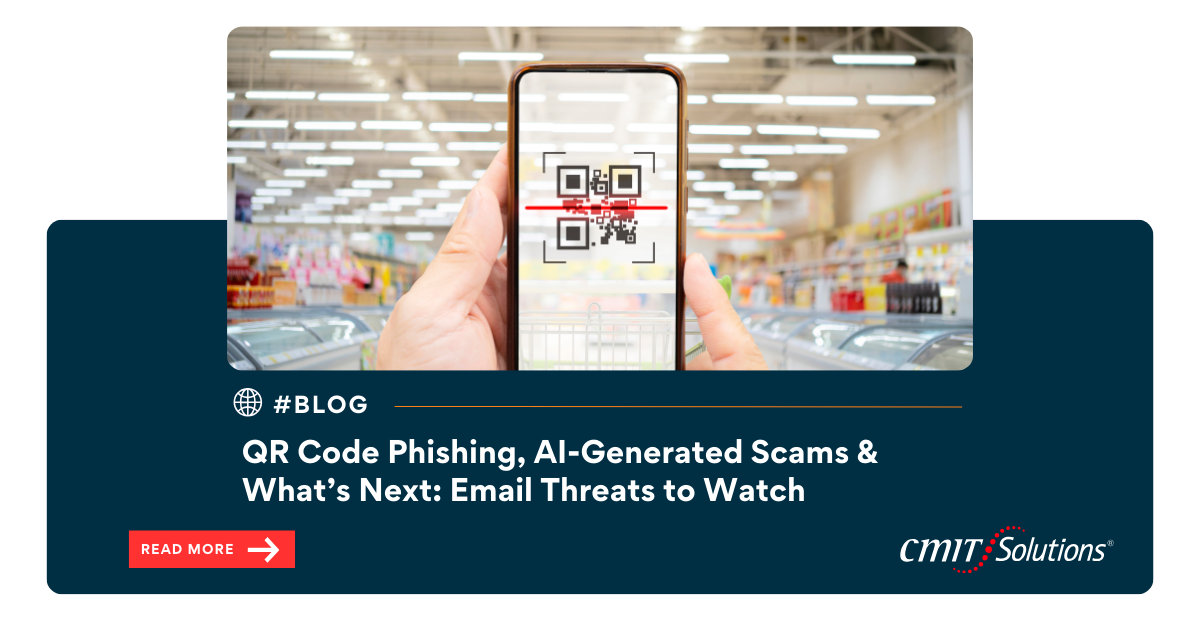
While most people associate phishing with suspicious links in an email, QR code phishing is even more deceptive because it bypasses traditional filters. Here’s how attackers trick employees step by step:
- The Setup: The attacker creates a phishing page that looks identical to a trusted service like Microsoft 365, a bank portal, or a payment site
- Delivery via Email: Instead of a direct link, the email contains a QR code. Since filters can’t easily analyze images, the malicious content slips through
- Employee Scan: The recipient scans the QR code with their phone, believing it’s from a legitimate source
- Redirection: The QR code redirects them to the fake login page
- Credential Theft: Once the employee enters their username and password, the attacker captures them instantly
- Exploitation: Stolen credentials are used to access sensitive data, launch further attacks, or spread malware
This is why endpoint protection and mobile monitoring must now be part of every multi layered email security strategy.
AI Generated Scams: When Emails Look Too Real
Generative AI is powering a new wave of phishing scams. Unlike traditional bulk spam, these scams are:
- Polished: Perfect grammar, formatting, and tone
- Contextual: Emails reference recent news, invoices, or conversations
- Adaptive: AI rewrites emails to evade detection if blocked
For SMBs, this means employees are more likely than ever to fall victim. AI can even create fake invoices and contracts that appear authentic. That’s why compliance ready IT solutions now include tools to verify data integrity and detect AI based anomalies.
Business Email Compromise (BEC): The Old Scam, Reinvented
BEC remains one of the costliest email threats. Traditionally, attackers impersonate executives to trick employees into sending payments. Now, with AI, impersonations are even more convincing.
Recent tactics include:
- AI written emails that mimic CEO tone and urgency
- Fake vendor invoices embedded with QR codes
- Deepfake audio attached to emails for “verification”
Fighting BEC requires data backup and recovery solutions and 24/7 network monitoring to ensure continuity if funds or data are compromised.
The Role of Cloud in Email Security
Cloud adoption has reshaped how businesses handle communication. While platforms like Microsoft 365 and Google Workspace provide baseline protections, attackers exploit misconfigurations and shadow IT.
By integrating cloud services with advanced monitoring, businesses gain scalability without sacrificing security. Without proper governance, employees may use unsanctioned apps introducing additional risks for phishing and data leaks.
The Human Factor: Why Employees Remain the Weakest Link
Technology can block many threats, but people are still the most targeted vulnerability. One click on a phishing link can undo millions of dollars of security investment.
Best practices to strengthen human defenses include:
- Regular phishing simulations
- Training staff to verify requests even if they look internal
- Clear reporting channels for suspicious messages
Pairing awareness with unified communication solutions ensures suspicious messages can be flagged quickly across teams.
Compliance Pressures: Regulators Take Email Seriously
With rising phishing attacks, regulators are tightening expectations for email security. HIPAA, GDPR, and new state level laws require businesses to demonstrate that sensitive data is both protected and recoverable.
Solutions like compliance management simplify audits and ensure that SMBs avoid costly fines. Ignoring compliance doesn’t just risk data it risks a business’s ability to operate legally.
What’s Next: Emerging Email Threats to Watch
Cybercriminals are always innovating. Beyond QR codes and AI scams, expect:
- Deepfake attachments: Fake video/audio convincing employees to act
- Multi channel phishing: Blending email, SMS, and collaboration apps
- Insider exploitation: Hackers targeting employees with privileged access
Preparing for these threats requires managed IT services that combine monitoring, endpoint protection, and compliance into a unified strategy.
Proactive Monitoring as the Frontline Defense
Attackers rely on stealth. By the time an employee realizes something is wrong, it’s often too late. Proactive monitoring detects unusual patterns before they escalate.
Why it matters:
- Identifies suspicious logins at odd hours
- Flags abnormal email forwarding rules
- Detects malware hidden in attachments
This is why proactive IT monitoring is now considered essential for small businesses.
Building Cyber Resilient Recovery Into Email Security
Even the best defenses can fail. That’s why cyber resilient recovery plans must be part of every email security strategy. If email systems are compromised, businesses can restore operations without losing critical data.
Pairing this with cloud backup and endpoint security minimizes downtime and restores trust.
Conclusion: Staying Ahead of Email Threats
Email threats are evolving faster than ever. From QR code phishing and AI generated scams to deepfake enabled BEC, attackers are raising the stakes. For SMBs, staying ahead requires more than spam filters—it demands multi layered defenses, proactive monitoring, and trusted IT partnerships.
With the right combination of cloud services, backup strategies, and compliance solutions, businesses can face the future with confidence.