Small businesses in 2026 face three dominant network security threats: AI-powered phishing campaigns, ransomware targeting unpatched endpoints, and supply chain attacks aimed at federal contractors. With 80% of small businesses reporting at least one cyberattack in 2025 and ransomware accounting for 88% of those incidents, the risk is no longer theoretical.
Businesses across Top of Virginia and Eastern Panhandle of WV, the Shenandoah Valley, and the Eastern Panhandle corridor need a clear picture of what they’re up against and what actually stops these attacks.
Key Takeaways
- 80% of small businesses experienced at least one cyberattack in 2025
- AI-driven phishing accounts for over 40% of modern attacks
- Ransomware remains the #1 threat, responsible for 88% of incidents
- Stolen credentials are a leading entry point in 23% of breaches
- Unpatched systems and weak access controls increase risk significantly
- Multi-factor authentication (MFA) blocks most credential-based attacks
- 24/7 monitoring and endpoint detection are essential for early threat detection
- Immutable and tested backups are critical for ransomware recovery
- Compliance frameworks like CMMC are becoming mandatory for contractors
- Managed cybersecurity services provide enterprise-level protection for SMBs
The Cybersecurity Threat Landscape in 2026
The intersection of federal government, defense contracting, and commercial enterprise in ways that make it a particularly attractive target for cybercriminals. The state has one of the highest concentrations of cybersecurity professionals in the country, yet the businesses that support federal agencies as subcontractors and vendors often don’t have dedicated security staff of their own.
Federal contractor ecosystem creates a dense attack surface. Threat actors treat small and mid-sized subcontractors as supply chain entry points into larger DOD and civilian agency networks, making network security threats businesses face more acute than in many other states.
The Department of Defense’s September 2025 final rule on CMMC 2.0 (Cybersecurity Maturity Model Certification) changed the compliance picture for every company in the Defense Industrial Base. Contracts issued from November 2025 onward can require contractors to demonstrate CMMC Level 2 compliance, covering 110 security practices drawn from NIST SP 800-171. For companies that haven’t started their assessment process, the clock is already running.
The scale of this shift is significant. Thousands of small and mid-sized businesses across Top of Virginia and Eastern Panhandle of WV, and the Shenandoah Valley corridor provide goods and services to prime contractors. Many haven’t completed a gap assessment, don’t have a System Security Plan on file, and aren’t sure whether their current IT provider can support CMMC requirements. CMMC compliance businesses need is exactly what CMIT Solutions’ compliance services are designed to address, helping businesses work through CMMC readiness without losing existing contracts.
Is Your Business Ready for 2026 Cyber Threats?
CMIT Solutions provides 24/7 managed cybersecurity for Top of Virginia and Eastern Panhandle of WV small and mid-sized businesses.
Which Industries Are Being Targeted Most in 2026?
Three sectors are drawing the most concentrated attack activity in 2026.
1. Defense Contractors and the CMMC 2.0 Compliance Transition
The CMMC 2.0 transition window has created an opening for threat actors. Government contractors in the process of documenting compliance controls often have temporary gaps in their security posture. Ransomware groups and nation-state actors have taken notice, treating the DIB as a high-value supply chain target. A small defense subcontractor in the Shenandoah Valley with access to Controlled Unclassified Information (CUI) can become an entry point into a prime contractor’s systems if that subcontractor’s email is compromised or their VPN isn’t patched.
CMIT Solutions’ managed services include the continuous network monitoring and documentation support that contractors need during CMMC assessment preparation.
2. Healthcare Providers Seeing More Ransomware Attacks in 2026
Health-ISAC’s 2025 annual threat report documented a 55% surge in cyber incidents targeting healthcare organizations. Healthcare sector, which includes large health systems in Top of Virginia and Eastern Panhandle of WV and smaller rural practices in the Shenandoah Valley and Southwest Virginia, faces attacks across the spectrum. Rural practices are particularly exposed because they often run older EHR software, don’t have IT staff on-site, and can’t afford extended downtime.
A healthcare clinic in the Shenandoah Valley with 12 providers was hit by ransomware in 2025, encrypting patient records across their network for 72 hours. The clinic paid $45,000 in ransom and lost an estimated $18,000 in appointment revenue before systems were restored. A tested backup strategy and 24/7 endpoint detection would have changed that outcome.
Read More About: Healthcare IT Compliance Requirements and Penalties
3. Small Manufacturers Targeted by Wiper and Credential Attacks
Small manufacturers were targeted by a wave of wiper malware and credential-harvesting campaigns in mid-2025, according to ConnectWise threat intelligence reporting. Networked industrial equipment that wasn’t designed with security in mind is frequently accessible from the internet with default credentials. When attackers get into operational technology networks through IT-side phishing attacks, the disruption can halt production lines for days.
How Attackers Get Into Small Business Networks
Understanding the specific initial access methods matters because defenses need to match the actual attack vectors. Cybersecurity small businesses use must address the patterns providers are consistently seeing in 2025 and 2026.
- Phishing emails, including AI-generated messages that mimic internal communications accurately enough to fool employees who are paying attention
- Compromised credentials, which accounted for 23% of ransomware entry points in 2025 – attackers purchase or harvest valid usernames and passwords and walk in through the front door
- Unpatched VPN appliances, which have been targeted repeatedly because many small businesses don’t have a patch management process and can go months without applying critical updates
- MFA fatigue attacks, where attackers send repeated authentication push notifications until a tired employee approves one
- Supply chain compromise, where a trusted software vendor or IT provider is breached and used as a distribution channel into client networks
Self-contained summary, How Ransomware Gets In: Ransomware operators don’t break through walls. They walk through unlocked doors. Phishing and stolen credentials together account for the majority of successful ransomware deployments against small businesses, which is why enforcing multi-factor authentication and security awareness training are the two highest-return defenses for SMBs with limited security budgets.
CMIT Solutions’ managed detection and response services provide 24/7 monitoring that catches credential misuse, lateral movement, and other attack behaviors before they reach the ransomware deployment stage.
Read More About: What is MDR hunting?
Why Small Businesses Face Higher Cybersecurity Risk
The cybersecurity small businesses can access is often far below what their risk exposure warrants. Several structural factors make SMBs in softer targets than organizations that have invested in dedicated security programs.
Most small businesses don’t have anyone whose job is security. IT responsibilities are distributed across whoever is most technically inclined, and security takes a back seat to keeping systems running. When an attack happens, there’s no incident response plan to follow, no communication tree, and no pre-identified legal or forensic resources to engage.
Personal and business accounts frequently share devices, credentials, and email addresses in small business environments. When an employee’s personal email is compromised, attackers can pivot directly into business systems if the same password is in use. This happens far more often than most business owners realize.
Acrisure’s 2025 cyber risk research found that 41% of cyberattacks on small businesses were AI-driven, meaning attackers used AI tools to craft more convincing phishing messages, automate credential stuffing, and adapt their tactics faster than traditional security awareness training can keep up. The attack surface expanded in 2024 and 2025 as remote work introduced personal devices and home networks into business workflows.
A construction firm in Top of Virginia and Eastern Panhandle of WV with 22 employees learned this the hard way in late 2025 when an AI-generated phishing email impersonating their general contractor fooled the office manager into entering credentials on a fake payment portal. The firm’s bank account was drained of $67,000 before the fraud was detected. The firm had no multi-factor authentication on their email accounts or banking portal at the time.
Your Business Can’t Afford to Be the Weakest Link
Managed cybersecurity gives SMBs enterprise-grade protection without an in-house team.
Practical Cybersecurity Defenses for Businesses
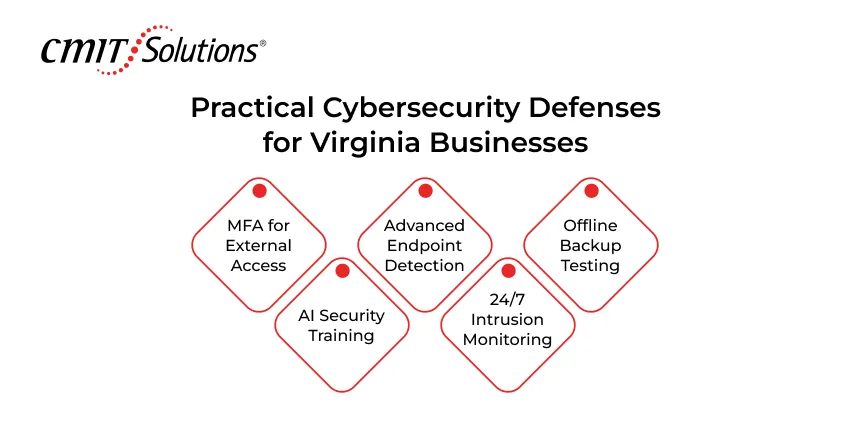
The network security threats businesses face in 2026 are serious, but they’re not unstoppable. A layered defense built on proven controls blocks the most common attack paths without requiring an enterprise security budget.
Enable MFA on Every External Login and Remote Access System
MFA implementation is the single highest-return control available to small businesses. Every email account, remote desktop connection, VPN, and cloud application should require a second factor beyond a password. Authenticator apps are preferable to SMS codes because they can’t be intercepted through SIM-swapping attacks. MFA alone would have prevented the Winchester construction firm incident described above.
Endpoint Detection and Response Beyond Signature-Based Tools
Traditional antivirus software looks for known malware signatures. Modern attackers use techniques that signature-based tools don’t catch. Endpoint security solutions using behavioral detection identify suspicious activity patterns, such as a user account suddenly accessing files it doesn’t normally touch, and flag them for review before damage spreads across the network.
Offline Backup Testing and Recovery for Ransomware Defense
Backups are only as valuable as their recovery process. Many businesses have backups that haven’t been tested in over a year. Air-gapped backups stored in a location separate from production systems, and tested on a regular schedule, are the foundation of any ransomware protection businesses should have in place. Immutable backups, which can’t be deleted or encrypted by ransomware, add an additional layer when combined with offline copies.
Security Awareness Training Updated for AI-Powered Threats
Security awareness training from 2022 doesn’t address AI-generated phishing. Training programs need to show employees what modern phishing attempts look like, including voice phishing (vishing), text-based smishing, and AI-crafted emails that use correct names, titles, and project references. Training should be quarterly at minimum and should include simulated phishing tests so employees practice identifying threats in a low-stakes environment.
24/7 Network Monitoring for Detecting After-Hours Intrusions
Attackers don’t limit their activity to business hours. Most ransomware deployments happen on nights and weekends, when no one is watching. Continuous monitoring through a managed cybersecurity provider catches anomalous activity and responds to it before attackers have time to encrypt data or exfiltrate files.
Read More About: FISMA Compliance Requirements in Cybersecurity
Step-by-Step: Your 2026 Cybersecurity Defense Checklist
Step 1: Enforce MFA Across All External Access Points
Audit every system that allows remote access or external login. Enable MFA on email (Microsoft 365 and Google Workspace both support it natively), VPN, remote desktop, cloud storage, and any line-of-business application. Document which systems have MFA enabled and which don’t so you can track completion.
Step 2: Run a Privileged Access Audit
Review who has administrator-level access to your systems and whether that access is still appropriate. Former employees, contractors who finished their engagement, and accounts created for one-time tasks often retain elevated privileges long after they should have been removed. Reducing the number of privileged accounts reduces the blast radius of any credential compromise.
Step 3: Test Your Backup Recovery Process
Pick a non-critical server or file set and go through the full recovery process. Measure how long it takes, identify any gaps in coverage, and confirm that backup files aren’t accessible from the same network segment as production systems. Document the recovery time objective (RTO) for your most critical systems and confirm your backup process can meet it.
Step 4: Update Security Awareness Training
Replace or supplement any security awareness training that doesn’t address AI-generated phishing, vishing, and smishing. Run a phishing simulation before and after training to measure improvement. Make sure employees know exactly what to do when they suspect they’ve clicked a malicious link, including who to call and not to try to handle it quietly on their own.
Step 5: Review and Test Your Incident Response Procedure
If you don’t have a written response plan, create one. If you have one, check that the contact information is current, the escalation steps are clear, and the plan has been reviewed within the past year. A plan that’s never been tested is better than nothing, but a plan that’s been walked through as a tabletop exercise is significantly more effective when an actual incident happens.
Step 6: Engage Managed IT Security Services
Evaluate whether your current IT provider can deliver 24/7 monitoring, incident response support, and endpoint detection. Many small business IT providers offer break-fix support and basic management but don’t have the security-focused staffing or tooling to detect and respond to modern attacks. Managed cybersecurity Top of Virginia and Eastern Panhandle of WV from a dedicated provider fills that gap without requiring you to hire an in-house security team.
Start Building Your Top of Virginia and Eastern Panhandle of WV Cybersecurity Defense Today
Let CMIT Solutions assess your current security posture and build a protection plan that fits your budget.
Key 2026 Cybersecurity Statistics for Businesses
| Statistic | Source | Year |
| 80% of small businesses experienced at least one cyberattack | Acrisure Cyber Risk Research | 2025 |
| 41% of small business cyberattacks were AI-driven | Acrisure Cyber Risk Research | 2025 |
| Ransomware comprised 88% of small business cyberattacks | ConnectWise MSP Threat Report | 2025 |
| Compromised credentials accounted for 23% of ransomware entry points | ConnectWise MSP Threat Report | 2025 |
| Healthcare organizations saw a 55% surge in cyber incidents | Health-ISAC Annual Threat Report | 2025 |
| CMMC 2.0 final rule effective for new DOD contracts | U.S. Department of Defense | September 2025 |
FAQ
What are the biggest cybersecurity threats for small businesses in 2026?
The biggest threats include ransomware, AI-powered phishing attacks, and credential theft. These attacks target weak access controls and unpatched systems.
How do ransomware attacks typically start?
Most ransomware attacks begin through phishing emails or stolen login credentials, allowing attackers to access systems before deploying malware.
Why are small businesses more vulnerable to cyberattacks?
Small businesses often lack dedicated security teams, advanced protection tools, and proper employee training, making them easier targets for attackers.
What is the most effective first step to improve cybersecurity?
Enabling multi-factor authentication (MFA) across all systems is the most effective first step, as it prevents unauthorized access even if passwords are compromised.
How do managed cybersecurity services protect businesses?
Managed cybersecurity services provide 24/7 monitoring, threat detection, and rapid incident response to prevent and contain cyberattacks before damage occurs.
What role do backups play in ransomware protection?
Backups allow businesses to restore data after an attack. Immutable and regularly tested backups ensure recovery without paying ransom.
What is CMMC compliance and why does it matter?
CMMC (Cybersecurity Maturity Model Certification) is a framework required for defense contractors to ensure proper protection of sensitive data.
Author Bio
CMIT Solutions Northern Shenandoah Valley is a locally operated managed technology services provider serving small and growing businesses across Winchester, Woodstock, Front Royal, and the broader Northern Shenandoah Valley. As part of the nationwide CMIT Solutions network, the local team delivers enterprise-grade IT infrastructure management, cybersecurity, compliance support, and responsive technology services tailored to the specific needs of Virginia businesses.