
Running a small business is challenging enough without tech issues slowing you down. These recurring problems aren’t just frustrating — they drain valuable time and money, directly cutting into your productivity and growth.
This is why many small and medium-sized businesses (SMBs) are turning to expert managed IT support with predictable budgeting. This approach is about more than just outsourcing support — it is a strategic investment focused on delivering a measurable Return on Investment (ROI).
This guide will show you exactly how maximizing ROI with managed IT is possible by improving cost-efficiency and productivity. To see the full picture, let’s first break down the true costs of a traditional IT approach versus a managed one.
Traditional IT Approach vs. Managed IT Services
When comparing IT models, many businesses assume an in-house team is the cheaper option — but that’s rarely the full picture once you account for all the hidden expenses.
- You don’t just pay a salary — you cover recruitment, continuous training, employee benefits, and the high operational costs of maintaining on-site infrastructure.
- Hiring and training full-time IT staff requires a significant investment that goes far beyond a base wage.
In contrast, managed IT services consolidate these unpredictable and variable costs into a single, predictable monthly fee.
- This model provides your business with a clear cost structure — enabling transparent financial planning and effective resource allocation that leads to substantial long-term cost savings.
- Additionally, these providers often have vendor relationships that can result in lower costs for your hardware and software purchases.
Unlike the high, unexpected fees from emergency break-fix scenarios, proactive managed IT services are built into the plan to prevent such financial shocks.
When you add up these benefits of managed IT services, the ROI becomes clear through:
- Drastically reduced infrastructure spending
- Lower labor costs
Ultimately, outsourcing your IT needs isn’t just a cost-cutting tactic — it is a strategic investment in your business’s stability and growth.
While these direct and indirect cost savings are significant, one of the most substantial financial drains on a business comes from an area many owners overlook: the true cost of downtime — let’s explore this next.
Calculate the Financial Impact of Improved Uptime and Productivity
When your IT systems fail, they can bring operations to a screeching halt.
Costly Downtime from system failures or cyberattacks drains your time and resources — leading to substantial revenue loss.
When calculating the cost of Costly Downtime, you must account for:
- Lost revenue
- Wasted employee wages
- Potential damage to your brand’s reputation
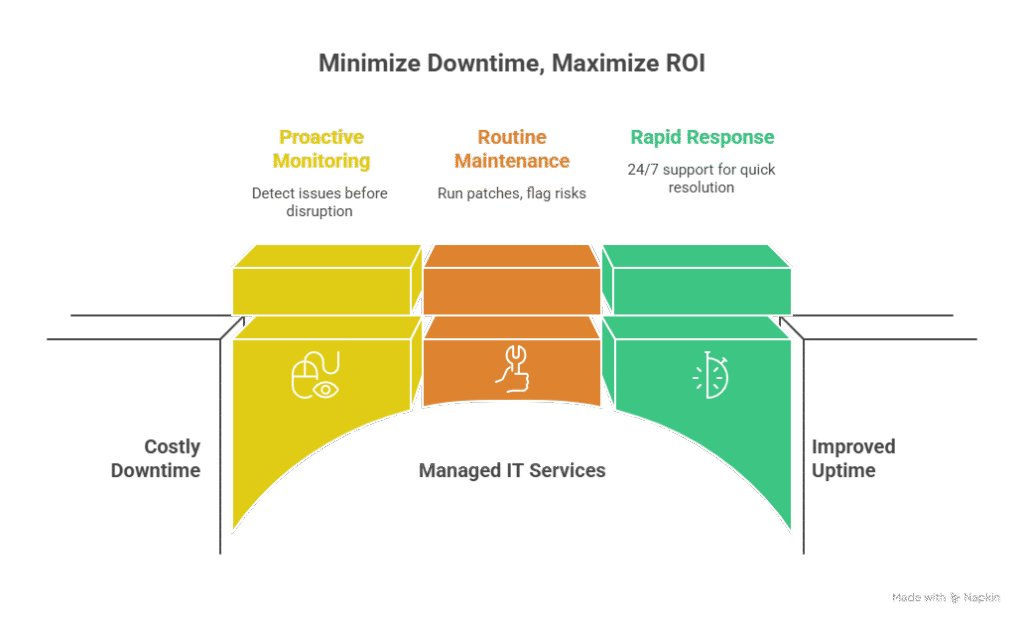
This is where managed IT service providers make a direct impact by:
- Employing state-of-the-art monitoring tools to keep a vigilant eye on your IT infrastructure around the clock
- Enabling real-time monitoring to detect and resolve potential issues before they disrupt your operations
- Running routine patches and flagging potential risks
This proactive approach/maintenance is the first step in preventing Costly Downtime, lost revenue, and last-minute scrambles.
And the operational gains from managed IT services?
- Fewer disruptions for employees — allowing them to maintain productivity and focus on core tasks.
- Faster resolution times for any issues that do arise — thanks to rapid response times and 24/7 support.
- Access to the latest technology and tools that an MSP implements — improving operational efficiency without a steep learning curve for your staff.
Ultimately, these operational gains protect your brand’s reputation and ensure your business’s long-term health — the foundation for maximizing ROI.
Next, let’s discuss how the true value of your IT services emerges when the relationship with your managed IT provider evolves beyond simple maintenance.
Also Read: Business Downtime: How Much Can You Afford?
Leverage a Strategic Partnership to Drive Business Growth
Managed IT services deliver the most value when used as a “strategic partnership” aligned with your business objectives — not just a reactive support function.
When IT strategy is aligned with business outcomes:
- Technology investments shift from being perceived as “cost centers” to becoming true “value drivers.”
- Your business gains access to a team of seasoned experts who can handle complex challenges — addressing critical skill gaps and freeing up your internal staff to focus on innovation.
So, how do you identify a true strategic partner?
Look for a team that delivers on these three key qualities:
- Proactively guides your “IT strategy” and contributes to “strategic roadmap planning.”
- Understands your key business goals and helps you track progress against key performance indicators.
- Helps you plan for future growth — ensuring your technology can scale with your ambitions.
When your technology is aligned with your goals, the next critical step is to protect the assets that drive that growth, which brings us to the most important investment of all: security.
Quantify the ROI of Proactive Cybersecurity and Data Protection
In an evolving threat landscape, robust cybersecurity is a critical investment essential to protecting your business’s future — even a single data breach can lead to severe financial losses.
This is where managed IT services make a difference — delivering layered protection through the following key strategies:
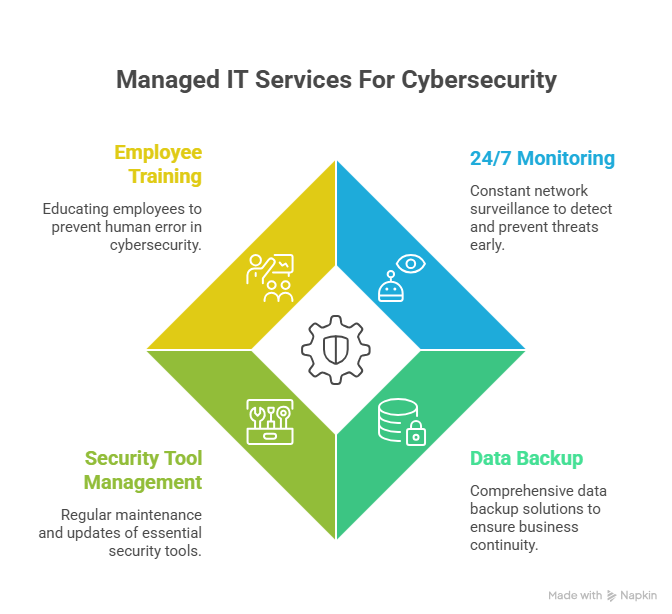
- 24/7 Monitoring and Proactive Threat Detection: Includes constant network monitoring to identify irregularities before they become major problems — helping to save your business from costly breaches.
- Data Backup and Disaster Recovery Planning: A comprehensive data backup solution and a viable disaster recovery plan to ensure business continuity and prevent data loss from cyberattacks or hardware failures.
- Management of Essential Security Tools: Involves the consistent management of firewalls, antivirus software, and regular security updates to maintain a strong defensive barrier around your IT environment.
- Employee Cybersecurity Training: Educates staff to recognize phishing and social engineering attacks — reducing risks from human error and strengthening overall security.
In addition to improving security, your provider will ensure your IT systems meet necessary industry standards — reducing the risk of fines and legal issues.
Ultimately, this comprehensive approach to cybersecurity mitigates security threats proactively — preventing the far more devastating financial and reputational losses that stem from a security disaster.
Make the Smart Financial Decision for Your Business Growth
Managed IT services are a strategic investment in the success and resilience of your business — ensuring your IT infrastructure empowers you to:
Thrive | Innovate | Grow
With proactive IT management in place, businesses benefit from:
- Improved uptime
- Stronger security
- Consistent productivity
Are you a business in Silver Spring and across Montgomery County looking to secure and grow your operations? At CMIT Solutions, we offer reliable IT services — helping you transform IT into a strategic driver of growth, agility, and competitive advantage that delivers long-term value.
Contact us today for a comprehensive IT assessment!