
The phishing email that fooled your bookkeeper in 2022 looked obviously fake. The one hitting Anaheim and Orange County small businesses in 2026 does not. AI phishing attacks for small businesses have moved from a future threat to a daily one, and the average SMB defense stack was not built for what is arriving in the inbox today.
The FBI’s Internet Crime Complaint Center (IC3) reported $16.6 billion in U.S. cybercrime losses in 2024, a 33% year over year increase. California led every state in both victim count and dollar losses. AI-powered cyberattacks, including AI-generated phishing emails, deepfake voice scam attempts, and hyper-targeted business email compromise, are among the fastest growing categories driving that surge.
If you run a small or mid-sized business in Anaheim, Irvine, Santa Ana, or anywhere across Orange County, this is your 2026 threat landscape.
What Makes AI Phishing Attacks Different From Traditional Phishing?
Traditional phishing relied on volume. Attackers sent thousands of poorly written emails and hoped a few would land. AI-powered cyberattacks flip that model. Generative AI now writes flawless, personalized emails using publicly scraped data from LinkedIn bios, company news, and vendor relationships in seconds. The result is an attack that reads like it came from someone your employee actually works with.
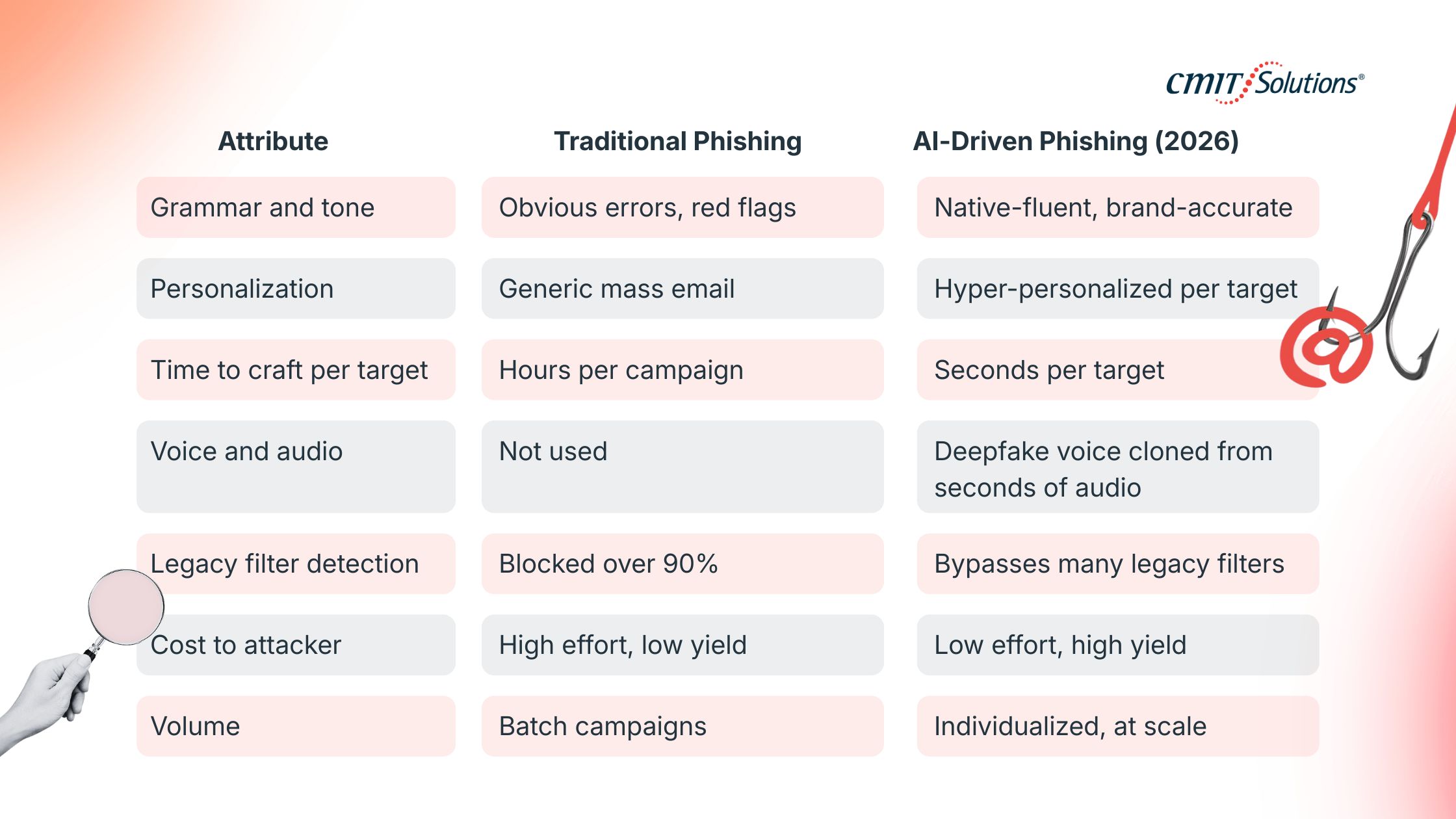
Here is what this means for how to spot AI-generated phishing emails in 2026. Grammar checks and “does this look fake?” instincts no longer work. Defense has to shift from user detection to layered technical controls.
How Does Deepfake Voice Fraud Target Small Businesses?
Deepfake voice fraud, also called vishing when delivered by phone, uses AI voice cloning to impersonate a trusted person. Attackers need only a few seconds of source audio, often pulled from a company webinar, podcast interview, or voicemail greeting, to generate a convincing clone.
For SMBs, deepfake voice fraud works in a predictable step by step pattern. A cloned voice of the CEO calls the controller to authorize an urgent wire transfer. A cloned vendor calls accounts payable to update banking information. A cloned family member calls an employee to extract a password reset. Deloitte’s 2024 financial services forecast estimated that generative AI could enable up to $40 billion in U.S. fraud losses by 2027, and phishing attacks on small business targets are a leading contributor.
“The businesses we work with across Anaheim and Orange County are seeing voice-based social engineering they simply were not seeing eighteen months ago,” says Navin, President, CMIT Solutions of Anaheim & Orange County. “A convincing deepfake voice call now costs an attacker almost nothing to produce. The signs of a deepfake voice call scam, urgency, an unusual request, off-hours timing, are the same ones we have always warned about. The playbook is old. The tools are new. That is why deepfake voice scam prevention has to be built into daily operations, not treated as awareness training filler.”
Talk to our team about closing that gap
Are Small Businesses in Orange County at Higher Risk Than Large Companies?
Yes, and the data is clear on why. Small businesses are targeted more than large companies in cyberattacks for one reason: weaker controls, same value data. Verizon’s 2024 Data Breach Investigations Report found that 68% of breaches involved a non-malicious human element. That is exactly the pressure point AI phishing attacks and social engineering attacks in 2026 exploit.
Orange County concentrates the profile attackers look for. High-density mid-market firms in healthcare, construction, real estate, professional services, and defense-adjacent contracting, most operating on lean IT teams. The IBM Cost of a Data Breach Report 2024 put the U.S. average breach cost at $9.36 million, with California consistently among the most expensive states.
What Cybersecurity Controls Should Your SMB Have in 2026?
The good news: five controls, aligned with the NIST cybersecurity framework for small businesses and CISA’s baseline Cyber Performance Goals, stop the large majority of AI-driven attacks. They also form the foundation of any effective ransomware recovery plan.
- Phishing-resistant multi-factor authentication (MFA). Basic SMS-based MFA is no longer enough. Multi-factor authentication setup for SMBs in 2026 should use authenticator apps or hardware keys (FIDO2). IBM’s 2024 research identified MFA as one of the highest ROI controls a business can deploy.
- Zero trust security for small business environments. Zero trust means no user or device is trusted by default. Every access request is verified. For SMBs, this translates to identity-based access controls, network segmentation, and continuous verification instead of “inside the firewall equals safe.”
- An email security gateway for small business inboxes. A modern email security gateway with AI-based detection catches AI-generated phishing emails that slip past legacy filters, including business email compromise attempts and payload-less social engineering.
- Endpoint detection and response (EDR) for SMBs, backed by managed detection and response in Orange County. Traditional antivirus is signature-based and misses novel attacks. Endpoint detection and response for SMBs monitors behavior in real time. Managed detection and response in Orange County adds 24/7 human analysts to triage alerts your internal team cannot cover.
- Ongoing security awareness training focused on AI threats. Training employees to recognize AI phishing attacks means updating your program: deepfake voice recognition, out of band verification for financial requests, and simulated attacks that mirror what employees actually see today. This is also the foundation of any credible incident response plan for a small business.
Together, these controls form the practical cybersecurity checklist for Orange County small businesses in 2026. They also form the baseline most cyber insurance underwriters now require before renewing coverage.
How CMIT Solutions Anaheim and Orange County Helps SMBs Stay Ahead
“Our approach with every Anaheim and OC client starts with the same question,” says Navin. “If an AI-crafted phishing email or a cloned voice call reached your team tomorrow, what would stop it, the employee, the technology, or nothing? Our cybersecurity services in Orange County are built to make sure the answer is never ‘nothing.’”
CMIT Solutions Anaheim and Orange County delivers managed cybersecurity, 24/7 monitoring, EDR and managed detection and response coverage, phishing-resistant MFA rollout, email security gateway deployment, and employee security awareness training as one coordinated program, not a stack of disconnected tools. Small businesses that need managed IT security services get one Anaheim-based team, one predictable monthly cost, and one accountability structure.
If your business does not have documented answers to the five controls above, now is the time to talk.
FAQs
What is AI-driven phishing and how is it different from traditional phishing?
AI-driven phishing uses generative AI to create flawless, personalized emails and cloned voice calls at scale. Traditional phishing relied on volume and obvious errors. AI phishing attacks are targeted, convincing, and often bypass legacy email filters.
What is deepfake voice fraud and how does it target small businesses
Deepfake voice fraud uses AI to clone a trusted person’s voice from seconds of audio, then calls employees to authorize wire transfers, change vendor payment details, or extract credentials. It is a growing threat for Anaheim businesses.
What are the five cybersecurity controls every SMB needs in 2026?
Phishing-resistant MFA, zero trust access controls, a modern email security gateway, endpoint detection and response backed by managed detection and response, and ongoing security awareness training focused on AI threats.
Are small businesses in Orange County at higher risk from cyberattacks than large companies?
Yes. Attackers target SMBs because controls are typically weaker while the data value is comparable. California leads all U.S. states in reported cybercrime losses per the FBI IC3 2024 Annual Report.
What is multi-factor authentication (MFA) and does my Anaheim business need it?
MFA requires a second proof of identity beyond a password. Every Anaheim SMB needs it, ideally phishing-resistant MFA using an authenticator app or hardware key rather than SMS.
What should my Anaheim business do immediately after a suspected phishing attack?
Isolate the affected account and device, preserve the email and any logs, notify your IT or cybersecurity provider, reset credentials, and review recent financial and access activity for anomalies.


