
Three pressure points are driving Orange County contractors to outsource IT support in 2026: job sites that no internal IT team can secure at scale, project files that are now high-value ransomware targets, and CMMC requirements landing on subcontractors who never planned for them. Each one alone is manageable. All three at once, on top of running a construction business, is why outsourced IT support for construction companies in Orange County has moved from a cost conversation to an operations conversation this year.
The industry data backs the shift. Sophos State of Ransomware 2024 found 68% of construction and engineering firms reported a ransomware attack in the prior year. AGC of America’s 2024 industry survey ranked cybersecurity among the top-five operational risks for the first time. The FBI Internet Crime Complaint Center 2024 Annual Report tied California to the largest share of reported cybercrime losses of any U.S. state, and construction sits inside the top verticals for business email compromise.
For general contractors and subs across Anaheim, Irvine, Santa Ana, and the rest of Orange County, the question in 2026 is not whether IT support needs to change. It is whether it makes sense to build it in-house or outsource it.
Why Are Construction Companies Outsourcing IT Support Instead of Hiring In-House?
Hiring a full-time IT manager in Southern California runs roughly $110,000 to $150,000 in base salary before benefits and tooling, according to 2024 regional compensation data from ZipRecruiter and Robert Half. One IT manager covers one shift, one office, and cannot deliver the 24/7 monitoring that cyber insurance underwriters and CMMC assessors now require. Building an internal team with round-the-clock coverage, endpoint detection and response tooling, backup infrastructure, and documented compliance processes runs into the mid-six figures annually before the first job site trailer is connected.
The outsourced alternative bundles the same capabilities into a fixed monthly cost, sized to endpoint count. For most Orange County construction firms in the 20 to 200 employee range, the math has stopped being close.
That is only half the reason. The other half is that construction IT is not standard SMB IT, and general-purpose IT managers do not have the field experience to build it. Which is where the three pressure points come in.
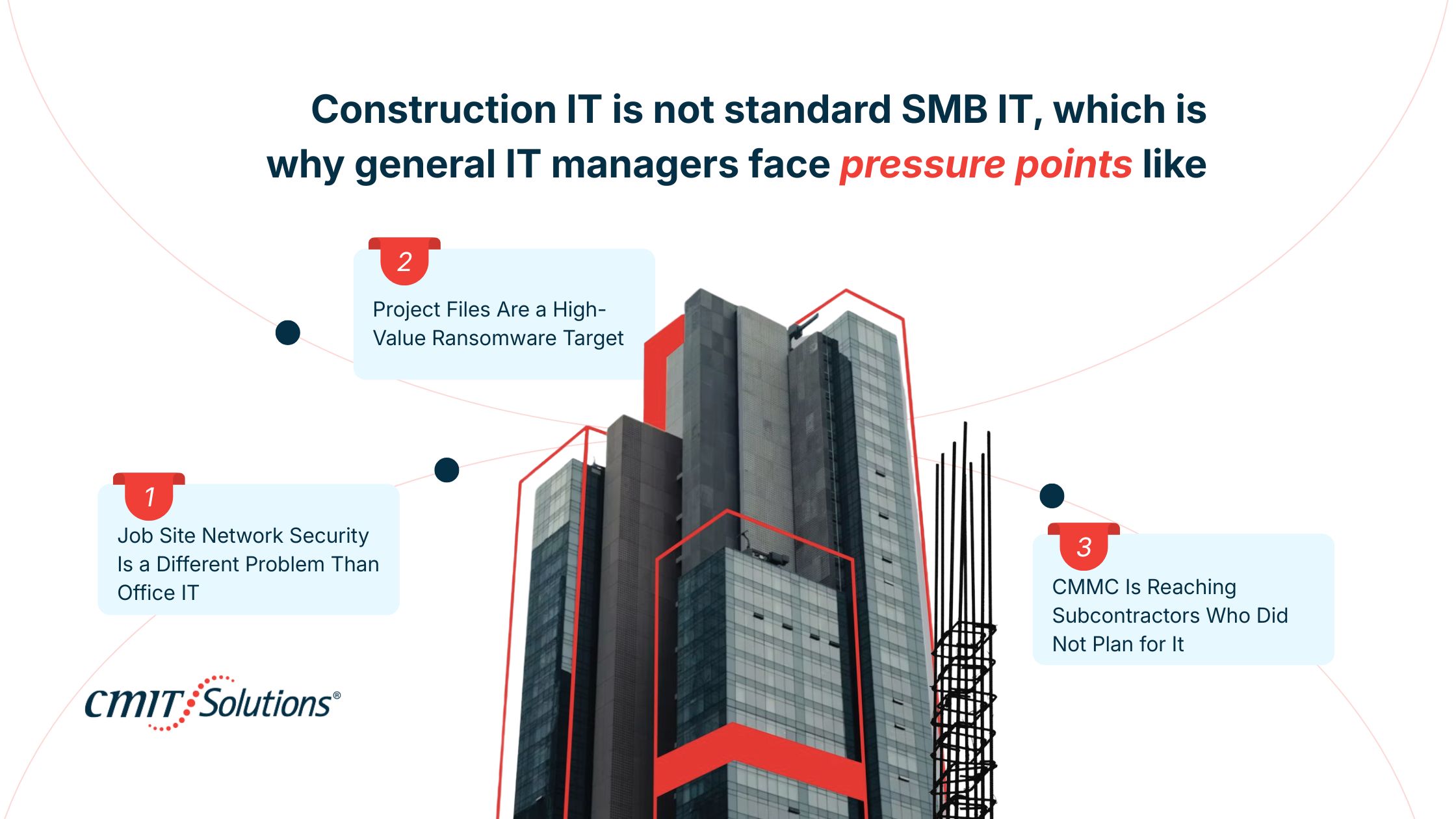
Pressure Point 1: Job Site Network Security Is a Different Problem Than Office IT
Every active construction project is a temporary IT environment. Trailer Wi-Fi, mobile hotspots, contractor-provided internet, jobsite cameras, GPS trackers on equipment, biometric access controls, and superintendent tablets all connect through networks that no central IT team controls. Job site network security is a discipline of its own.
How to secure project files across multiple job sites is now a project management problem as much as an IT problem. The core moves are segmented jobsite networks that keep site cameras and IoT devices off the same VLAN as project files, hardware VPNs for connecting the trailer back to headquarters, managed mobile devices with encryption and remote wipe, and a documented process for provisioning and deprovisioning site connectivity as projects open and close. Superintendents and site supervisors checking in from trailers, trucks, or home offices add another layer to this. The same cybersecurity for remote work principles that protect a distributed office workforce apply just as much to a distributed jobsite workforce.
An outsourced IT support company in Orange County with construction experience treats every new project as a network build, not an afterthought. That is a capability internal IT teams at small and mid-sized contractors almost never have the bandwidth to deliver.
Pressure Point 2: Project Files Are a High-Value Ransomware Target
Project file security for construction companies is not the same as protecting customer records for a retail SMB. BIM models, CAD drawings, structural calculations, pre-award bid documents, geotechnical reports, and project schedules represent months of engineering work. Ransomware operators know these files cannot wait a week for recovery without missing a bid deadline or a contract milestone.
Sophos data on construction ransom demands and recovery costs continues to land in the low millions per incident for mid-market firms. NordLocker’s industry ransomware analysis consistently places construction in the top three most-targeted sectors. The AGC of America has been direct about the risk profile.
Per AGC of America’s 2024 cybersecurity guidance for construction firms, contractors face a compounding exposure: high-value intellectual property, deadline-bound recovery windows, and a subcontractor ecosystem that expands the attack surface with every new project. AGC’s guidance emphasizes that the traditional construction IT posture, built around office productivity and email, is structurally under-invested for the threat environment the industry now operates in.
The outsourced response is a construction-specific data protection stack: immutable cloud backups with tested recovery time objectives measured in hours not days, endpoint detection and response on every device that touches project files, role-based access controls that give subs only what the current project phase requires, and 24/7 monitoring so a ransomware event at 2 a.m. does not become a discovered-at-8 a.m. crisis.
Pressure Point 3: CMMC Is Reaching Subcontractors Who Did Not Plan for It
Does CMMC compliance apply to Orange County construction contractors? For any firm touching Department of Defense projects, or subcontracting to a prime contractor who does, yes. And the enforcement window is no longer distant. New DoD solicitations under DFARS 252.204-7021 are now including CMMC self-assessment or third-party certification requirements at award. Primes are pushing those requirements down to subs on 2026 bids that were being written 24 months ago without CMMC language.
CMMC compliance requirements for construction project files intersect directly with the two pressure points above. Level 2 requires audit logging, 24/7 monitoring, MFA on all remote access, encrypted backups, incident response documentation, and a written System Security Plan mapped to 110 NIST SP 800-171 controls. Most contractors get there by building on a CMMC-ready IT stack already running Microsoft 365 GCC High, rather than retrofitting compliance onto commercial cloud tools after the fact. For a full explainer on the CMMC framework and where it applies, our earlier post on CMMC compliance for Orange County contractors is the deep-dive resource.
The outsourcing signal is that CMMC IT support for construction subcontractors is not a build-once project. It is a continuous compliance posture that has to survive project cycles, staff turnover, and audit cycles. Internal teams at small subs rarely have the process discipline to sustain it. This is the specific reason CMMC has become an outsourcing accelerant for Orange County contractors in 2026, not just a compliance topic.
What Should Contractors Look for in an IT Provider for Job Site Support?
Not every IT support company in Orange County can support construction operations, and the list of what to look for is short and specific.
- Local dispatch across the counties where you build. Orange County, Los Angeles, Riverside, and San Bernardino counties, at minimum. Job site problems do not resolve over Zoom.
- Named construction experience. Not “we support small businesses.” Ask specifically about jobsite network builds, BIM and CAD workflow support, and Procore or Autodesk Construction Cloud integration.
- CMMC and DFARS capability. If any part of your pipeline touches DoD work, this is not optional. Managed IT services for general contractors in Anaheim need to include a documented CMMC readiness pathway.
- Cybersecurity built into the base plan. Endpoint detection and response, 24/7 monitoring, phishing-resistant MFA, and immutable backup should be standard, not upsells.
- Fixed monthly pricing. Break-fix pricing on construction IT is a budget grenade. Predictable monthly cost is the outsourcing decision.
- Cyber insurance alignment. Your provider should know what your underwriter is asking for in 2026 and be able to document evidence for renewal.
What Happens if a Contractor Fails a CMMC Audit?
A failed CMMC assessment closes the current DoD contract window. New solicitations requiring CMMC at award go to competitors who passed. Remediation and reassessment typically take several months, during which the pipeline stops. For OC subcontractors whose 2026 revenue depends on DoD or prime flow-down work, a failed assessment is a revenue event.
The outsourcing case is that a construction-experienced managed IT partner delivers the infrastructure, monitoring, and documentation a C3PAO assessor asks for as part of a monthly engagement, not as a scramble in the 60 days before an assessment.
CMIT Solutions Anaheim: IT Support Built for Orange County Contractors
CMIT Solutions Anaheim provides outsourced IT support for construction companies in Orange County, delivered by a locally-based Anaheim team with 24/7 monitoring, managed cybersecurity, jobsite network security, cloud backup and disaster recovery, CMMC readiness support, and Microsoft 365 management under one predictable monthly plan. Construction firms across Anaheim, Irvine, Santa Ana, and Orange County get one point of contact, one accountability structure, and one team that understands how construction actually runs.
If your firm is weighing whether to build in-house or outsource in 2026, a construction-specific IT assessment is the right first conversation.
Get a free construction IT assessment
FAQs
Does CMMC compliance apply to Orange County construction contractors?
Yes for any firm touching DoD projects directly or as a subcontractor to a prime. Level 2 is the standard for most firms handling Controlled Unclassified Information. New solicitations now include CMMC requirements at award.
Why are construction companies outsourcing IT support instead of hiring in-house?
A single in-house IT manager in Southern California runs $110,000 to $150,000 in base salary and covers one shift. Outsourced IT delivers 24/7 monitoring, EDR, backup, and compliance capability at a fixed monthly cost that most 20 to 200 employee firms cannot match in-house.
How do contractors keep project files secure across multiple job sites?
Segmented jobsite networks, hardware VPNs, managed mobile devices, immutable cloud backups, endpoint detection and response, role-based access for subcontractors, and 24/7 monitoring across every active project location.
What happens if a contractor fails a CMMC audit?
The current DoD contract window closes. New solicitations requiring CMMC at award go to competitors. Remediation and reassessment typically take several months during which the pipeline stops.
What should a contractor look for in an IT provider for job site support?
Local dispatch across OC and adjacent counties, named construction experience, CMMC and DFARS capability, cybersecurity built into the base plan, fixed monthly pricing, and cyber insurance renewal support.


