It is 6:30 AM on a Monday.
The warehouse team is logging in. The forklifts are powering up and trucks are scheduled to leave by 8:00. All of a sudden, you discover that the EDI connection that handles your largest retailer’s orders failed sometime overnight.
As a result, the shipping team is now staring at an empty pick queue and customer service is fielding angry calls from a national account. The ERP is showing inventory that should have been allocated hours ago, and the IT provider is still not responding to the urgent ticket submitted forty minutes earlier.
For many wholesale distributors across Anaheim, this scenario happens every week. To prevent this, IT support for wholesale distributors in Anaheim cannot be treated like generic small business IT.
Why Anaheim Wholesale Distributors Are Different from Typical SMBs
Anaheim is at the center of one of the largest distribution corridors in the country. Proximity to the Ports of Los Angeles and Long Beach, access to the Inland Empire, and the density of consumer brands in Southern California have made the region a hub for wholesale distributors, third-party logistics providers, and B2B fulfillment operations.
These businesses share characteristics that make their IT requirements very different from typical SMBs:
- Operations depend on multiple interconnected systems
- Downtime has immediate financial and contractual consequences
- Retail partners enforce strict data and integration requirements
- Warehouse environments need specialized network and device support
- Cybersecurity exposure is high because of vendor and customer data
- Peak season pressure leaves no margin for slow IT response
A distributor shipping 5,000 orders a day cannot wait six hours for a help desk ticket to escalate. The cost of waiting shows up as chargebacks, missed shipping cutoffs, and damaged retailer relationships.
The Systems That Cannot Go Down
For wholesale distribution operators, certain systems are mission critical. When any one of them fails, the entire fulfillment process stalls.
- EDI (Electronic Data Interchange): EDI is how your business exchanges orders, ASNs, invoices, and inventory data with major retail partners. A broken EDI map or expired connection can stop incoming orders, trigger chargebacks, and put compliance at risk with partners like Walmart, Costco, Target, Amazon Vendor Central, and large grocery chains.
- Warehouse Management System (WMS): Your WMS controls picking, packing, putaway, cycle counts, and inventory accuracy. If scanners cannot connect to the WMS, the warehouse stops moving.
- Order Management System (OMS): The OMS connects sales channels including B2B portals, marketplaces, EDI orders, and direct customer orders to your fulfillment process. OMS sync failures lead to overselling, duplicate orders, and missed promise dates.
- ERP: Whether you run NetSuite, Acumatica, Sage, Microsoft Dynamics, or SAP Business One, the ERP is the financial and operational backbone. Downtime affects everything from purchasing to AR to inventory valuation.
- Warehouse network and devices: Barcode scanners, label printers, mobile carts, Wi-Fi access points, and shipping stations all depend on a stable, well-designed warehouse network.
If your IT support does not understand how these systems connect, your approach could end up being reactive instead of preventive.
The Real Cost of Warehouse Downtime
Most wholesale distributors underestimate the financial impact of IT downtime because invoices and chargebacks arrive weeks later.
Operational downtime in distribution leads to:
- EDI compliance chargebacks from major retailers
- Missed carrier pickup windows
- Stalled picking and packing operations
- Oversold inventory across channels
- Delayed invoicing and cash flow disruption
- Customer service backlog
- Damaged retailer relationships
- Lost reorders
A single missed shipping cutoff with a major retailer can result in chargebacks ranging from hundreds to thousands of dollars per occurrence. For high-volume distributors, repeated incidents can push vendor scorecards into penalty territory. Learning how to reduce EDI chargebacks with better IT often starts with rethinking monitoring and response capabilities.
Core Components of IT Support for Warehouse Operations
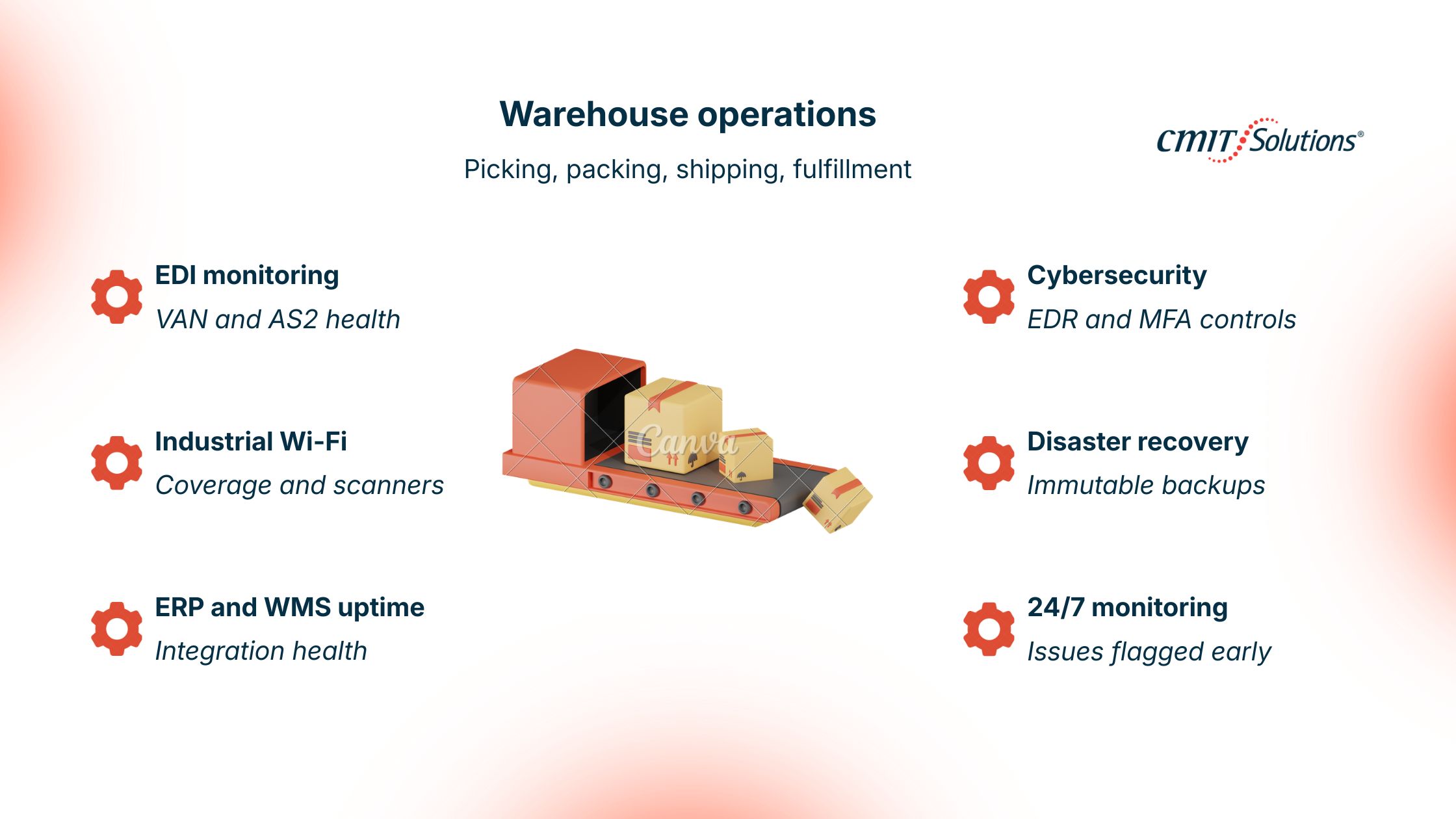
A capable provider of managed IT services for distributors should treat these areas as core deliverables, not extras.
1. EDI Support Services and Monitoring
EDI failures are often silent. A connection might drop overnight, an acknowledgment might fail to send, or a mapping change at the partner end might break order intake. By the time the team notices, the damage is already done.
Strong EDI support services for wholesale distribution include:
- Active monitoring of EDI connections, VAN, and AS2 endpoints
- Alerting on dropped or failed transmissions
- Coordination with EDI providers and trading partners
- Documentation of trading partner requirements
- Backup connectivity for critical retailers
Knowing how to prevent EDI failures in wholesale distribution requires monitoring designed around transactions, not just server uptime.
2. Industrial Wi-Fi for Warehouses and Network Monitoring
Warehouse Wi-Fi is not office Wi-Fi. Coverage gaps, weak signal in racking aisles, scanner battery issues, label printer failures, and outdated firmware all directly affect throughput.
Proper warehouse IT support includes:
- Industrial Wi-Fi for warehouses with coverage testing across full racking layouts
- Scanner and mobile device management
- Label printer support and replacement workflows
- Network segmentation between warehouse, office, and guest
- Network monitoring for distribution warehouses with real-time alerting
- Backup connectivity to keep operations running during ISP issues
3. ERP Support for Distributors and WMS Uptime
ERP, WMS, and OMS platforms often run as SaaS, but uptime still depends on the underlying network, identity management, integration health, and endpoint reliability.
Reliable ERP support for distributors involves:
- Monitoring integration health between ERP, WMS, and OMS
- Managing user access and role permissions
- Endpoint reliability for warehouse and office users
- Coordination with software vendors during outages
- Backup validation for cloud-based platforms
If you have ever wondered how to keep my WMS running 24/7, the answer rarely lies inside the WMS itself. You have to dig deeper into the network, endpoints, and integrations around it.
4. Cybersecurity for Distribution Companies
Wholesale distributors are increasingly targeted by cybercriminals because of their data, their retail partner connections, and their dependency on uptime during peak seasons.
Cybersecurity for distribution companies should include:
- Endpoint detection and response across warehouse and office devices
- Email security and phishing protection for purchasing and AP teams
- Multi-factor authentication on all systems
- Network segmentation between operational and corporate environments
- Vendor and third-party risk reviews
- Security awareness training for warehouse and office staff
Ransomware protection for distributors is especially critical. Attacks during peak season have shut down distributors for days, and recovery without proper preparation can cost more than the ransom itself.
5. Disaster Recovery for Warehouses
A disaster recovery plan for warehouse operations needs to cover more than email and file servers, and should include:
- ERP and database backups
- WMS configuration and data backups
- EDI mapping documentation
- Network device configurations
- Recovery testing on a regular schedule
Disaster recovery for warehouses is not a one-time project, and should be a part of ongoing distribution business continuity services that are reviewed and tested every quarter.
6. 24/7 IT Monitoring for Anaheim Distributors
Distribution does not run on a 9-to-5 schedule. Overnight EDI batches, early morning shipping waves, and late evening receiving all create dependencies that need 24/7 IT monitoring for distributors.
A modern monitoring setup covers:
- Network and connectivity
- EDI transmissions and acknowledgments
- ERP, WMS, and OMS integration health
- Endpoint and server health
- Backup job completion
- Security alerts and anomaly detection
24/7 IT monitoring for Anaheim distributors means problems are flagged and resolved before the warehouse team walks in for the next shift.
Why Generic IT Support Fails Wholesale Distribution Businesses
Most break-fix IT providers were not built for the operational reality of wholesale and distribution work.
They respond to tickets. They reset passwords. They restart servers. But they often do not understand EDI workflows, warehouse network design, ERP integrations, or the cybersecurity exposure that comes with handling retail partner data.
For distribution operators, this gap shows up as slow response times, repeat issues, recurring downtime, and growing risk that leadership cannot fully see until something breaks.
Choosing the Best MSP for Warehouse and Distribution in Anaheim
If your business is evaluating the best MSP for warehouse and distribution Anaheim has to offer, look for providers that bring distribution operations into every conversation, not just technical support.
The right MSP for wholesale distribution should be capable of:
- Full IT support Anaheim distributors need across office and warehouse
- Co-managed IT for distribution businesses Anaheim teams already running internal IT staff
- Proven response times during peak season
- Direct experience with EDI, WMS, OMS, and ERP environments
- Clear documentation and onboarding practices
Final Thoughts
Wholesale distributors do not have the luxury of treating IT as background infrastructure. EDI, WMS, OMS, ERP, warehouse networks, and cybersecurity all directly affect daily operations, retail partner relationships, and revenue.
At CMIT Solutions of Anaheim West, we deliver managed IT services for Anaheim wholesale companies built around uptime, security, and operational continuity. From EDI support services and industrial Wi-Fi for warehouses to ERP support, ransomware protection, and 24/7 IT monitoring, our role is to help distribution operators stay focused on fulfillment instead of firefighting.
If your business is approaching peak season or evaluating IT support to prevent warehouse downtime, now is the right time to assess whether your current setup can handle what comes next.
FAQs
What is the cost of warehouse downtime for a wholesale distributor?
Cost varies by order volume and retail partner exposure, but even short outages can result in missed shipping cutoffs, EDI chargebacks, oversold inventory, and lost reorders. For high-volume distributors, a single peak season incident can run into five or six figures.
What IT systems does a wholesale distribution business depend on?
The core stack typically includes EDI, a WMS, an OMS, an ERP, warehouse Wi-Fi, barcode scanners, label printers, and shipping station hardware. These systems are interconnected, so a failure in one usually affects the others.
How does IT support prevent EDI chargebacks?
Through active EDI monitoring, alerting on failed transmissions, fast response to mapping or connection issues, and documentation of trading partner requirements. Most chargebacks happen because EDI problems are detected too late.
What is the difference between an EDI VAN and AS2?
A VAN (Value Added Network) is a third-party service that routes EDI messages between trading partners. AS2 is a direct point-to-point protocol that uses encryption and digital signatures to send EDI data over the internet. Many distributors use both depending on partner requirements.
How can managed IT services improve warehouse uptime?
Through proactive monitoring, industrial Wi-Fi design, network segmentation, endpoint reliability, ERP and WMS integration health checks, and rapid response to incidents before they impact shipping operations.
Why does industrial Wi-Fi keep dropping in my warehouse?
Common causes include weak access point coverage in racking aisles, interference from forklift equipment, outdated firmware, undersized network capacity, and Wi-Fi designed for offices rather than industrial environments.
How do I prevent ransomware from shutting down my distribution business?
Use endpoint detection and response, multi-factor authentication, network segmentation between warehouse and corporate environments, employee security training, and tested backup recovery. Ransomware protection for distributors works best when prevention and recovery are planned together.
What is the right backup and disaster recovery setup for a 3PL or distributor?
A complete setup covers ERP and database backups, WMS configuration backups, EDI mapping documentation, network device configurations, off-site redundancy, and regular recovery testing. Disaster recovery for warehouses should be reviewed quarterly.
How do I integrate my ERP, WMS, and OMS without breaking EDI?
Plan the integration around the EDI requirements of your largest trading partners first. Map data flows carefully, use middleware where needed, monitor integration health continuously, and stage changes in test environments before going live.
What should I look for in an MSP for a wholesale or distribution business in Anaheim?
Look for direct experience with EDI, WMS, OMS, and ERP environments, industrial Wi-Fi expertise, 24/7 monitoring, ransomware protection, proven response times during peak season, and the ability to operate either fully managed or co-managed alongside an internal IT team.