Data security for construction businesses is not the same problem as data security for a standard small business. A construction firm holds high-value project files that live on multiple job sites, moves large payments on predictable schedules, shares network access with dozens of subcontractors, and now operates under cyber insurance and prime contractor requirements that keep tightening. Standard SMB IT is not built for any of that. This is why Anaheim construction firm data security has become its own category of managed IT services for construction firms in 2026.
The pressure is measurable. NordLocker’s most recent industry ransomware analysis ranked construction among the top three most-targeted sectors globally. Sophos State of Ransomware 2024 found construction recovery costs averaging in the low millions per incident. The FBI’s Internet Crime Complaint Center 2024 Annual Report tied construction to a disproportionate share of business email compromise losses, with California leading every U.S. state in both victim count and dollar losses.
Construction Industry Cybersecurity Risks Are Not Standard SMB Risks
Ask an IT provider what they do for a “small business” and you will get the same answer regardless of industry: firewall, antivirus, backups, Microsoft 365. That baseline stops the easy attacks. It does not address the risks that are unique to construction.
Here are the data security risks unique to the construction industry.
- Distributed job sites with temporary networks. Every active project runs on trailer Wi-Fi, mobile hotspots, or contractor-provided internet that no central IT team controls. Jobsite data security is a separate discipline from office network security.
- Rotating subcontractor access. Subs come and go across the life of a project. Each one may need access to shared drives, project management platforms, or file transfer systems. Most firms have no formal offboarding process, and subcontractor data sharing security risks compound with every project.
- High-value, deadline-bound project data. BIM models, CAD files, structural drawings, geotechnical reports, and pre-award bid documents represent months of engineering work. Ransomware operators know these files cannot wait a week to be recovered without missing a bid deadline or a contract milestone.
- Predictable, high-dollar payment flows. Monthly draw requests, sub payments, retainage releases, and change orders create a payment calendar an attacker can map. That is why construction ranks so high for business email compromise.
- Jobsite IoT and equipment telematics. Site cameras, GPS trackers on equipment, connected tools, and biometric access controls all connect to the same network as project files. IoT security for construction jobsites is now part of the attack surface.
- Cyber insurance and prime contractor requirements. Underwriters and general contractors are pushing security controls down to subs at contract award, not renewal.
Construction Firms vs. Standard SMBs: Where Cybersecurity Needs Diverge
For anyone wondering how construction firms differ from SMBs in cybersecurity needs, here is a side-by-side.
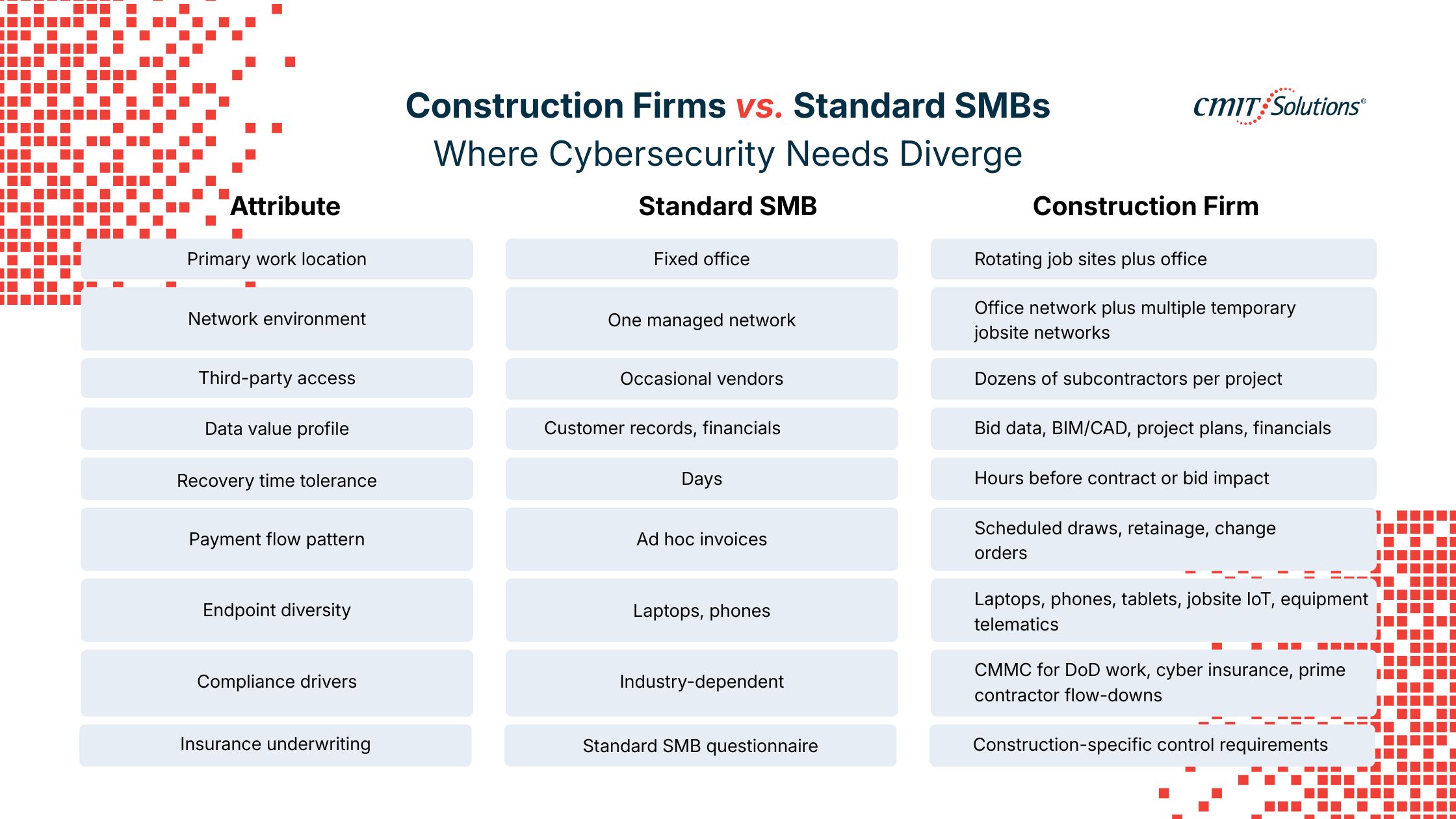
Managed IT services vs standard SMB IT for construction is not a marketing distinction. It is an operational one.
Best Cybersecurity Practices for Orange County Contractors in 2026
Best cybersecurity practices for Orange County contractors start with the same baseline every SMB needs, then add construction-specific controls on top.
Protect the project data first. Construction project data protection strategies for 2026 should treat BIM files, bid documents, and project schedules as regulated intellectual property. That means immutable backups, tested recovery time objectives measured in hours not days, encryption in transit and at rest, and role-based access controls so a sub never has more access than the current project phase requires. Protecting bid data and project plans from cyberattacks is a construction-specific engineering problem.
Harden the jobsite. Construction firm network security has to extend to the trailer. That means segmented jobsite networks, hardware VPNs, managed mobile devices, and a documented process for connecting site cameras, GPS trackers, and biometric access controls without exposing project files.
Lock down the money movement. Business email compromise remains the highest-dollar single attack against contractors. Multi-factor authentication on every account, out-of-band verification for any wire transfer or banking change, and email security that catches AI-generated phishing are non-optional.
Secure construction management software. How to secure construction management software (Procore, Autodesk Construction Cloud, PlanGrid, and equivalents) means enforcing MFA at the platform level, auditing user access monthly, and revoking sub access at project close.
Plan for ransomware recovery, not just prevention. Construction company ransomware protection has two halves: stopping the attack, and recovering fast enough to keep the project on schedule. Immutable backups, endpoint detection and response, 24/7 monitoring, and a documented incident response plan are the difference between a bad week and a lost contract.
“Standard SMB IT stops at the office door,” says Navin, CMIT Solutions Anaheim & Orange County. “For a construction firm, the office is only one node on the network. The trailers, the subs, the connected equipment, the project management platform, the payment workflow, all of it is part of the attack surface. When we build Anaheim construction firm data security, we build it around how construction actually operates, not how a generic small business operates. That is the difference our contractor clients see in the first thirty days.”
Cybersecurity Compliance in the Construction Industry Is Tightening
Construction firm cyber insurance requirements for 2026 now include MFA on all remote access, EDR on all endpoints, documented backup testing, security awareness training records, and increasingly a written incident response plan before an underwriter will renew. Sophos found that 97% of organizations with cyber insurance had to make security improvements to obtain or renew coverage.
For contractors touching DoD work, CMMC Phase 1 enforcement went live in November 2025 under DFARS 252.204-7021. New solicitations now include CMMC self-assessment or third-party certification requirements at award. C3PAO assessor scheduling is measured in months, not weeks. Cybersecurity compliance in the construction industry has moved from a “someday” concern to a bid gate.
IT Support for Construction Companies in California: What to Look For
What should a construction firm look for in a managed IT provider? Not a generic MSP that also happens to have construction logos on the client page. Look for jobsite dispatch capability across Orange County, Los Angeles, Riverside, and San Bernardino counties. Look for named services in construction-adjacent compliance (CMMC pathway support, HIPAA if you touch healthcare projects). Look for cybersecurity built into the base plan, not sold as an add-on. Look for cloud backup and disaster recovery with tested RTOs. And look for a provider that can name what makes construction different before you have to explain it to them.
CMIT Solutions Anaheim provides construction-specific IT security assessments for Orange County contractors, delivered by a locally-based Anaheim team with 24/7 monitoring, managed cybersecurity, cloud backup and disaster recovery, CMMC compliance support, and Microsoft 365 management under one predictable monthly plan. If your current IT support for construction companies in California looks the same as your neighbor’s dentist office IT, that is the problem worth fixing this quarter.
FAQs
Why do construction firms need different cybersecurity than other small businesses?
Construction firms operate across multiple job sites, share network access with dozens of subcontractors, hold high-value project files with hard deadlines, and move large payments on predictable schedules. Standard SMB IT does not cover any of those attack surfaces.
What are the biggest cybersecurity risks for construction companies in 2026?
Ransomware targeting BIM and project files, business email compromise on wire transfers and change orders, subcontractor access risks, jobsite network exposure, and cyber insurance non-renewal for firms without documented controls.
Do construction companies need cyber insurance?
Yes, and most underwriters now require MFA, EDR, backup testing, security awareness training, and a written incident response plan before they will bind or renew a construction policy.
How does jobsite technology increase cybersecurity risk?
Jobsite Wi-Fi, mobile hotspots, site cameras, GPS trackers, connected tools, and biometric access controls all connect to the same network as project files, expanding the attack surface far beyond the office.
What compliance requirements apply to construction firms handling sensitive data?
DoD subcontractors face CMMC Phase 1 requirements (live since November 2025). All contractors face cyber insurance control mandates. Firms handling healthcare or government projects may face HIPAA or CCPA obligations as well.
How can Anaheim construction firms protect against ransomware?
Deploy endpoint detection and response, immutable cloud backups with tested recovery, 24/7 monitoring, MFA on every account, employee security awareness training, and a documented incident response plan.
What should a construction firm look for in a managed IT provider?
Local jobsite dispatch, construction-specific security controls, CMMC compliance support, cybersecurity built into the base plan, tested backup and disaster recovery, and a provider that understands construction operations without a translator.