
Most businesses buy security backwards. They purchase a firewall, add antivirus, maybe sign up for a monitoring tool, then hope the pieces add up to protection, but they rarely do. Spending on tools before understanding your actual risk is like buying locks without knowing which doors are open.
An assessment-first approach reverses that order. Before recommending a single product, a cybersecurity consultant measures where your business is exposed, ranks those gaps by real-world risk, and builds a plan around what actually threatens you. For small and mid-sized businesses across Orange County, that sequence is the difference between spending on security and being secure.
What Is a Cybersecurity Assessment?
A cybersecurity assessment is a structured evaluation of how well your business is protected against threats. It examines your networks, devices, data, access controls, and policies, then identifies where attackers could get in and what the damage would be if they did.
The output is not a pass or fail. It is a clear picture of your current security posture, a prioritized list of gaps, and a roadmap to close them. Think of it as a diagnosis before treatment, so every dollar you spend afterward targets a known weakness.
Why an Assessment-First Approach Beats Buying Tools First
Threats are not evenly distributed, and neither is your exposure. Without an assessment, you are guessing which risks matter, and guessing is expensive.
The IBM Cost of a Data Breach Report 2024 put the global average cost of a breach at $4.88 million, and consistently found that organizations with stronger security posture and faster response paid meaningfully less. An assessment is how you build that posture on purpose instead of by luck. It tells you which fixes cut the most risk first, so you are not paying for tools that guard doors no one is trying to open while your real weak point stays wide.
Cybersecurity Assessment vs. Audit: What Is the Difference?
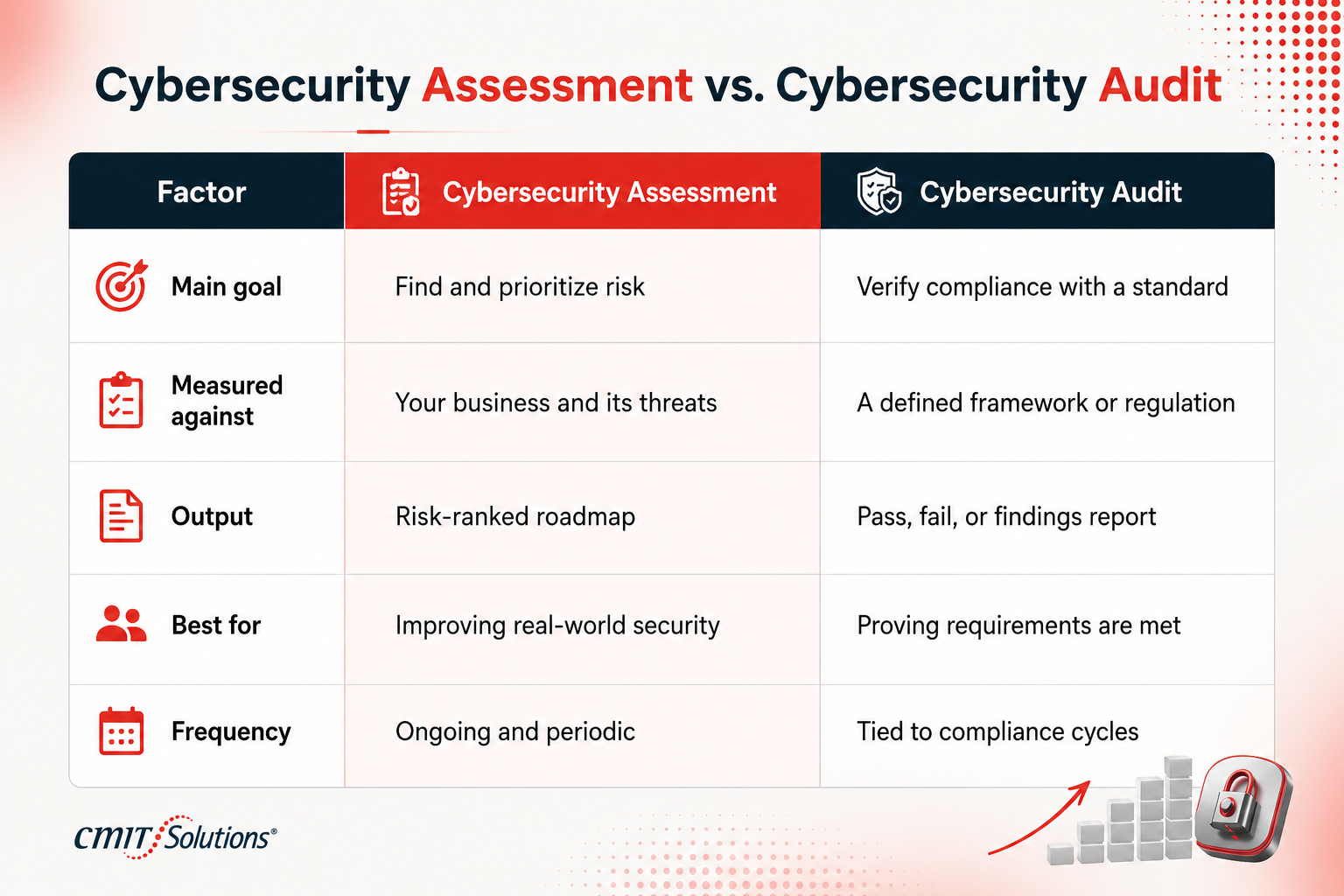
These terms get used interchangeably, but they answer different questions. An assessment asks “where are we exposed and what should we do?” An audit asks “do we meet a specific standard?” The table below breaks it down.
What Does a Cybersecurity Risk Assessment Include?
A thorough cybersecurity risk assessment covers your whole environment, not just the perimeter. A strong engagement typically includes:
- Asset inventory, cataloging the devices, systems, and data that need protection.
- Network security assessment, checking firewalls, segmentation, and remote access for weak points.
- Threat and vulnerability identification, mapping how an attacker could get in.
- Access and identity review, confirming who can reach what, and whether that is appropriate.
- Gap analysis, comparing your current controls against sensible security baselines.
- Prioritized remediation plan, ranking fixes by risk reduced and effort required.
That last item is what separates a useful assessment from a report that gathers dust. You should walk away knowing exactly what to fix first.
What Happens After a Cybersecurity Assessment?
The assessment is the starting line, not the finish. Once gaps are ranked, the work is closing them and keeping them closed. That usually means a phased remediation plan, hardening the highest-risk areas first, followed by managed cybersecurity services that monitor, detect, and respond around the clock. Security is not a one-time project because threats change weekly. The value of an assessment-first partner is that the same team that found your gaps stays on to defend them.
How Often Should a Business Do a Security Assessment?
At minimum, once a year. Beyond that, run an assessment whenever your business changes in a way that changes your risk: a new office, a cloud migration, a merger, remote-work expansion, or a new compliance requirement.
Frameworks like the NIST Cybersecurity Framework treat security as a continuous cycle, not an annual checkbox. For a growing Orange County business, treating assessment as ongoing keeps your defenses aligned with how you actually operate today, not how you operated last year.
Do Small Businesses in Orange County Really Need a Cybersecurity Assessment?
Yes, and often more than large ones. Attackers target small and mid-sized businesses precisely because they assume defenses are thin. The Verizon Data Breach Investigations Report has repeatedly documented that a large share of breaches hit small businesses, and many of those companies lack the in-house team to catch problems early.
An assessment levels the field. It gives a small business the same clear-eyed view of its risk that an enterprise security team would demand, without the cost of building that team internally. For OC firms in healthcare, professional services, construction, and property management, where client data and compliance obligations are real, that visibility is not optional.
Cybersecurity Consulting for Small Businesses in Orange County
Choosing a consultant comes down to one question: do they measure before they sell? The best cybersecurity consulting firms in Orange County start with your risk, not their product catalog. Look for a partner who assesses first, explains findings in plain language, prioritizes fixes by impact, and stays on to manage what they recommend.
CMIT Solutions of Anaheim West brings an assessment-first approach to cybersecurity consulting for small and mid-sized businesses across Orange County, pairing risk assessment with managed cybersecurity services and local, hands-on support. This month, CMIT is offering OC businesses a free one-hour IT assessment call, no cost and no obligation, to pinpoint where your systems are exposed and what to fix first. To claim yours, contact CMIT Solutions of Anaheim West at (657) 230-7099..
Frequently Asked Questions
What is a cybersecurity assessment?
A cybersecurity assessment is a structured review of your networks, devices, data, and policies to find where your business is exposed. It produces a prioritized list of risks and a roadmap to fix them, so security spending targets real weaknesses.
What is the difference between a cybersecurity assessment and an audit?
An assessment finds and ranks your security risks and recommends fixes. An audit verifies whether you meet a specific standard or regulation, producing pass or fail findings. The assessment shapes your security program; the audit later confirms it meets requirements.
Why should businesses take an assessment-first approach to cybersecurity?
Buying tools before understanding your risk wastes money on the wrong protections. An assessment-first approach measures your actual exposure, then targets spending at the gaps that reduce the most risk, building security on purpose rather than by guesswork.
What does a cybersecurity risk assessment include?
It typically includes an asset inventory, network security review, threat and vulnerability identification, access and identity review, gap analysis against security baselines, and a prioritized remediation plan. The goal is a clear, ranked list of what to fix first.
Do small businesses really need a cybersecurity assessment?
Yes. Attackers often target small businesses expecting weak defenses, and many lack in-house security staff to catch issues early. An assessment gives a small business enterprise-level visibility into its risk without the cost of building an internal team.
How do I choose a cybersecurity consultant in Orange County?
Choose a consultant who assesses before recommending products, explains findings in plain language, ranks fixes by real-world impact, and offers managed services to maintain protection. Local presence and references from businesses your size are strong signals of a reliable partner.


