
For years, healthcare has carried the highest breach costs of any industry, according to the IBM Cost of a Data Breach report. Large hospital systems can absorb that. A five-person practice in Anaheim cannot. The gap between what a breach costs and what a small practice can pay is exactly where the danger sits, and it is why cybersecurity for medical practices has to be treated as a financial safeguard, not just an IT task.
Most small Orange County practices are not priced for the event they are most exposed to. Here is what that event actually costs, and what closes the gap.
Why Is Healthcare the Most Breached Industry?
Patient records are worth more to attackers than almost any other data. A medical record combines a Social Security number, date of birth, insurance details, and a full medical history in one file. That data cannot be canceled the way a credit card can, which makes it durable and valuable on criminal markets.
Small practices compound the problem. They hold the same sensitive patient data as a hospital but rarely have the same healthcare IT security in place. Attackers know it. A practice with rich data and thin defenses is a favorable target, which is why medical practice cybersecurity cannot be deferred until the practice is bigger.
How Much Does a Healthcare Data Breach Cost?
More than most practices assume. The IBM Cost of a Data Breach 2024 report put the global average across all industries at 4.88 million dollars, and healthcare has consistently ranked as the most expensive sector.
A small practice does not pay the enterprise total, but the healthcare data breach cost lands harder relative to revenue. The costs stack across several categories at once.
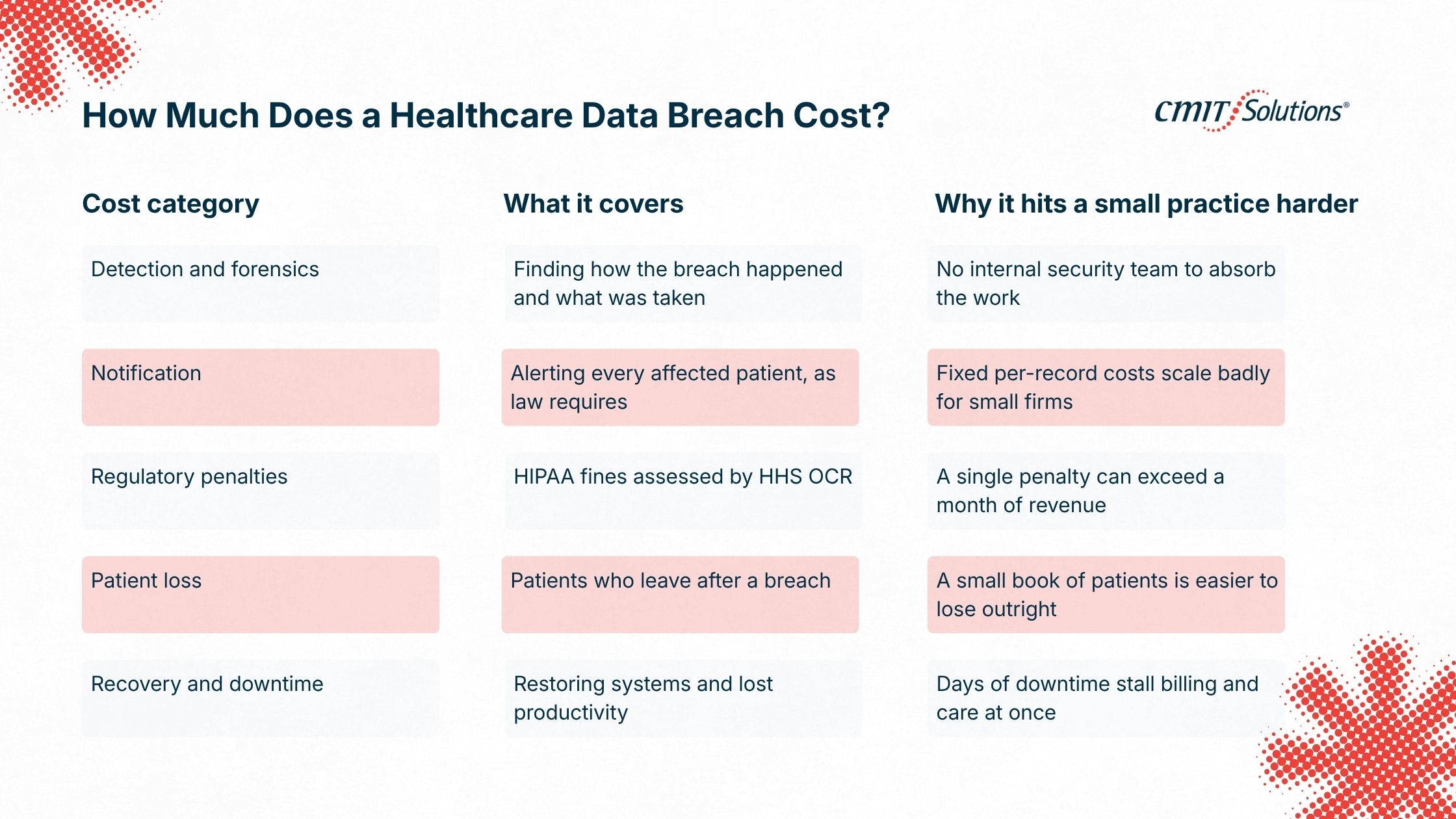
This is why the question is not whether a practice can afford cybersecurity solutions for healthcare. It is whether it can afford the alternative.
Why Aren’t Small OC Practices Priced for a Breach?
Because the budget assumes the breach will not happen. A practice plans for staff, rent, equipment, and malpractice coverage. The line item for a medical practice data breach, the forensics and notification and lost patients, usually does not exist until the incident forces it to. At that point it is an emergency expense, not a planned one, and emergency expenses are what close practices are.
Ransomware Is the More Immediate Threat
Data theft is not the only threat, or even the most common one. Ransomware attacks lock a practice out of its own patient records and scheduling systems until a ransom is paid, and healthcare has been one of the most targeted sectors for exactly this kind of attack for several years running.
A breach exposes data. Ransomware stops the practice from operating. A locked EHR system means no charting, no scheduling, and no billing until systems are restored, which makes ransomware downtime cost, not just breach cost, part of the same budgeting conversation. For a deeper look at how ransomware attacks unfold and what stops them, see our ransomware guide.
What Is the Cost of a HIPAA Violation?
HIPAA penalties are tiered by culpability and assessed by the HHS Office for Civil Rights, with per-violation amounts and annual caps that reach into six and seven figures at the higher tiers. For a small practice, even a lower-tier finding, paired with a required corrective action plan, can outweigh years of what proper patient data protection would have cost.
The penalty is not the whole bill. It arrives on top of notification, forensics, and lost patients, which is why HIPAA penalties for small practices are so damaging.
How Long Do You Have to Report a Breach?
HIPAA requires notification to affected patients without unreasonable delay, and no later than 60 days after discovery of the breach. Breaches affecting 500 or more individuals must also be reported to HHS within that same window, and to local media if the breach affects more than 500 residents of a single state or jurisdiction.
That 60-day clock is why practices with no incident response plan in place end up scrambling: forensics, notification, and reporting all have to happen inside a fixed window, not on the practice’s own timeline.
Do California Medical Practices Face Stricter Rules Than HIPAA?
In several respects, yes. California layers its own requirements on top of federal HIPAA, including the Confidentiality of Medical Information Act, which governs how medical information is handled and can carry its own penalties. The practical takeaway for healthcare cybersecurity Orange County practices is that meeting the federal minimum is not automatically enough. California providers face obligations that go beyond HIPAA alone, and this is not legal advice.
Is Cybersecurity Cheaper Than a Breach?
By a wide margin. The controls that prevent most incidents are ordinary and affordable next to the cost of the event they prevent:
- Multi-factor authentication on email and every system that touches patient records.
- Access control that removes logins the moment a clinician or front-desk employee leaves.
- Encryption and monitoring on the devices and accounts that hold protected health information.
- Documented policies and audit logging that support HIPAA compliance rather than scramble for it after the fact.
Done properly and monitored continuously, these are the core of cybersecurity for healthcare providers. They cost a fraction of a single breach, which is the entire argument for acting before an incident instead of after.
Who Provides HIPAA-Compliant IT Support in Orange County?
CMIT Solutions Anaheim West works with small and mid-sized businesses across Orange County, including medical practices, on managed IT and cybersecurity solutions for healthcare. That means protecting the systems that hold patient data, controlling who can reach them, and putting monitoring and documentation in place that support HIPAA compliance before an audit or an incident.
Book a 30-Minute Cybersecurity Audit With Navin
You protect your patients. This is about protecting the records that come with them. In a free 30-minute cybersecurity audit, Navin Gupta, President of CMIT Solutions Anaheim West, sits down with you and points to the gaps most likely to turn into a HIPAA problem or a breach. Plain language, no jargon, no obligation. You walk away knowing exactly what to fix first.
Book your 30-minute Cybersecurity Audit Today
Frequently Asked Questions
How much does a healthcare data breach cost?
The IBM Cost of a Data Breach 2024 report put the global average at 4.88 million dollars, with healthcare consistently the most expensive sector. Small practices pay less in total but far more relative to revenue.
Why is healthcare the most breached industry?
Patient records combine Social Security numbers, insurance details, and medical history in one file that cannot be canceled. That makes the data durable and valuable, and small practices often hold it with weaker defenses.
Is cybersecurity cheaper than a data breach?
Yes, by a wide margin. Multi-factor authentication, access control, encryption, and monitoring cost a fraction of a single breach, which stacks forensics, notification, penalties, and lost patients into one bill.
Do small medical practices need cybersecurity?
Yes. Small practices hold the same sensitive patient data as large systems but usually have weaker defenses, which makes them a favorable target and creates legal duties if that data is exposed.
What is the cost of a HIPAA violation?
HIPAA penalties are tiered by culpability and set by the HHS Office for Civil Rights, reaching into six and seven figures at higher tiers. A corrective action plan and other breach costs land on top.
Who provides HIPAA-compliant IT support in Orange County?
CMIT Solutions Anaheim West provides managed IT and cybersecurity services for small and mid-sized businesses across Orange County, including medical practices, with support aimed at protecting patient data and HIPAA compliance.
How do I find cybersecurity for a medical practice in Orange County?
Look for a local provider experienced with healthcare and HIPAA, offering access control, monitoring, encryption, and documentation. CMIT Solutions Anaheim West serves medical practices across Orange County and offers a free 30-minute cybersecurity audit.
Do California medical practices have stricter data privacy rules than HIPAA?
In several respects, yes. California adds requirements beyond federal HIPAA, including the Confidentiality of Medical Information Act. Meeting the federal minimum is not automatically enough for California providers. This is not legal advice.


