
For many small and mid-sized businesses, managed services and cybersecurity are viewed primarily as IT operating expenses. There is a monthly technology bill. There are cybersecurity tools to pay for. There are backups, monitoring, support, software updates, employee training, and other ongoing services. When everything is working as it should, it can be tempting to ask:
What are we actually getting for all of this spending?
The answer isn’t necessarily found in the number of tickets your IT provider closes or the number of security alerts they block. The real value is often found in the problems that never become business disruptions—and in how quickly the business can respond when something does go wrong.
In 2026, that distinction is becoming increasingly important. Cyber criminals are exploiting vulnerabilities faster, ransomware continues to be widespread, and AI is accelerating the speed and scale of attacks. For business owners, CEOs, CFOs, and CTOs, the question isn’t simply whether managed services and cybersecurity are worth the investment. It is:
How much does it cost to reduce technology risk—and how much could it cost the business if that risk is left unmanaged?
The Cost of a Breach Is More Than the Cost of Fixing IT
When executives think about a cyber attack, the first costs that often come to mind are technical:
- Removing malware
- Restoring systems
- Replacing hardware
- Recovering data
- Bringing in emergency IT support
Those costs are real. But they are only part of the financial equation. According to IBM’s 2026 Cost of a Data Breach Report, the global average cost of a data breach reached $4.99 million, a 12% increase from the previous year and a record high. Importantly, IBM found that lost business and detection and escalation accounted for 63% of breach costs.
That finding matters for business leaders because it demonstrates that a breach isn’t simply a technology expense. The financial impact can come from:
- Lost productivity
- Disrupted operations
- Lost or delayed business
- Incident investigation
- Customer and stakeholder response
- Legal and regulatory requirements
- Recovery efforts
- Management time
- Reputational consequences
The longer an incident affects the business, the more expensive it can become. That’s why prevention and preparedness deserve to be evaluated as financial risk-management strategies—not simply IT expenditures.
The Threat Landscape Is Moving Faster
The case for proactive IT and cybersecurity isn’t based solely on the potential cost of a breach. The other consideration is that attackers are becoming more efficient.
Verizon’s 2026 Data Breach Investigations Report found that exploitation of software vulnerabilities had become the leading initial access vector, accounting for 31% of breaches. For the first time in the 19-year history of the DBIR, vulnerability exploitation surpassed stolen credentials as the leading way attackers gained access. That’s particularly relevant to businesses that don’t have the internal resources to continuously monitor, patch, assess, and maintain their technology environment.
And ransomware isn’t going away. Verizon’s 2026 DBIR found ransomware was present in 48% of breaches, up from 44% the previous year. Meanwhile, IBM’s 2026 X-Force Threat Intelligence Index reported a 44% year-over-year increase in attacks exploiting public-facing applications. IBM also identified the continued use of AI by attackers to accelerate their operations.
For an SMB, this creates a simple business problem: There are more opportunities for something to go wrong, and attackers are working faster to take advantage of them.
Prevention Isn’t About Eliminating Risk
No managed services provider or cybersecurity solution can guarantee that a business will never experience an attack, outage, hardware failure, or other technology problem. The goal is different. A mature IT and cybersecurity strategy is designed to:
- Reduce the likelihood of an incident
- Identify problems earlier
- Limit the scope of an incident
- Maintain access to critical data and systems
- Restore operations as quickly as possible
That last point is particularly important. Cybersecurity isn’t only about keeping attackers out. It’s also about making sure the business can keep operating—or recover quickly—if something gets through. That’s the difference between prevention and resilience.
Where Managed IT Creates Financial Value
The ROI of managed services isn’t necessarily one dramatic cost savings number. Instead, it can come from multiple areas of the business.
1. REDUCING UNPLANNED DOWNTIME
Proactive monitoring and maintenance can identify technology problems before they become major outages. A failing device discovered during routine monitoring is an IT issue. A failed device that takes a critical employee, application, or business process offline for an entire day becomes a financial issue.
For example, consider a 40-person company. If the average fully loaded employee cost were $50 per hour, an eight-hour outage affecting all employees would represent:

That’s an illustrative calculation—not a published industry statistic—and it doesn’t include lost sales, missed deadlines, customer disruption, or other revenue impacts. The point is that downtime has an economic value, even when there isn’t a line item labeled “downtime” on the income statement.
2. MAKING IT COSTS MORE PREDICTABLE
Break-fix IT can create a difficult budgeting problem. A business may have relatively low technology expenses during a normal month, followed by an unexpected server failure, security incident, hardware replacement, or emergency support bill. Managed services shift some of that spending toward a more predictable model.
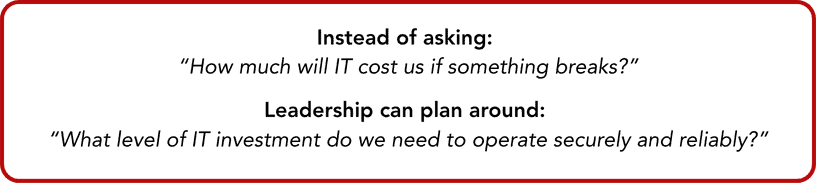
That predictability has value for CFOs and business owners even when it doesn’t show up as a direct cost reduction.
3. REDUCING THE FINANCIAL IMPACT OF SECURITY INCIDENTS
The strongest cybersecurity ROI isn’t necessarily preventing every attack. It’s reducing the probability and potential impact of a successful attack. Consider two businesses that experience the same initial security event:
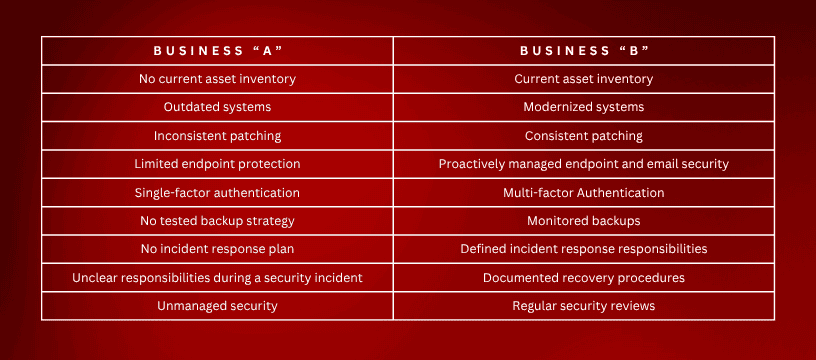
Neither business can guarantee that it will avoid an attack. But the second business has invested in reducing the number of ways an attacker can gain access—and in limiting the damage if one succeeds. That is the financial value of preparedness.
4. FASTER DETECTION CAN REDUCE BUSINESS IMPACT
Time matters during a security incident. The longer an attacker has access to an environment, the greater the opportunity for additional damage.
IBM’s 2026 research reinforces that breach economics are heavily influenced by detection and escalation costs, which together with lost business represented 63% of total breach costs. That makes proactive monitoring and security detection more than a technical function. They are financial controls.
If suspicious activity can be identified and contained before an attacker moves deeper into the environment, the organization may be able to limit:
- The number of systems affected
- The amount of data exposed
- Operational downtime
- Recovery requirements
- Customer impact
The objective isn’t simply to detect an attack. It’s to detect it early enough to change the outcome.
5. RECOVERY IS PART OF THE ROI
Even the strongest cybersecurity strategy cannot guarantee that a business will never experience an incident. That’s why backups and disaster recovery are so important. A backup that exists but has never been tested isn’t the same thing as a recovery strategy.
Businesses should know:
- What systems need to be restored first
- How quickly they need to be restored
- How much data loss is acceptable
- Who is responsible for initiating recovery
- Whether backups are protected from ransomware
- Whether restoration procedures have actually been tested
These concepts are commonly expressed as Recovery Time Objectives (RTOs) and Recovery Point Objectives (RPOs). The financial question is straightforward: How much would it cost the business to be offline for one hour, one day, or one week? Once leadership understands that number, investment in resilience becomes much easier to evaluate.
The ROI Isn’t Just About Cybersecurity
Managed services can also create value in less obvious ways.
Employee productivity: Employees lose time when systems are slow, applications aren’t working, devices aren’t properly configured, or technology problems remain unresolved. A proactive IT partner can address recurring issues rather than simply resolving them one at a time.
Technology lifecycle management: Replacing hardware only after it fails can create emergency purchases and unexpected downtime. Strategic lifecycle planning allows businesses to budget for technology replacements before equipment becomes a business-critical failure.
Software and patch management: Keeping systems current isn’t simply a maintenance task. Verizon’s 2026 findings demonstrate why: vulnerabilities are now the leading initial access vector in its breach data. Regular patching and vulnerability management therefore have a direct connection to risk reduction.
Strategic planning: Technology decisions are more valuable when they’re connected to business objectives. That moves IT from a reactive support function toward a strategic business resource. A managed services relationship can help leadership evaluate questions such as:
- Is our current technology environment scalable?
- Are we investing in tools employees actually need?
- Where are we carrying unnecessary risk?
- Which systems are approaching end of life?
- What should we budget for next year?
- Are our cybersecurity controls appropriate for our risk profile?
What Does the ROI Actually Look Like?
There isn’t a responsible universal formula that says: “Spend $1 on managed IT and get $X back.”
IT environments, industries, employee counts, revenue models, regulatory requirements, and risk profiles vary too widely. Instead, businesses should think about ROI in terms of risk-adjusted cost. Consider these four questions:
- What does an hour of downtime cost us? Include employee productivity, revenue-generating activity, customer service, and other critical operations.
- What would a serious cybersecurity incident require us to spend? Consider emergency IT response, legal and regulatory costs, data recovery, customer communications, downtime, and lost business.
- How much technology risk are we currently carrying? Look at unsupported systems, unpatched software, weak authentication, inadequate backups, excessive permissions, and other vulnerabilities.
- How quickly could we recover?
If a critical system became unavailable tomorrow, would you know:
- What happened?
- Who would respond?
- What gets restored first?
- Where the backups are?
- How long recovery should take?
- Who communicates with customers and employees?
If the answers aren’t clear, that’s an important business risk.
Prevention vs. Recovery: The Better Financial Comparison
The wrong question is: “Can we afford managed services and cybersecurity?”
The better question is: “Can we afford the financial consequences of being unprepared?”
That doesn’t mean every SMB needs to purchase every available cybersecurity tool or service. It means the investment should be proportional to the business’s actual risk. For one company, the priority may be strengthening backups and disaster recovery. For another, it may be addressing outdated systems and vulnerability management. Another may need stronger identity controls, employee security awareness training, email protection, or a formal incident response plan.
The objective is not maximum technology spending. It’s appropriate risk reduction.
The Bottom Line for SMB Leaders
For business owners, CEOs, CFOs, and CTOs, managed services and cybersecurity should be evaluated in the same way as other forms of risk management. You don’t purchase insurance because you expect your building to burn down. You don’t maintain backup generators because you expect the power to fail tomorrow. And you don’t invest in cybersecurity because you expect your company to be breached next week.
You invest because the financial consequences of being unprepared can be far greater than the cost of preparing in advance. For an SMB, the exact dollar impact of an incident will be different. But the business principle is the same: Prevention is an investment. Recovery is a cost.
A proactive managed services and cybersecurity strategy helps businesses spend deliberately today to reduce the likelihood, duration, and financial impact of problems tomorrow. And in an environment where cyber threats are moving faster than ever, that isn’t simply an IT decision. It’s a business decision.
SOURCES:
- IBM — Cost of a Data Breach Report 2026 — global breach costs and 2026 breach economics.
- Verizon — 2026 Data Breach Investigations Report — breach entry points, ransomware and current threat trends.
- IBM — X-Force Threat Intelligence Index 2026 — current attacker behavior and vulnerability exploitation trends.
- IBM — What Is a Data Breach? — 2026 breach-cost breakdown and business impact.