
A few years ago, monitoring a business network meant watching dashboards, waiting for alerts, and hoping someone noticed a warning sign before it turned into an outage. Today, that entire process looks different. Artificial intelligence now sits underneath the monitoring tools that managed service providers use every day, quietly analyzing patterns across thousands of data points and flagging problems long before a human technician would ever spot them manually.
This shift has a name: AIOps, short for artificial intelligence for IT operations. It represents one of the most significant changes in how technology gets managed behind the scenes, and it is reshaping what businesses should expect from their IT support relationship. Instead of a technician reacting to a ticket, AIOps enables a level of continuous, predictive oversight that simply was not possible with traditional monitoring tools.
Understanding what AIOps actually does, and how it changes the day-to-day experience of working with a managed IT partner, helps business owners ask better questions and set realistic expectations. This article breaks down how AIOps works, where it delivers the most value, and what to look for when evaluating whether your current provider is actually using it effectively.
What AIOps Actually Means
AIOps combines machine learning, big data analytics, and automation to help IT teams monitor, manage, and troubleshoot complex technology environments. Rather than relying on static thresholds and manual log review, AIOps platforms continuously learn what “normal” looks like across a network, then flag deviations that suggest an emerging problem.
This differs meaningfully from traditional monitoring in a few important ways:
- Traditional monitoring alerts based on fixed thresholds, such as a server exceeding 90 percent CPU usage. AIOps learns typical usage patterns and flags unusual behavior even within normal-looking ranges.
- Traditional tools generate large volumes of alerts, many of which are false positives. AIOps correlates related alerts into a single incident, dramatically reducing noise.
- Traditional troubleshooting starts after a ticket is filed. AIOps often identifies the root cause before a user notices any disruption at all.
- Traditional systems require manual tuning as environments grow. AIOps models adapt automatically as usage patterns evolve.
For businesses working with a managed provider, this translates directly into fewer surprises and faster resolution when something does need attention, all supported by outsourced IT management built around continuous, intelligent oversight rather than reactive troubleshooting.
From Reactive Monitoring to Predictive Insight
The traditional break-fix model of IT support waited for something to fail before taking action. Even early forms of managed services largely followed a similar pattern: monitor for known warning signs, then respond quickly once a threshold was crossed. AIOps represents the next evolution beyond both approaches, shifting the focus toward prediction rather than reaction.
This shift mirrors a broader trend across the industry, often described as predictive technology management, where providers use historical data and pattern recognition to anticipate failures before they occur. A hard drive showing early signs of degradation, a server trending toward memory exhaustion, or a network device exhibiting unusual latency patterns can all be flagged days or weeks before an actual failure, giving IT teams time to intervene on a planned schedule instead of during an emergency.
The practical benefit for businesses is straightforward:
- Fewer unplanned outages disrupting daily operations.
- Maintenance windows scheduled proactively instead of forced by sudden failures.
- Lower repair costs, since early intervention is almost always cheaper than emergency response.
- More accurate budgeting for hardware replacement, based on predicted failure timelines rather than guesswork.
How AIOps Works Behind the Scenes
Understanding the mechanics helps demystify what can otherwise sound like a vague buzzword. AIOps platforms typically pull data from a wide range of sources across a business’s technology environment, including servers, network devices, security tools, and cloud applications. That data feeds into machine learning models trained to recognize both normal operating patterns and early indicators of trouble.
A typical AIOps workflow includes several layered stages:
Data collection. Logs, performance metrics, and event data are gathered continuously from every connected system, creating a comprehensive view of the environment rather than isolated snapshots.
Pattern recognition. Machine learning models establish a baseline of normal behavior specific to each business’s unique environment, since what counts as typical activity varies significantly from one organization to another.
Anomaly detection. Once a baseline exists, the system flags deviations that suggest a developing problem, ranking them by severity and likely impact rather than treating every alert equally.
Correlation and root cause analysis. Instead of generating dozens of separate alerts for what is actually one underlying issue, the system groups related signals together and points toward the likely root cause.
Automated or guided response. Depending on the situation, the system may resolve simple issues automatically or route more complex problems to a technician with contextual information already attached, cutting diagnostic time significantly.
This layered approach explains why AIOps has become such a natural complement to network performance monitoring, since the sheer volume of data generated by a modern business network is far beyond what any human team could review manually in real time.
AI-Enhanced Cybersecurity Monitoring
Cybersecurity has become one of the most impactful applications of AIOps, largely because attackers are also using automation and AI to scale their efforts. Defending against faster, more adaptive threats requires monitoring tools that can keep pace, which is exactly what machine learning defense systems are designed to provide.
AI-driven security monitoring offers several advantages over traditional signature-based detection methods:
- Recognizing entirely new attack patterns that do not match any previously known signature.
- Detecting subtle behavioral anomalies, such as a user account suddenly accessing files it has never touched before.
- Correlating seemingly unrelated events across different systems to reveal a coordinated attack in progress.
- Reducing the time between initial compromise and detection, which directly limits the damage an attacker can cause.
This capability supports a broader shift toward AI driven threat detection that many businesses now expect from their security providers, particularly as attackers continue refining automated techniques designed specifically to evade older, static defense systems.
Real-Time Threat Monitoring and the Evolution of SIEM
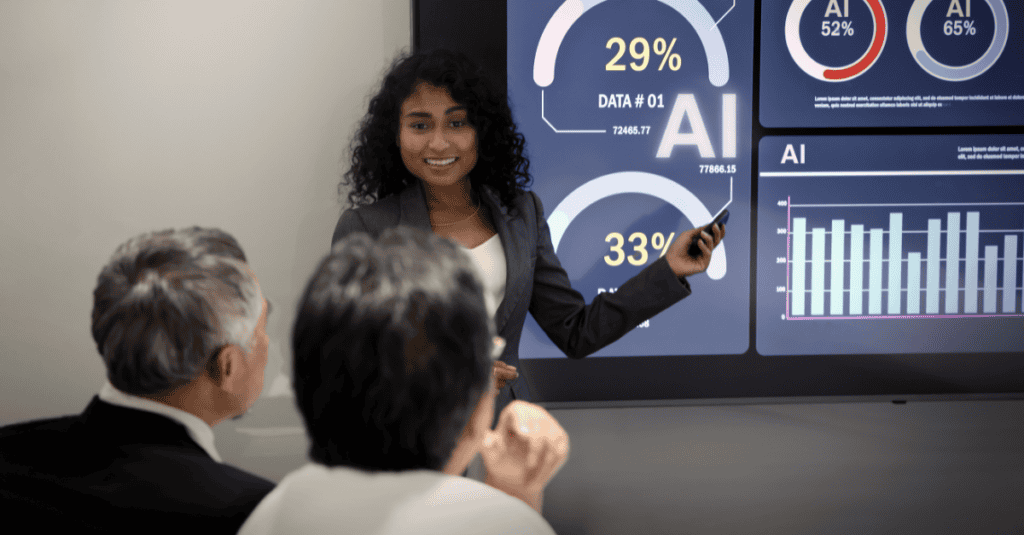
Security information and event management systems, commonly known as SIEM platforms, have long served as the backbone of enterprise security monitoring. AI has transformed what these systems are capable of, moving them from simple log aggregation tools into genuinely intelligent monitoring platforms.
Modern real time threat monitoring capabilities allow security teams to see and respond to threats as they unfold rather than reviewing logs after the fact. Combined with a security operations center staffed by trained analysts, AI-enhanced SIEM platforms provide continuous coverage that would be prohibitively expensive for most small and mid-sized businesses to build entirely in-house.
Key benefits of this evolution include:
- Faster mean time to detection across an increasingly complex threat landscape.
- Reduced alert fatigue for security teams, since AI filters out low-priority noise automatically.
- Better visibility across hybrid environments spanning on-premises systems and multiple cloud platforms.
- Historical pattern analysis that helps predict where future attacks are likely to target next.
Predictive Maintenance and Downtime Prevention
Downtime remains one of the most expensive problems a business can face, disrupting revenue, damaging client relationships, and frustrating employees. AIOps directly addresses this by shifting maintenance from a reactive, calendar-based exercise into a data-driven, predictive process.
Traditional maintenance schedules replace parts or perform updates on a fixed timeline, regardless of actual equipment condition. This approach often either replaces components too early, wasting money, or too late, risking failure. Predictive maintenance powered by AIOps instead monitors actual performance indicators continuously, supporting the broader push toward preventing network downtime before it ever disrupts daily operations.
Businesses benefit from this shift in several concrete ways:
- Hardware replacement decisions based on actual wear indicators rather than arbitrary age.
- Fewer emergency service calls, since developing issues are caught during routine monitoring.
- Better allocation of IT budgets, since spending aligns with genuine need rather than guesswork.
- Improved employee experience, since fewer unexpected outages interrupt daily work.
Automating Routine IT Tasks
Beyond monitoring and threat detection, AI is increasingly handling routine operational tasks that once consumed significant technician time. This frees up skilled IT staff to focus on higher-value strategic work rather than repetitive manual processes.
Common tasks now supported by automation and AI include:
- Automatically applying tested software patches during scheduled maintenance windows.
- Resetting passwords and unlocking accounts through self-service tools backed by AI-driven verification.
- Provisioning new employee accounts and access permissions based on predefined role templates.
- Generating routine reports on system health, security posture, and compliance status without manual compilation.
This broader move toward daily operations automation reflects a wider transformation happening across nearly every business function, not just IT. As routine tasks get automated, human expertise shifts toward the judgment calls, strategic planning, and complex problem-solving that AI cannot yet replicate on its own.
Where AI Adds Risk Alongside Efficiency
It would be misleading to present AIOps and workplace AI adoption as risk-free. Every efficiency gain introduces new considerations that businesses need to manage carefully, and understanding AI workplace risks is just as important as understanding the benefits.
Key risk areas businesses should watch closely include:
- Over-reliance on automated systems without adequate human oversight for critical decisions.
- Sensitive data inadvertently shared with AI tools that were not properly vetted for security and privacy compliance.
- False confidence in AI-generated recommendations without appropriate validation from qualified staff.
- Employees adopting AI tools independently without IT department awareness or approval.
That last point has become significant enough to earn its own name within the industry.
Shadow AI: A Growing Blind Spot
Just as “shadow IT” once described employees adopting unauthorized software without company oversight, a similar pattern has emerged specifically around AI tools. Employees experimenting with free or personal AI accounts to speed up their work can inadvertently expose sensitive company or client data without anyone in leadership realizing it is happening.
Understanding shadow AI risks has become essential for any business serious about data protection. Common scenarios include employees pasting client information into public AI chat tools to summarize documents, or uploading spreadsheets containing sensitive financial data to get quick analysis, all without the company’s knowledge or approval.
Addressing this blind spot requires a combination of policy and technology:
- Establishing clear, written guidelines on which AI tools are approved for business use.
- Providing sanctioned AI tools with appropriate security controls so employees are not tempted to seek unauthorized alternatives.
- Monitoring for data leaving the network through unapproved channels, including consumer AI platforms.
- Training staff on why certain AI tools carry data privacy risks that are not always obvious at first glance.
Data Quality: The Foundation Every AIOps System Depends On
AIOps and predictive analytics are only as good as the data feeding them. A system built on incomplete, inconsistent, or poorly structured data will produce unreliable predictions, regardless of how sophisticated the underlying algorithms are. This is why AI data quality has become such a critical, if less glamorous, part of any successful AI initiative.
Businesses considering deeper AI adoption should evaluate their data readiness across several dimensions:
- Consistency of data formats across different systems and departments.
- Completeness of historical records needed to train accurate predictive models.
- Clear ownership of data governance, so someone is accountable for data accuracy over time.
- Integration between systems, since siloed data limits the value any AI tool can extract from it.
Businesses that invest in cleaning up and organizing their data before rolling out AI tools tend to see far better results than those that adopt AI hoping it will somehow compensate for messy underlying systems.
Predictive Analytics Beyond IT Operations
While much of this discussion focuses on IT monitoring, the same underlying technology also powers broader business insights. Predictive analytics tools analyze historical business data to identify trends, forecast demand, and surface opportunities that would be difficult to spot manually.
Businesses using predictive data insights effectively often apply them across multiple functions:
- Forecasting seasonal demand fluctuations to optimize staffing and inventory decisions.
- Identifying early warning signs of customer churn before a client relationship is lost.
- Spotting inefficiencies in operational workflows that were previously invisible in raw data.
- Supporting more accurate financial planning based on data-driven projections rather than intuition alone.
This connects directly back to the value of AIOps, since the same infrastructure and data discipline required for effective IT monitoring also lays the groundwork for these broader analytical capabilities.
AI-Powered Productivity Tools Changing Daily Workflows
Beyond backend monitoring and security, AI has also transformed the tools employees use every single day. Features embedded directly into common business software now handle tasks that once required significant manual effort, from drafting emails to summarizing lengthy meetings.
Businesses adopting everyday AI workflows report measurable time savings across departments, particularly for tasks involving document creation, data analysis, and internal communication. Getting the most value out of these tools generally requires a bit of upfront investment in training and clear usage guidelines.
Organizations exploring whether they are staying ahead AI curve relative to competitors often start by identifying a handful of high-friction, repetitive tasks and testing AI-assisted approaches on those specific workflows before expanding more broadly across the organization.
Where AI Also Empowers Attackers
It is worth acknowledging directly that the same technology improving defense is also being used offensively. Attackers now use AI to craft more convincing phishing emails, generate realistic fake voices for social engineering attempts, and automate the scanning process that identifies vulnerable systems at scale.
Understanding AI powered phishing tactics has become essential training content for employees at every level of an organization, since the old advice of watching for spelling mistakes and obviously suspicious formatting no longer reliably identifies malicious messages the way it once did.
This arms race reinforces why AI-enhanced defensive monitoring is not optional. Businesses relying purely on traditional detection methods are increasingly outmatched by threats built using the same class of technology their defenses lack.
Compliance Considerations Around AI-Driven Monitoring
As AI takes on a larger role in monitoring and managing business systems, compliance frameworks are beginning to catch up with specific expectations around AI usage. Businesses need to think through several considerations as they expand AI-driven operations:
- Documenting which systems use AI-driven decision-making and how those decisions can be reviewed or audited.
- Ensuring compliance monitoring solutions account for AI-specific data handling requirements, particularly around data retention and third-party processing.
- Confirming that AI vendors meet the same security and privacy standards expected of any other technology partner.
- Maintaining human oversight over decisions with significant consequences, rather than allowing AI systems to operate entirely without review.
Businesses that build these considerations into their AI adoption strategy from the start avoid the scramble of retrofitting compliance controls after regulations catch up with widespread AI usage.

Where Does Your Business Stand in the AI Journey?
Adoption levels vary widely from one organization to the next. Some businesses have integrated AI deeply into daily operations, while others remain hesitant, uncertain where to start or wary of the risks involved. Understanding AI adoption journey stages can help leadership assess realistically where their organization currently sits.
Common stages businesses tend to move through include:
- Awareness, where leadership recognizes AI’s potential but has not yet taken concrete steps.
- Experimentation, where individual employees or departments begin testing specific tools informally.
- Formalization, where the organization establishes policies and approved tools for broader use.
- Integration, where AI becomes embedded into core operational and monitoring systems.
- Optimization, where the organization continuously refines its AI usage based on measured results.
Most small and mid-sized businesses currently sit somewhere between experimentation and formalization, which makes this an important moment to establish clear governance before informal, ungoverned AI use becomes deeply entrenched across the organization.
Agentic AI and the Next Phase of Automation
A newer development gaining attention involves AI systems capable of taking multi-step actions autonomously, rather than simply generating a response to a single prompt. These systems, often called agentic AI, can complete complex workflows involving multiple decisions and actions with limited human intervention.
Early applications of agentic AI efficiency gains are already appearing in data engineering and IT operations, where these systems can identify a problem, determine an appropriate response, and execute a fix without waiting for a human technician to manually approve each step. This represents a meaningful evolution beyond current AIOps capabilities, though most businesses will want to approach fully autonomous action carefully, maintaining appropriate oversight until trust in these systems is well established through consistent, verified performance.
How to Know if Your MSP Is Actually Using AIOps Effectively
Not every provider that claims to use “AI-powered monitoring” is applying the technology in a way that delivers real value. Business owners evaluating their current or prospective provider should ask specific questions rather than accepting vague marketing claims at face value.
Useful questions to ask include:
- Can you show examples of issues detected before they caused a visible disruption?
- How does your system reduce alert noise compared to traditional monitoring approaches?
- What data sources feed into your monitoring platform, and how comprehensive is that coverage?
- How quickly does your team typically respond once an anomaly is flagged?
- What role does a human technician play once an AI system identifies a potential issue?
Providers offering genuine AI powered IT management should be able to answer these questions clearly and specifically, with concrete examples rather than generic reassurances.
What This Means for Your Business Going Forward
The broader implication of AI business transformation extends well beyond IT departments. Businesses that embrace intelligent monitoring and automation tend to experience fewer disruptions, faster issue resolution, and more predictable technology costs over time. Those that stick with older, purely reactive support models increasingly find themselves at a competitive disadvantage, particularly as client expectations around reliability and security continue rising.
Practical steps businesses can take right now include:
- Asking current IT providers directly about their use of AIOps and predictive monitoring.
- Prioritizing workplace productivity software that includes built-in AI features rather than adding disconnected tools later.
- Establishing clear policies around approved AI tools before shadow AI usage becomes widespread internally.
- Investing in advanced threat protection that incorporates AI-driven detection rather than relying solely on legacy security tools.
Supporting Infrastructure That Makes AIOps Possible
None of these capabilities function in isolation. Effective AIOps depends on a well-integrated technology environment where data flows freely between systems rather than sitting trapped in isolated silos.
- Reliable cloud platform services that centralize data and simplify monitoring across distributed systems.
- Automated backup systems that feed recovery point data directly into broader monitoring and reporting dashboards.
- Team communication tools that keep staff informed when automated systems flag issues requiring human attention.
- Thoughtful technology purchasing decisions that prioritize tools capable of integrating with AI-driven monitoring platforms.
- Responsive IT help available when automated systems identify issues that genuinely require human expertise to resolve.
Planning Ahead With the Right Technology Roadmap
Adopting AIOps effectively is rarely a single project with a defined end date. It works best as an ongoing evolution guided by technology roadmap planning that accounts for a business’s current maturity level and growth trajectory. Businesses at earlier stages of adoption benefit from starting with foundational monitoring and gradually layering in more sophisticated predictive and automated capabilities as trust in the systems builds over time.
Flexible engagement models matter here as well. Businesses evaluating flexible service plans should look for providers willing to scale AI-driven monitoring capabilities alongside the business, rather than locking organizations into a fixed scope that cannot adapt as needs evolve.
How CMIT Solutions of Dallas Approaches AI-Driven Monitoring
CMIT Solutions of Dallas has integrated AI-enhanced monitoring and predictive maintenance into how we support local businesses, moving well beyond the reactive break-fix model that once defined much of the managed services industry. Our approach combines intelligent monitoring with experienced technicians who review flagged issues and apply the judgment that automated systems alone cannot replicate. That balance between automation and human expertise is what genuinely differentiates AIOps done well from AI used purely as a marketing buzzword.
Conclusion
AIOps represents a genuine shift in how technology gets managed, moving businesses away from reactive troubleshooting and toward continuous, predictive oversight that catches problems before they disrupt daily operations. The businesses gaining the most benefit are those working with providers who apply this technology thoughtfully, combining intelligent automation with real human expertise rather than relying on either one alone. If you want to understand how AI-driven monitoring could reduce downtime and strengthen security for your organization, schedule a consultation with our team to see what a more predictive approach to IT management could look like for your business.
Frequently Asked Questions