Every hour a construction project sits idle costs money. Crews are on the clock, equipment sits unused, subcontractors wait for direction, and deadlines that were already tight get tighter. Most contractors plan carefully for weather delays, material shortages, and permitting holdups, but far fewer plan for the kind of downtime caused by a server outage, a ransomware attack, or a project management platform that goes down in the middle of a bid deadline. Technology failures rarely make it into the risk register, yet they interrupt schedules just as effectively as a rainstorm.
Construction has become a technology heavy industry whether firms intended it to or not. Estimating software, project management platforms, drone surveying tools, equipment tracking systems, and mobile apps used on the job site have all become standard parts of daily operations. When any of these systems go down, the ripple effect touches the office, the field, and every subcontractor relying on shared information. CMIT Solutions of Fort Myers South works with contractors across the region who are trying to close this gap between how much they depend on technology and how little proactive support that technology actually gets.
This article looks at why downtime hits construction companies especially hard, where it usually comes from, and how a proactive managed IT approach prevents most of it before it ever reaches the job site. Getting there starts with informed technology decisions made before a crisis forces the issue, not after a project has already stalled.
Why Downtime Hits Construction Companies Harder Than Most Industries
A retail business with a slow network might lose a few transactions. A construction company with a network outage can lose an entire day of coordinated work across multiple crews, vendors, and inspectors, all of whom were relying on the same shared schedule or document set. The financial impact compounds quickly because construction projects are built around interdependent timelines. When one piece falls out of sync, everything scheduled after it shifts too.
Several factors make construction uniquely vulnerable to technology downtime:
- Projects rely on real time coordination between office staff, site supervisors, and subcontractors
- Equipment and material orders are often tied to system generated schedules
- Payment processing and payroll frequently depend on the same systems used for project tracking
- Job sites often have inconsistent connectivity, making backup planning more complicated
- Many firms run older, less supported software that was never designed for today’s threat landscape
Downtime in this environment is rarely just an inconvenience. It shows up directly in the bottom line through idle labor costs, contract penalties, and strained subcontractor relationships.
The Most Common Causes of Downtime in Construction Firms
Downtime does not usually come from one dramatic event. It builds up from a series of smaller issues that go unaddressed because nobody has the time or specialized knowledge to catch them early.
Outdated or unpatched software Many firms run project management or accounting software that has gone months without updates. Missed patches leave known vulnerabilities open, and outdated software is more likely to crash under the load of larger files like drone imagery or CAD drawings.
Weak network infrastructure Office networks built years ago often were not designed for the bandwidth demands of cloud based project tools, video calls with architects, and large file transfers between the office and the field.
Inconsistent backup practices Firms sometimes assume their cloud software provider is handling backups automatically, when in reality the responsibility for a full recovery plan often still falls on the business itself.
Lack of monitoring Without active monitoring, a failing hard drive, an overloaded server, or a suspicious login often goes unnoticed until it causes a full outage rather than being caught and resolved quietly in the background.
Human error and social engineering Construction firms are frequent targets for invoice fraud and phishing schemes, partly because payment requests between contractors and subcontractors are common and easy to imitate convincingly.
Aging hardware in demanding environments Laptops, tablets, and site equipment used in construction take a harder physical toll than office equipment sitting on a desk all day. Dust, heat, vibration, and drops all shorten the usable life of hardware, and firms that do not plan for regular replacement often end up running critical software on devices that are already failing.
Taken together, these issues rarely cause a single dramatic failure. They tend to compound quietly, with each small gap making the next one more likely, until a firm experiences an outage that feels sudden but was actually building for months.
Reactive IT vs Proactive IT: The Real Difference
Many construction companies still operate on a reactive IT model, where a technician gets called only after something breaks. This approach feels cheaper on paper because there is no ongoing service fee, but it consistently costs more in the long run through emergency repair rates, lost productivity, and the kind of downtime that a proactive system would have prevented entirely.
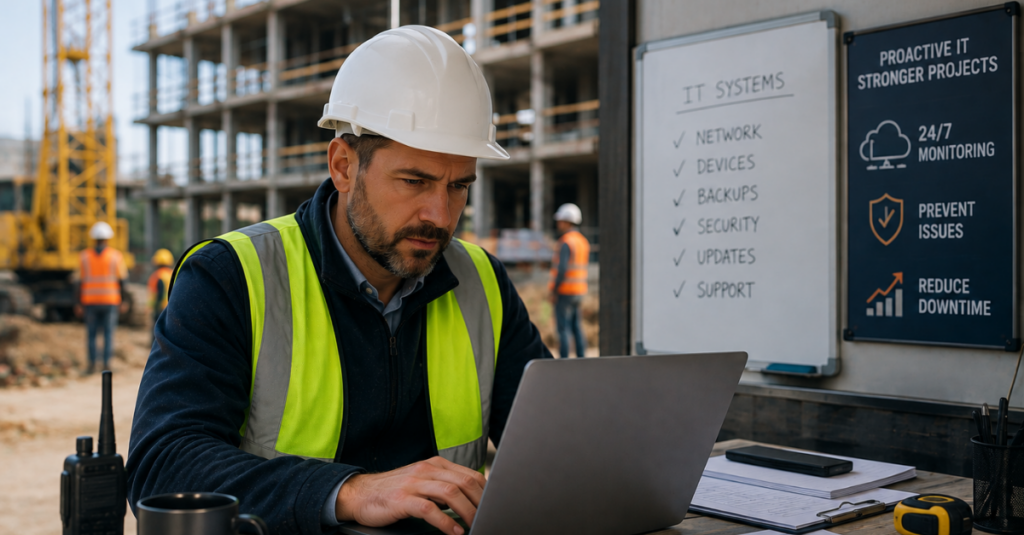
A proactive approach flips this model. Instead of waiting for failures, systems are monitored continuously, updates are applied on a schedule, and small issues are caught and resolved before they interrupt a project. This shift toward proactive IT management tends to save construction firms far more in avoided downtime than it costs in monthly service fees.
The difference becomes obvious during a crisis. A firm with reactive support might wait hours for a technician to diagnose an issue from scratch. A firm with proactive monitoring often has the issue flagged, diagnosed, and partially resolved before anyone in the office even notices something was wrong. When something does require a human touch, having access to responsive help desk support that already understands the firm’s systems cuts resolution time dramatically compared to starting from zero with an unfamiliar technician.
Building Reliable Connectivity Between the Office and the Field
Construction is one of the few industries where a meaningful part of the workforce operates away from a traditional office, often in locations with limited or inconsistent connectivity. This makes network planning more complex than simply securing a single office location.
A few practices consistently reduce connectivity related downtime:
- Redundant internet connections at the main office so a single provider outage does not halt operations
- Mobile hotspot backups for site trailers in areas with unreliable service
- Regular testing of VPN access so remote users can reach project files securely without delays
- Clear protocols for offline work so crews can continue documenting progress even without a live connection
Maintaining site wide network reliability across multiple active job sites requires more coordination than most in house teams have time for, especially firms juggling several projects simultaneously in different locations. This is one of the clearest areas where dedicated oversight pays for itself quickly.
Data Backup and Disaster Recovery Built for Construction
Construction firms generate an enormous volume of critical data: contracts, change orders, permits, inspection records, drawings, and financial documents. Losing access to any of this, even temporarily, can stall a project and create serious liability questions during disputes or audits.
Backup strategy needs to account for a few construction specific realities:
- Large files like drone footage and CAD drawings require backup systems with enough capacity and speed to handle them without slowing daily work
- Documents tied to active permits or inspections often need to be recoverable quickly, not after a multi day restoration process
- Backup systems need to be tested regularly, not just installed and left alone
Firms that rely on dependable backup systems are far better positioned to recover quickly from hardware failure, accidental deletion, or a cyberattack, without losing weeks of project history in the process. A backup that has never been tested is essentially a guess, and guessing is not a strategy any contractor wants to rely on when a project deadline is on the line.
Broader continuity planning matters here too. The way businesses approach recovery has changed significantly as more operations move to the cloud, and firms benefit from understanding modern continuity planning rather than relying on recovery plans written years ago for a completely different technology environment.
Cybersecurity Risks Specific to the Construction Industry
Construction companies handle a lot of money moving between parties, which makes them attractive targets for financially motivated cybercriminals. Invoice fraud, where an attacker impersonates a subcontractor or vendor to redirect a payment, is one of the most common and costly schemes affecting the industry.
Comprehensive protection needs to cover more than just antivirus software. Comprehensive cyber protection for a construction firm typically includes email filtering, endpoint protection across every device used in the field, and staff training specifically focused on recognizing payment fraud attempts, since this is where construction firms are most frequently targeted.
Phishing tactics have also become harder to spot. What used to look like an obviously fake email now often reads as a legitimate request from a known vendor. Understanding evolving inbox threats helps office staff recognize warning signs that are no longer as obvious as a misspelled sender address or a broken logo.
Continuous monitoring plays a major role in catching these threats early. Firms that invest in real time threat monitoring are far more likely to catch a compromised account before a fraudulent payment goes out, rather than discovering the problem after the money is already gone.
Access management is another area worth tightening. As crews grow and subcontractors rotate through projects, modern access controls make it far easier to grant and revoke system access as people join and leave projects, rather than leaving old credentials active long after someone has moved on.
Recovering Quickly When Something Does Go Wrong
Even with strong preventative measures in place, no system is completely immune to disruption. What separates firms with minimal downtime from firms with prolonged outages is not the absence of incidents, but how quickly they can recover from them.
A strong recovery plan should be able to answer a few basic questions clearly before an incident ever happens:
- What is the maximum acceptable time before critical systems need to be back online
- Who is responsible for initiating recovery procedures
- Where are backups stored, and how quickly can they actually be restored
- How will field crews stay informed if office systems go down
Cyber specific recovery planning deserves its own attention, separate from general disaster recovery. Ransomware and data breaches behave differently than a hardware failure or natural disaster, and firms need cyber recovery readiness that accounts for those differences rather than assuming a general backup plan covers every scenario equally well.
Cloud Access and Mobile Tools for Field Teams
Job sites are not static locations, and the technology supporting them needs to work just as well from a truck cab or a site trailer as it does from a corporate office. Cloud based systems have made this far more achievable, but only when they are set up correctly.
Reliable cloud based project access allows supervisors to update schedules, upload site photos, and pull drawings directly from a mobile device without waiting until they are back at a desk. This immediacy matters in an industry where decisions often need to happen on site, in real time, based on current conditions rather than information that is hours old.
Moving to the cloud is not without risk if it is done carelessly. Poorly planned migrations create their own downtime, and firms should be aware of common cloud migration pitfalls before moving critical project systems, since a rushed migration can cause more disruption than the outdated system it was meant to replace.
Compliance and Contractual Considerations
Construction contracts often include specific requirements around data handling, record retention, and reporting, particularly for firms working on government or large commercial projects. Falling short of these requirements can create liability well beyond the cost of the technology issue itself.
Understanding contractual compliance standards relevant to a firm’s typical project types helps avoid situations where a technology gap turns into a contract dispute. This is especially important for firms bidding on public projects, where documentation and data handling requirements tend to be more rigid than typical private sector work.
These requirements often extend beyond the immediate project team. General contractors are frequently held responsible for how subcontractors handle shared data, which means a gap in a subcontractor’s own technology practices can still create liability for the firm at the top of the chain. Building basic data handling expectations into subcontractor agreements, and confirming those expectations are actually being followed, closes a gap that many firms do not think about until a dispute or audit forces the issue.
Keeping Crews Connected Across Multiple Sites
Communication breakdowns between the office, the field, and subcontractors are one of the most common sources of avoidable delay on construction projects. When a schedule change does not reach everyone who needs it, the result is often wasted labor, misallocated equipment, or duplicated work.
Strong systems for seamless crew communication help make sure updates reach the right people immediately, whether that means a voice call, a text alert, or a shared platform update, rather than relying on a phone tree that breaks down the moment someone is unreachable.
Project management platforms play a similar role. The right project management software keeps schedules, documents, and communication centralized so everyone involved in a project is working from the same current information instead of outdated printed schedules or scattered email threads.
Planning Technology Purchases Around Project Growth
Construction firms often buy technology reactively, purchasing new laptops, tablets, or software licenses only when an old system finally fails or a new project demands it. This approach makes budgeting unpredictable and often results in mismatched equipment that does not integrate well together.
A more deliberate approach to equipment technology sourcing helps firms plan purchases around actual project pipelines rather than emergencies, which also tends to result in better vendor pricing and more consistent equipment standards across job sites.
It also helps to periodically step back and evaluate whether current systems still fit the business. A technology readiness review gives leadership a clear picture of where infrastructure gaps exist before those gaps turn into unplanned downtime during a critical phase of a project.
Firms newer to technology planning may also benefit from a basic grounding in the terminology itself. Understanding core IT terminology makes it easier for leadership to evaluate vendor proposals and ask informed questions rather than relying entirely on a vendor’s own explanation of what a system does.
Integrating Financial and Project Systems
Many downtime incidents in construction trace back to disconnected systems that were never designed to talk to each other. When accounting software, project management tools, and payroll systems all run separately, staff end up manually re entering the same data multiple times, increasing both the workload and the chance of costly errors.
Properly planned ERP system integration connects these systems so information flows automatically between them, reducing the manual work that often causes delays and billing discrepancies on active projects.
Protecting Remote and Distributed Crews
As more construction work spans multiple sites and involves remote supervision, protecting devices and data outside the traditional office perimeter has become essential. Laptops, tablets, and mobile devices used in the field are frequently the weakest link in an otherwise secure system.
Solutions built around remote workforce protection extend security coverage to devices operating outside the office network, which matters significantly for firms where site supervisors and project managers spend most of their time away from a centralized location.
Seasonal risks deserve attention too. Certain fraud attempts spike during specific times of year, and firms should stay alert to seasonal scam tactics that target businesses processing higher volumes of payments and closing out projects before year end deadlines.
Choosing a Managed IT Partner That Understands Construction
Not every IT provider understands the specific rhythm of construction work, where deadlines are unforgiving and downtime has an immediate, visible cost. Firms benefit from working with a provider that has actual experience supporting contractors, rather than a generic provider applying the same approach used for a retail store or a law office.
Look for a dependable IT partner with a track record specific to firms managing multiple active job sites, tight subcontractor coordination, and the kind of mobile, field based work that construction depends on daily.
A few things worth checking before choosing a provider:
- Does the provider offer support structured around construction’s typical hours and urgency
- Can they demonstrate proven project outcomes with similar sized construction firms
- What do existing clients say through contractor client feedback about actual response times and reliability
- Are they backed by vetted technology vendors with strong industry reputations
Support should also fit the size and structure of the firm rather than forcing every client into the same package. Tailored support plans allow a growing construction company to scale its IT support alongside its project volume instead of overpaying for services it does not need or underinvesting in areas that matter most.
Firms interested in learning more before committing to a provider can also review published construction technology insights covering common challenges and practical solutions relevant to the industry.
Working with a regional support team that understands local permitting requirements, regional vendor networks, and the specific challenges facing contractors in the area often makes a meaningful difference compared to a national provider with no local context.
What a Proactive Partnership Actually Looks Like Day to Day
Proactive IT support is not a one time setup and then hands off approach. It is an ongoing relationship built around consistent monitoring, scheduled maintenance, and a partner who understands the business well enough to anticipate problems rather than just respond to them after the fact.
In practice, this typically includes:
- Continuous monitoring of servers, networks, and critical software across every active project
- Scheduled patching and updates handled outside of working hours to avoid disrupting active projects
- Regular reviews of backup systems to confirm data can actually be restored, not just that a backup file exists
- Clear communication protocols so field teams know exactly who to contact and how quickly to expect a response
- Periodic strategy conversations that align technology decisions with upcoming project pipelines
This kind of partnership does not eliminate every possible disruption, but it dramatically reduces both the frequency and severity of downtime, which translates directly into protected labor costs, preserved deadlines, and stronger relationships with clients and subcontractors who depend on the firm staying on schedule.
Conclusion
Downtime in construction rarely announces itself in advance. It shows up as a server that will not boot on a Monday morning, a phishing email that tricks an office manager into redirecting a payment, or a project management platform that goes down right before a bid deadline. Firms that treat technology support as a proactive, ongoing investment consistently experience less of this disruption than firms that wait for something to break before taking action.
CMIT Solutions of Fort Myers South works with contractors who want to stop reacting to technology problems and start preventing them, with support built around the specific demands of construction work rather than a generic one size fits all approach. If downtime has become a recurring cost on your projects, it may be time to look at what a proactive support model could change. You can schedule a consultation to talk through where your current systems stand and what a stronger setup could look like for your next project.
Frequently Asked Questions