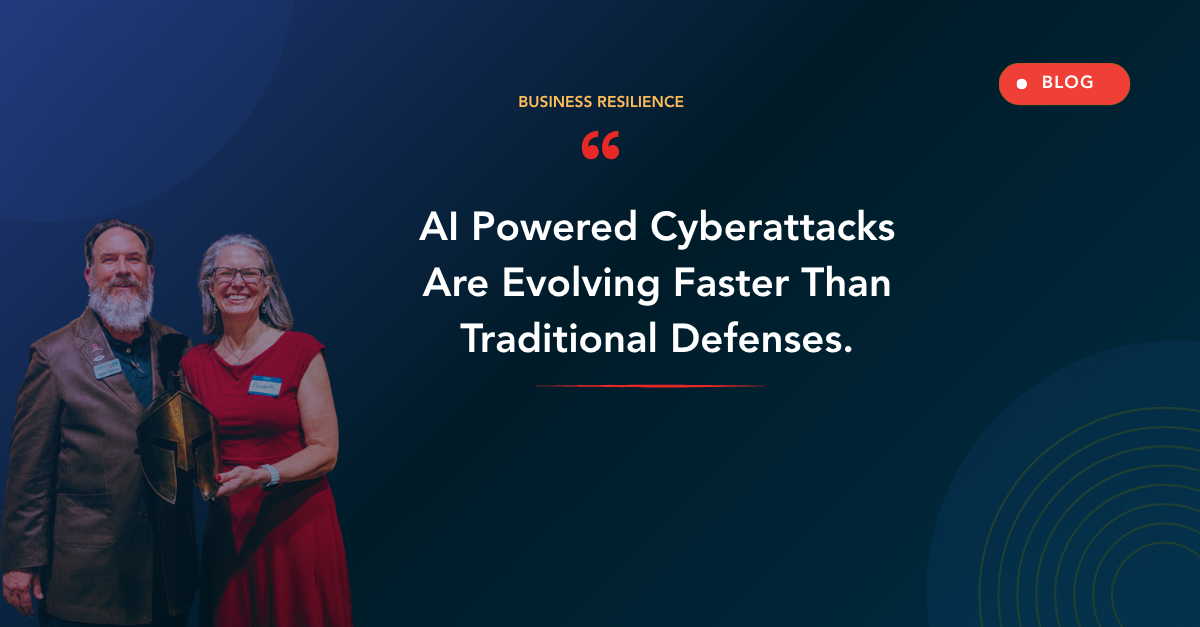
There was a time when a suspicious email was easy to spot. Bad grammar, a strange sender address, an offer that was too good to be true. Those days are gone. Attackers now use artificial intelligence to write flawless messages, clone voices, mimic writing styles, and study a company’s habits before striking. For business owners across Greenville, this shift has turned cybersecurity from a background concern into something that keeps people up at night.
CMIT Solutions of Greenville has spent years watching this threat landscape evolve, and the pace of change over the last eighteen months has been unlike anything seen before. Attackers are no longer relying on brute force. They are using machine learning models to test thousands of attack variations in minutes, adapt to defenses in real time, and target the exact weak points inside a company’s network. This article explains why AI powered attacks are so dangerous, what makes Greenville businesses particularly exposed, and what practical steps leaders can take to protect their operations.
What makes this moment feel different from previous waves of cybercrime concern is the sense of unpredictability it brings. Business owners are used to planning around known risks, from equipment failure to seasonal cash flow challenges to routine compliance deadlines. AI powered threats do not follow the same predictable rhythm. A defense that worked last quarter may already be outdated, simply because the tools attackers use have continued to improve in the background. That uncertainty is a large part of why so many leaders describe feeling like they are constantly playing catch-up, even when they have already invested in security measures.
The New Reality of AI Powered Attacks
Cybercriminals have always looked for the path of least resistance. What has changed is the tooling available to them. Generative AI models can now write convincing phishing emails in seconds, translate scams into perfect English, and even generate fake invoices that mirror a vendor’s actual formatting. Attackers no longer need deep technical skill to run a sophisticated campaign. They simply need access to the right tools.
This democratization of attack capability means small and mid-sized businesses, once considered too small to be worth targeting, are now squarely in the crosshairs. A cybersecurity trends 2026 review shows that automated reconnaissance tools can scan a company’s public digital footprint, build a profile of its employees, and craft messages tailored to specific individuals. That personalization is what makes these attacks so effective and so hard to detect with traditional filters.
The result is a threat environment where volume and precision have both increased. Attackers can launch thousands of tailored attempts while investing almost no additional time per target. For a company without dedicated security staff, that is an overwhelming imbalance.
Why Greenville Businesses Are Especially Exposed
Greenville’s economy is built on a mix of manufacturing, healthcare, legal services, financial firms, and hospitality businesses, many of which operate with lean internal IT teams. That combination creates a soft target profile that criminals actively look for.
Several factors compound the risk locally:
- Rapid regional growth means more companies are digitizing operations for the first time, often without mature security practices in place.
- Many firms rely on a patchwork of legacy software and newer cloud tools, creating gaps that are difficult to monitor consistently.
- Remote and hybrid work arrangements have expanded the attack surface beyond the traditional office network.
- Smaller firms frequently assume they are not attractive targets, which leads to underinvestment in protective measures.
A closer look at how fragile IT systems form over time shows that this is rarely intentional. Companies add tools, vendors, and integrations as they grow, and each addition introduces a new potential entry point. Without a coordinated strategy, these systems become brittle exactly when the business needs them to be most resilient.
How AI Is Changing Phishing and Social Engineering
Phishing has always been the most common entry point for attackers, and AI has made it far more convincing. Instead of generic mass emails, criminals now use language models to study a company’s public communications, tone, and structure, then generate messages that sound like they came from a trusted colleague or vendor.
Some of the tactics showing up in real incidents include:
- Messages referencing recent, publicly available company news to appear legitimate.
- Emails that mimic the exact writing style of an executive, based on samples pulled from social media or press releases.
- Fake vendor invoices that match previous billing formats almost exactly.
- Voice cloning used in follow-up phone calls to confirm a fraudulent email request.
Guidance on phishing and ransomware preparedness stresses that employee awareness training has to evolve alongside these tactics. The old advice of watching for typos and odd formatting no longer applies when the message is generated by a model trained to avoid exactly those mistakes.
Financial teams are particularly at risk. A review of common email fraud threats found that wire transfer requests and payroll changes are frequent targets because they involve money moving quickly, often under time pressure that discourages careful verification.

Deepfakes and the Rise of Synthetic Impersonation
Perhaps the most unsettling development is the use of AI generated audio and video to impersonate real people. A finance employee might receive what sounds like a phone call from their CEO, requesting an urgent transfer. The voice matches. The urgency feels real. But it is entirely synthetic.
This is not a distant, hypothetical risk. Voice cloning technology has become accessible enough that a short audio clip, sometimes lifted from a podcast interview or a company video, is enough to generate a convincing replica. Video deepfakes remain harder to produce at scale but are improving quickly, and their use in targeted corporate fraud is expected to grow.
Discussion of AI cyber threats highlights that verification protocols, not just technology, are the real defense here. A business that requires a second communication channel to confirm any financial request, regardless of how convincing the original message sounds, closes off this entire category of attack.
Automated Ransomware and Self-Learning Malware
Ransomware has been a persistent threat for years, but AI has changed how it spreads and adapts. Modern ransomware strains can analyze a network’s structure after initial infection, identify the most valuable data, and adjust encryption tactics based on the defenses they encounter. Some variants even negotiate ransom demands using automated chat systems calibrated to a company’s estimated ability to pay.
Insights on ransomware defense strategies point out that static, once-a-year security reviews are no longer sufficient against threats that evolve continuously. Attackers test defenses constantly, which means protective measures need equally continuous attention.
A few characteristics of these newer threats:
- Self-propagating code that moves laterally through a network faster than human responders can react.
- Encryption routines that adapt based on the type of files being targeted, prioritizing financial and client records.
- Double extortion tactics, where data is stolen before encryption, adding a second layer of pressure.
- Reduced dwell time, meaning attackers spend less time inside a network before executing their payload, giving defenders a smaller window to respond.
Business continuity planning has to account for this compressed timeline. Reviewing backup and recovery practices regularly ensures that even if an attack succeeds, the business can recover without paying a ransom or losing critical data permanently.
The Speed Problem: Why Traditional Defenses Fall Behind
Traditional cybersecurity tools were built around known signatures, meaning they recognize threats based on patterns seen before. AI powered attacks are designed specifically to avoid matching those known patterns. Each attempt can be slightly different, generated on the fly, making signature-based detection far less reliable.
This speed mismatch is one of the central challenges businesses face today. Attackers using AI can:
- Generate hundreds of unique phishing variations in the time it takes a human analyst to review one report.
- Probe a network’s defenses automatically, adjusting tactics based on what triggers an alert.
- Scale a campaign across many targets simultaneously without added manual effort.
Meanwhile, defenders relying on manual review processes or outdated software cannot keep pace. This is why more companies are exploring zero trust security frameworks, which assume no user or device should be automatically trusted, even inside the network perimeter. This model reduces the damage a single compromised credential can cause, since every action still requires verification.
Some organizations are also turning to AI themselves as a defensive tool. A look at AI cybersecurity risks and benefits notes that machine learning based monitoring can flag unusual behavior patterns far faster than a human team scanning logs manually, effectively fighting automation with automation.
Industries Most at Risk in Greenville
Not every industry faces the same level of exposure. Certain sectors handle data or operate under conditions that make them especially attractive targets.
Legal firms hold enormous amounts of sensitive client information, and a breach carries professional and regulatory consequences beyond the immediate financial loss. A discussion of legal tech innovations shows how case management platforms need to balance accessibility with strict access controls. Beyond the technical exposure, there is a professional dimension too: a data breach prevention failure at a firm can trigger bar association scrutiny, not just a technical cleanup.
Healthcare practices manage protected patient records that carry strict compliance obligations. Coverage of navigating compliance changes for 2026 outlines how regulatory requirements are tightening at the same time attack sophistication is rising, creating pressure from both directions.
Financial services firms are natural targets given the direct access to funds and sensitive account data they maintain. Attackers specifically design AI generated fraud attempts to exploit the urgency built into financial workflows.
Manufacturing companies increasingly rely on connected operational technology, and a disruption to production systems can halt physical operations, not just digital ones. Guidance on resilient IT infrastructure explains why uptime planning matters as much for a manufacturing floor as it does for a corporate office.
Hospitality businesses handle a constant stream of guest payment data and personal information, often across multiple locations with varying levels of security maturity, making consistent oversight difficult.
Building a Defense Strategy for the AI Threat Era
Facing AI powered attacks does not mean businesses are powerless. It means the defense strategy has to change to match the threat. A modern approach typically includes several layers working together rather than relying on any single tool.
Key components of a strong defense include:
- Continuous monitoring rather than periodic checkups, since threats evolve daily.
- Multi-factor verification for any financial or data access request, regardless of how legitimate it appears.
- Regular employee training that reflects current attack tactics, not outdated advice.
- Segmented networks so a single compromised account cannot access everything.
- Tested and verified backup systems that can restore operations quickly after an incident.
An overview of proactive IT management explains why waiting for a problem to surface is a losing strategy against threats designed to move quickly and quietly. Proactive monitoring catches unusual activity before it becomes a full-blown incident.
Companies are also rethinking how they assess risk in the first place. An IT risk management framework helps leadership understand where the biggest exposures actually sit, rather than spreading limited resources evenly across every possible concern.
The Growing Role of Security Operations Centers
One of the more significant shifts in the last year has been the adoption of dedicated monitoring teams that watch network activity around the clock. These centers combine human expertise with automated detection tools to catch threats that would otherwise go unnoticed until it was too late.
A look at why security operations center adoption is rising among local firms shows that this is no longer viewed as an enterprise-only investment. Smaller businesses are increasingly accessing this level of monitoring through managed service arrangements, since building an in-house team of that caliber is rarely realistic for a company outside the largest organizations.
Endpoint protection has also become more sophisticated as a result. Every laptop, phone, and connected device represents a potential entry point, and endpoint security solutions now use behavioral analysis to spot suspicious activity on individual devices before it spreads across a network.
The Hidden Risk of Unauthorized AI Tools
While companies work to defend against external AI powered attacks, an internal risk is quietly growing as well. Employees are adopting AI tools on their own, often without approval or oversight, to speed up daily tasks. These tools can inadvertently expose sensitive company data if not properly vetted.
Concerns around shadow AI tools highlight how easily confidential information can end up processed by third-party platforms with unclear data handling practices. A staff member pasting client details into a public chatbot to draft an email, for example, may have no idea that data could be retained or used elsewhere.
This is why a growing number of businesses are formalizing their approach through a structured AI readiness assessment, which evaluates both the opportunities and the risks of adopting AI tools before a policy vacuum leads to accidental exposure.
Practical Steps Business Owners Can Take Today
Business leaders do not need to become cybersecurity experts to meaningfully reduce their risk. A handful of practical steps can make an outsized difference:
- Require a second verification step for any financial transaction request, even ones that appear to come from a known executive.
- Review who has access to sensitive systems and remove permissions that are no longer needed.
- Schedule regular, realistic phishing simulations so employees recognize new tactics as they emerge.
- Confirm that backup systems are tested regularly, not just installed and forgotten.
- Ask vendors and partners about their own security practices, since a weak link anywhere in the supply chain can become an entry point.
- Document a clear incident response plan so the team knows exactly what to do in the first hour after a suspected breach.
A broader cybersecurity gap assessment can uncover blind spots that internal teams often miss simply because they are too close to daily operations to notice them.
Why a Managed Partner Matters More Than Ever
Very few small or mid-sized businesses have the internal resources to track every emerging AI threat, evaluate new defensive tools, and staff continuous monitoring around the clock. This is where a managed technology partner becomes valuable, not as an outsourced afterthought, but as an extension of the leadership team’s risk management strategy.
CMIT Solutions of Greenville works with local businesses to build defense strategies that match the realities of the current threat landscape rather than relying on outdated assumptions. That includes ongoing 24/7 IT monitoring, regular compliance solutions reviews for regulated industries, and tailored secure AI adoption guidance for companies exploring how to use these tools safely.
A strong proactive threat protection approach combines technology, process, and people, since no single tool can address every angle of a modern attack on its own.
Looking Ahead: What 2026 Will Likely Bring
The pace of change shows no sign of slowing. Attackers will continue refining their use of generative AI, and defensive tools will continue evolving in response. A few trends worth watching closely include:
- Wider use of autonomous defensive systems that can respond to threats in real time without waiting for human approval, discussed in coverage of autonomous IT operations.
- Increased regulatory attention on how companies handle AI tools internally, tying back to the same AI workplace risks businesses are already navigating.
- Growing insurer scrutiny of a company’s security posture before issuing or renewing policies, as covered in analysis of cyber insurance requirements.
- Continued consolidation of fragmented technology stacks into unified, better-monitored systems, a shift explored in coverage of strategic technology planning.
Businesses that treat this as an ongoing process rather than a one-time fix will be far better positioned than those waiting for a wake-up call.

The Underlying Infrastructure Question
Much of this discussion focuses on attacks and detection, but the foundation underneath all of it matters just as much. A network that is poorly documented, inconsistently patched, or stitched together from years of ad hoc decisions will struggle to support even the best security tools layered on top of it. Attackers count on this kind of hidden fragility, since it is often invisible to leadership until something breaks.
Solid network management practices bring visibility to what is actually running across a company’s systems, which devices are connected, and where outdated software might be quietly creating exposure. Without that visibility, even a well-intentioned security investment can miss the mark because it is protecting the wrong things or leaving blind spots unaddressed.
Cloud adoption adds another layer of complexity here. Many Greenville businesses have moved core operations into cloud platforms over the past few years, often across multiple providers and services. Thoughtfully managed cloud services reduce the risk of misconfigured storage buckets, unmonitored access permissions, and other common causes of accidental data exposure that have nothing to do with a sophisticated attacker and everything to do with basic oversight.
Finally, day-to-day reliability matters more than it might seem in a conversation about advanced threats. When employees experience constant friction with slow systems or unreliable connectivity, they tend to look for workarounds, and workarounds are frequently where security gaps creep in. Dependable IT support services keep daily operations running smoothly enough that staff are not tempted to bypass approved tools or processes just to get their work done, which quietly removes one more avenue attackers might otherwise exploit.
Taken together, these foundational elements are not separate from the fight against AI powered threats. They are the base layer that makes every other defensive measure actually work as intended.
Final Thoughts
AI powered cyberattacks are not a distant future threat. They are an active, daily reality for businesses across Greenville right now. The good news is that the same pace of innovation driving these threats is also driving better defensive tools, smarter monitoring systems, and more accessible expertise for companies of every size.
Losing sleep over cybersecurity is understandable given the headlines, but it does not have to be a permanent state. With the right partner, clear processes, and a commitment to staying current rather than static, Greenville businesses can face this new threat landscape with confidence instead of anxiety. For leaders ready to take the next step, a conversation with a team that lives in this landscape every day is a good place to start. Reach out to schedule a consultation and get a clear picture of where your business stands today.
Frequently Asked Questions