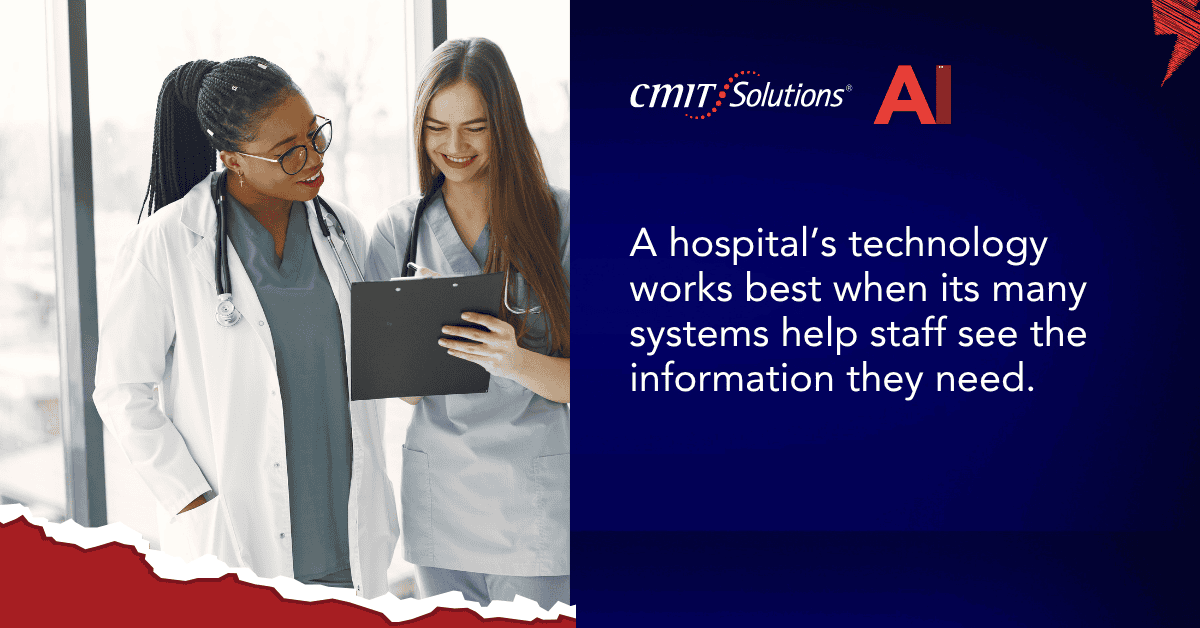
Walk into any modern hospital or medical practice and the technology running quietly in the background is doing far more work than most patients, and even many administrators, ever realize. Behind every appointment, prescription, lab result, and insurance claim sits a web of interconnected software systems, each with its own vendor, its own compliance requirements, and its own potential point of failure.
For practice administrators and healthcare business owners, understanding this stack at a high level is no longer optional. Decisions about which systems to adopt, how they connect, and who is responsible for securing them directly affect patient safety, staff efficiency, and regulatory exposure. This guide walks through fifteen core software systems that make up the modern healthcare technology stack, explained in plain business terms.
Why the Healthcare Tech Stack Deserves More Attention Than It Gets
Healthcare organizations often accumulate technology one decision at a time. A new scheduling tool gets added because the old one was clunky. A telehealth platform gets rushed into place during a crisis. A billing system stays in place for a decade simply because switching feels too disruptive. Over time, this creates the same fragmented environment described in this breakdown of IT vendor sprawl, except in healthcare, the stakes are higher because patient safety and regulatory compliance are directly on the line.
Understanding what each system does, and how it connects to the others, is the first step toward a stack that actually supports the organization rather than working against it.
Electronic Health Records (EHR)
The EHR is the backbone of the modern healthcare stack. It stores patient history, diagnoses, medications, treatment plans, and clinical notes in one centralized digital record accessible to authorized providers. A well-configured EHR reduces duplicate testing, improves care coordination, and creates the audit trail required for compliance purposes.
Key considerations for EHR systems:
- How easily providers can access records during time-sensitive situations
- Whether the system integrates cleanly with lab, imaging, and billing platforms
- How access controls prevent unauthorized viewing of sensitive records
Practice Management Software
While the EHR handles clinical data, practice management software runs the business side: scheduling, patient registration, insurance verification, and reporting. Weak integration between these two systems is a common source of duplicate data entry and scheduling errors.
Picture Archiving and Communication System (PACS)
PACS stores and transmits medical imaging such as X-rays, MRIs, and CT scans. It allows radiologists and physicians to access images remotely and compare them against prior studies. Given the size of imaging files, PACS performance depends heavily on network speed and storage architecture.
Laboratory Information System (LIS)
The LIS manages the full lifecycle of lab testing: order entry, sample tracking, result reporting, and quality control. A properly integrated LIS reduces the chance of mislabeled samples or delayed results reaching the wrong provider.
Revenue Cycle Management (RCM) Software
RCM software tracks the financial side of patient care from initial scheduling through final payment, including insurance claims, denials management, and patient billing. Inefficient revenue cycle systems are one of the most common sources of cash flow problems in healthcare organizations, closely tied to broader technology risks covered in this look at financial firm tech risks that apply across regulated industries handling sensitive financial data.
Patient Portal and Engagement Tools
Patient portals allow individuals to view test results, request appointments, message providers, and pay bills online. Adoption of these tools has accelerated demand for stronger identity verification, since portals represent a direct entry point into sensitive clinical data, a concern addressed in this overview of identity-first security approaches.
Telehealth Platforms
Telehealth software enables remote video visits, remote monitoring check-ins, and virtual triage. These platforms need to be both easy for patients to use and secure enough to protect sensitive conversations, a balance that becomes more complex as more staff work outside traditional office settings, a shift covered in this discussion of healthcare access controls for remote and hybrid clinical staff.
Health Information Exchange (HIE)
HIE systems allow different healthcare organizations, hospitals, labs, pharmacies, and specialists, to securely share patient data with each other. This reduces duplicate testing and improves continuity of care when patients see multiple providers across different systems.
Clinical Decision Support (CDS) Systems
CDS tools analyze patient data in real time and alert providers to potential drug interactions, allergy conflicts, or recommended screenings. These systems depend heavily on accurate, well-structured data flowing in from the EHR and other connected platforms.
Pharmacy Management Systems
These systems manage medication dispensing, inventory tracking, and interaction checking within hospital pharmacies or affiliated retail pharmacies. Integration with the EHR is critical to prevent medication errors caused by miscommunication between prescribing and dispensing systems.
Remote Patient Monitoring (RPM) Platforms
RPM tools collect data from wearable devices or home monitoring equipment, tracking metrics like blood pressure, glucose levels, or heart rhythms outside the clinical setting. This data typically feeds back into the EHR, allowing providers to intervene before a condition becomes an emergency.
Real-Time Location Systems (RTLS)
Hospitals use RTLS to track the physical location of equipment, staff, and sometimes patients throughout a facility. This reduces time wasted searching for shared equipment and can improve patient flow through busy departments.
Cybersecurity and Threat Monitoring Systems
Given the sensitivity of patient data, healthcare organizations require dedicated systems for continuous threat detection, endpoint protection, and incident response. Healthcare remains one of the most targeted industries for cyberattacks, a trend explored in this look at silent cyberattacks that often go unnoticed until significant damage has already occurred. Endpoint management across the many devices used in clinical settings has become especially important, a topic covered in this overview of endpoint management security.
Backup and Disaster Recovery Systems
Healthcare organizations cannot afford extended downtime, since patient care depends on continuous access to clinical records. Reliable backup and recovery systems ensure that a hardware failure, ransomware attack, or natural disaster does not translate into a complete loss of access to critical data, a priority explored in this discussion of business continuity planning.
Unified Communications and Care Team Messaging
Modern care coordination increasingly depends on secure messaging platforms that connect physicians, nurses, and administrative staff in real time, replacing outdated paging systems and unsecured text messages. Organizations that modernize this layer report measurably better coordination, a shift described in these lessons on unified communications strategy.
How These Systems Connect (or Fail to Connect)
The real complexity of a healthcare tech stack is not any single system, it is how well they talk to each other. A hospital might have excellent individual tools for imaging, lab work, and billing, yet still struggle if those systems cannot share data smoothly.
Common integration failure points include:
- Duplicate patient records created when systems do not sync properly
- Delayed lab or imaging results due to poor interface configuration
- Billing errors caused by mismatched data between clinical and financial systems
- Staff resorting to manual workarounds, such as printing and re-scanning documents, when systems do not connect directly
These integration gaps often trace back to the same root cause explored in this look at top technology challenges, where individual tools were selected without a clear plan for how they would work together.

Compliance Runs Through Every Layer of the Stack
Nearly every system in the healthcare tech stack touches protected health information in some way, which means compliance cannot be treated as a separate project handled by one department. It has to be built into how each system is configured, accessed, and monitored.
Key compliance touchpoints across the stack:
- Access logs showing exactly who viewed or modified a patient record and when
- Encryption of data both in transit between systems and at rest in storage
- Business associate agreements with every vendor that touches patient data
- Regular risk assessments identifying gaps before they become violations
Many healthcare organizations are unaware of how many compliance gaps exist across their stack until an audit forces the issue, a problem explored in detail in this review of HIPAA compliance gaps. A more comprehensive approach to compliance planning treats it as an ongoing discipline rather than a once-a-year checklist, a shift described in this overview of compliance competitive advantage.
Security Threats Unique to the Healthcare Stack
Healthcare data is among the most valuable information on the black market, which makes hospitals and practices a consistent target for attackers. A few threat patterns worth understanding:
- Ransomware attacks that lock providers out of patient records during active care, forcing impossible decisions between paying attackers and delaying treatment
- Business email compromise targeting billing departments to redirect payments, a scheme explained in this breakdown of business email compromise tactics
- Phishing attacks increasingly powered by AI, making fraudulent messages far more convincing than in the past, a trend covered in this look at AI-powered phishing
- Unmanaged medical devices connected to the network without proper security oversight, expanding the potential attack surface significantly
Healthcare organizations that fail to modernize their defenses across every layer of the stack often do not discover the exposure until real damage has occurred, a pattern reflected in this look at signs of hacking that many organizations miss for months.
The Cost of a Fragmented Stack
Beyond security risk, a poorly integrated healthcare tech stack quietly drains money and staff time through:
- Redundant licensing for overlapping tools that perform similar functions
- Extended downtime when one system fails and others depend on it
- Staff time spent manually reconciling data between disconnected platforms
- Delayed reimbursements caused by billing errors traced back to poor data flow
The financial impact of these inefficiencies is often underestimated until leadership actually calculates the true data breach costs and operational costs tied to a poorly maintained stack, a number that tends to be far higher than expected once fully accounted for.
How AI Is Reshaping the Hospital Tech Stack
Artificial intelligence is increasingly woven into several layers of the healthcare stack, from predictive analytics in clinical decision support to automated administrative workflows. Practices are exploring how AI-assisted productivity tools can reduce the administrative burden on clinical staff, a trend covered in this look at AI productivity tools applicable well beyond finance departments.
Governance becomes especially important as these tools expand, since AI systems interacting with patient data need clear oversight and access controls, a requirement discussed in this overview of Copilot IT governance that applies broadly to AI adoption in sensitive environments. Automated help desk tools are also beginning to reduce the burden on internal IT teams supporting these complex systems, a shift explored in this look at AI help desk automation.
Building a Resilient Healthcare Tech Stack
Establish Clear Ownership
Every system in the stack should have a clear owner responsible for updates, security patches, and vendor relationships. Without this, systems drift out of date and vulnerabilities go unnoticed.
Prioritize Integration Over Isolated Features
When evaluating new software, prioritize how well it integrates with existing systems over how many standalone features it offers. A tool that does not talk to the EHR often creates more work than it saves.
Build in Redundancy for Critical Systems
Systems that directly affect patient care, EHR access, pharmacy management, and monitoring platforms, need redundancy plans so a single point of failure cannot take down essential functions during an emergency, a priority closely tied to broader disaster recovery planning efforts.
Train Staff Continuously, Not Just at Onboarding
Many security incidents in healthcare trace back to human error rather than a technical flaw. Ongoing training keeps staff alert to evolving threats rather than relying on a single orientation session years earlier.
Reassess the Full Stack Regularly
Healthcare technology evolves quickly, and a stack that was well designed three years ago may already contain outdated or redundant systems. A periodic review, similar to the process described in this overview of IT infrastructure modernization, helps organizations catch these gaps before they become expensive problems. This kind of review is especially important given how quickly top IT challenges tend to shift year over year across every industry, healthcare included, as new threats and regulatory requirements continue to emerge.
Mapping the Stack to the Right Service Areas
Just as with any complex technology environment, each layer of the hospital tech stack typically falls under a specific area of IT support and oversight. Understanding this mapping helps healthcare leaders know exactly who to turn to when something in the stack needs attention:
- Day-to-day troubleshooting across clinical and administrative software usually falls under responsive IT support
- Servers, storage, and hosting for systems like the EHR and PACS are typically managed through a broader managed IT services engagement
- Threat detection and endpoint protection across connected medical devices and workstations fall under a dedicated cybersecurity program
- HIPAA and regulatory requirements touching every system in the stack are best managed through an ongoing compliance program
- Patient data protection and recovery planning is typically covered under a dedicated data backup strategy
- Network performance supporting imaging transfers and remote access depends on strong network management
- Secure care team messaging and internal notifications typically fall under a broader unified communications strategy
- Cloud-hosted clinical or administrative platforms are usually supported through a dedicated cloud services strategy
- Everyday scheduling and office productivity tools used alongside clinical systems often fall under productivity applications support
- New software and hardware purchasing decisions across the stack are best guided by a disciplined IT procurement process
- Long-term technology roadmapping for the entire stack benefits from ongoing IT guidance rather than reactive, system-by-system decision making
For healthcare leaders who are unsure where their current gaps sit, the homepage resources available through a managed IT provider are often a useful starting point for identifying which service area needs the most immediate attention.
Common Warning Signs the Stack Is Falling Behind
Many healthcare organizations do not realize their tech stack has become a liability until something breaks. A few signs worth watching for:
- IT tickets repeatedly tied to the same integration point between two systems
- Staff maintaining shadow spreadsheets to track information the software should already handle
- Growing frustration during shift handoffs due to inconsistent data between systems
- Rising costs from redundant licensing across overlapping platforms
- Increasing time required to onboard new clinical staff onto the full suite of systems
These symptoms often mirror the broader warning signs IT support gaps tend to produce across any growing organization, though the consequences in a clinical setting are considerably higher.
Why Proactive Planning Beats Reactive Fixes
Healthcare organizations that wait for a system failure before addressing stack-wide issues tend to pay significantly more, both financially and operationally, than those who plan ahead. A proactive approach to IT support catches small integration problems and aging infrastructure before they escalate into patient-facing disruptions, a shift explored in this discussion of proactive IT support as a genuine competitive advantage rather than a nice-to-have.
This proactive mindset also extends to how leadership plans technology investment more broadly, treating the stack as a strategic asset managed by CMIT Solutions of Long Beach and internal leadership together, rather than a collection of tools purchased in isolation over the years.
Questions Healthcare Leaders Should Ask About Their Stack
- Which systems in our stack currently do not integrate well with each other, and what is that costing us in staff time?
- Who is responsible for patching and updating each critical system?
- How quickly could we recover patient access if our EHR went down for twenty-four hours?
- Are all vendors touching patient data covered by a current business associate agreement?
- How are we monitoring for unusual access patterns across our systems?
- What is our plan if a ransomware attack targeted our most critical clinical system during business hours?

Why the Right Technology Partner Matters in Healthcare
Very few healthcare organizations have the internal resources to manage fifteen interconnected systems, each with its own compliance requirements and security considerations, without dedicated support. CMIT Solutions of Long Beach works with healthcare practices to bring structure to this complexity, from access control strategy to ongoing monitoring across every layer of the stack.
This includes guidance on modernizing outdated systems that create the biggest security and compliance exposure, a challenge outlined in this discussion of healthcare IT security, as well as broader support for practices working to protect patients and providers alike, a mission described in this overview of healthcare IT protection. Predictive monitoring approaches are also helping practices catch potential system failures before they disrupt patient care, a shift covered in this look at predictive IT support. Organizations weighing whether to bring more of this oversight in-house or lean on an outside partner often find that a managed IT guide helps clarify which approach actually fits their size and growth stage.
Practical Next Steps for Healthcare Leaders
- Create a full inventory of every system currently in use, including who owns it and what data it touches
- Identify the top three integration gaps causing the most staff frustration or delay
- Confirm business associate agreements are current for every vendor with access to patient data
- Schedule a security review focused specifically on endpoint devices connected to the network
- Build a communication plan for what happens if a critical system goes down unexpectedly, drawing on the broader principles covered in this guide to reducing IT downtime
- Review how your organization’s disaster recovery approach compares to broader recommendations covered in this guide to data backup recovery planning
- Evaluate whether your current network can support growing imaging and data transfer demands, a consideration explored in this look at network speed optimization
A Note on Cost and Long-Term Value
Healthcare leaders often approach stack improvements with concern about upfront cost, and that concern is understandable given how many competing budget priorities exist in a clinical setting. It helps to frame these investments the same way any other critical infrastructure decision would be framed: not as an expense to be minimized, but as a safeguard against far larger costs down the road, whether that is a compliance fine, a ransomware payout, or the reputational damage of a preventable patient safety incident.
Organizations that have gone through this exercise consistently find that the math favors proactive investment. A single day of EHR downtime, a single ransomware incident, or a single missed compliance requirement can easily cost more than years of disciplined, well-planned technology spending. Framing the stack this way tends to make budget conversations with ownership or a board considerably easier, since the numbers speak for themselves once properly laid out.
Final Thoughts
The modern hospital tech stack is far more than an EHR and a billing system. It is a network of fifteen or more interconnected platforms, each carrying real consequences for patient safety, staff efficiency, and regulatory exposure. Healthcare leaders who understand how these pieces fit together, and who invest in keeping them properly integrated and secured, put their organizations in a far stronger position than those who let the stack grow unmanaged over time.
Building and maintaining this kind of resilient, well-integrated technology environment takes more than good intentions. It takes ongoing attention, the right expertise, and a partner who understands both the clinical and business sides of healthcare technology. If your organization is ready for a clear-eyed look at how your systems fit together, and where the gaps might be putting patients or compliance at risk, schedule a consultation to get a full assessment of your current technology stack.
Frequently Asked Questions