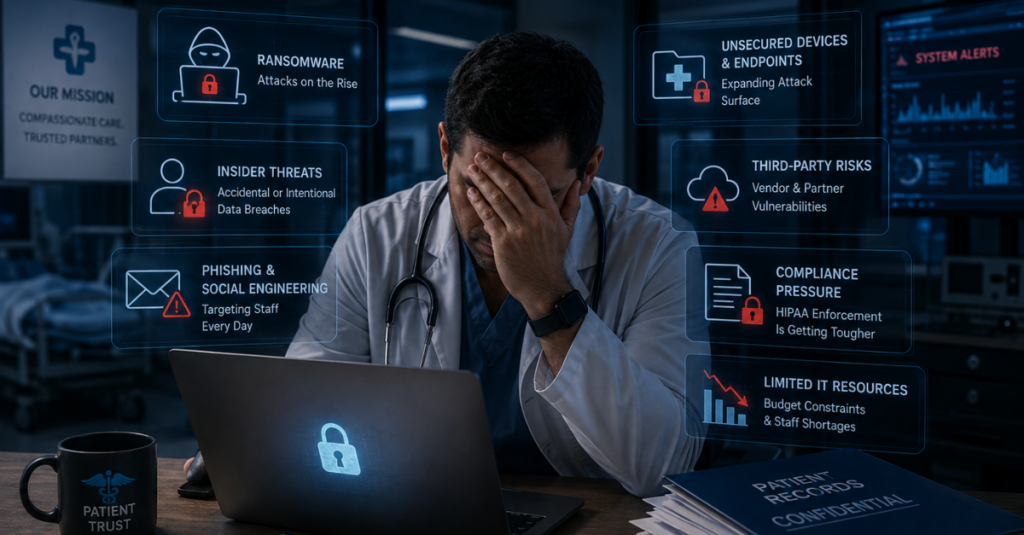
Medical practices have become one of the most heavily targeted sectors in cybersecurity, and 2026 is shaping up to be a year where that pressure only intensifies. Patient records carry a combination of personal, financial, and medical information that fetches a higher price on underground markets than almost any other type of stolen data. At the same time, practices are managing more connected devices, more remote staff, and more third party software vendors than ever before, which means the attack surface keeps expanding faster than most in house teams can secure it.
For small and mid sized medical practices in particular, the resources available to fight this trend often lag far behind the sophistication of the threats. A hospital system might have a dedicated security operations center. A local family practice, dental office, or specialty clinic usually has a front desk team juggling scheduling, billing, and patient calls, with technology handled as an afterthought until something breaks. That gap is exactly where attackers are focusing their efforts.
This article walks through the specific security challenges medical practices are facing this year, from ransomware targeting patient records to the growing complexity of connected medical devices, along with practical steps practices can take to close the gaps before they turn into a breach. CMIT Solutions of Long Beach works directly with healthcare providers across the region, and the patterns described here reflect what local practices are dealing with right now.
Why Healthcare Remains a Top Target for Attackers
Patient data is uniquely valuable to criminals because it rarely changes. A stolen credit card can be cancelled within hours. A stolen medical record containing a Social Security number, diagnosis history, and insurance details remains useful for identity theft and insurance fraud for years. This durability is a big part of why healthcare breaches consistently command higher prices on illicit marketplaces than most other categories of stolen data.
Several other factors compound the risk for medical practices specifically:
- Practices often operate on tight margins, which limits investment in dedicated security staff or advanced tools
- Legacy systems and older medical software are frequently kept in place because replacing them is expensive and disruptive
- Staff turnover in front office and clinical roles makes consistent security training difficult to maintain
- The sheer number of parties involved, including labs, pharmacies, insurers, and referral practices, creates many points where data can be exposed
- Downtime has an immediate impact on patient care, which makes practices more likely to pay a ransom quickly rather than risk delaying treatment
Attackers know that a compromised practice faces pressure that goes beyond financial loss. When patient scheduling systems, electronic health records, or diagnostic equipment go offline, the consequences extend directly to patient safety, which increases the likelihood that a practice will pay to restore access quickly rather than work through a lengthy recovery process.
The Expanding Attack Surface Inside Modern Practices
A decade ago, a medical practice’s technology footprint was relatively contained: a handful of desktop computers, a server room, and maybe a website. That footprint has grown considerably. Today’s practice typically includes:
- Cloud based electronic health record platforms accessed from multiple locations
- Patient portals allowing direct login access from personal devices
- Connected diagnostic and monitoring equipment
- Telehealth platforms used for remote consultations
- Mobile devices used by clinical staff for charting and communication
- Billing and insurance verification systems connected to external payer networks
Each of these represents a potential entry point. A single unpatched piece of diagnostic equipment or an outdated telehealth application can become the weak link that gives an attacker access to the broader network. This is part of why endpoint management strategies have become such a central part of healthcare security planning, since visibility across every connected device is now a baseline requirement rather than a nice to have.
HIPAA and the Growing Weight of Compliance in 2026
Regulatory expectations around patient data protection continue to climb. HIPAA requirements haven’t changed in structure, but enforcement scrutiny and the technical bar for what counts as reasonable safeguards have both risen considerably. Practices are now expected to demonstrate encryption standards, access logging, breach detection capability, and documented incident response procedures that go well beyond a basic written policy.
Many practices that were considered adequately protected just a few years ago now fall short of what regulators and cyber insurers expect. A broader look at growing compliance expectations explains how this shift has affected small and mid sized organizations across nearly every regulated industry, not just healthcare specifically.
For practices trying to map their current setup against what’s actually required, a structured compliance solutions approach helps translate regulatory language into specific technical safeguards, rather than leaving staff to interpret dense legal requirements on their own. A related resource covering the IT compliance guide outlines what’s expected across the board heading into this year, much of which applies directly to healthcare providers.
Ransomware and the Direct Threat to Patient Records
Ransomware remains the single most disruptive threat facing medical practices. Unlike a typical data breach, where the primary concern is information exposure, a ransomware attack against a healthcare provider halts operations entirely. Appointment scheduling stops, records become inaccessible, and in some documented cases, practices have had to redirect patients to other facilities for urgent care while systems were restored.
The financial toll extends well past any ransom payment. Recovery costs, regulatory fines, patient notification requirements, and reputational damage all compound quickly. A detailed look at the cost of cyberattacks illustrates how quickly these expenses stack up for a small organization that wasn’t prepared with proper backup and continuity planning in advance.
Attackers have also gotten more strategic about timing, often launching attacks during weekends, holidays, or periods when IT support is less available. A closer read on silent cyberattack risks explains how many attacks go undetected for weeks before the damage becomes visible, which gives criminals extended access to sensitive systems before a practice even realizes something is wrong.
Remote and Hybrid Care Access Challenges
Telehealth adoption, once accelerated by necessity, has become a permanent fixture in how many practices operate. That convenience comes with new security considerations that didn’t exist when every patient interaction happened inside a controlled clinical environment.
Common challenges include:
- Staff accessing patient records from home networks that lack enterprise grade security
- Video consultation platforms that may not meet the same encryption standards as internal systems
- Personal devices used for on call communication without proper endpoint protection
- Inconsistent access policies between in office and remote clinical staff
A closer look at remote access controls covers how practices are adjusting their approach as hybrid clinical work becomes more common, particularly around verifying identity and limiting exposure when staff connect from outside the office.
Framework shifts are also underway more broadly across industries managing distributed teams. A related explanation of secure access service edge describes how combining network security and access control into a single cloud delivered framework has become increasingly common for organizations supporting a mix of in office and remote staff.
Identity and Access Management for Clinical Staff
Not every staff member needs access to every patient record. Yet many practices still operate with broad, loosely managed access permissions that make it difficult to track who viewed what information and when. This creates both a compliance risk and a security vulnerability, since a single compromised login can expose far more data than necessary.
Practical steps for tightening access include:
- Role based permissions that limit access according to job function
- Automatic logging of every record access for audit purposes
- Scheduled reviews of user accounts to remove access for former employees promptly
- Multi factor authentication required across every system touching patient data
Credential theft remains one of the most common ways attackers gain initial access to healthcare systems. A deeper explanation of identity management security covers why identity has become the primary target for attackers, often bypassing perimeter defenses entirely by simply using a stolen password.
The broader shift toward continuous identity verification is also reshaping how practices think about network security overall. A related look at identity first security explains why verifying every user and device on an ongoing basis has replaced the older model of trusting anything already inside the network perimeter.
Endpoint and Device Security Across Care Settings
Medical practices manage a wider variety of connected devices than most other small businesses, ranging from standard workstations to specialized diagnostic and monitoring equipment. Many of these devices run on older operating systems that manufacturers rarely update, creating long lived vulnerabilities that are difficult to patch through normal channels.
A layered approach to device security typically includes:
- Network segmentation that isolates medical devices from general administrative systems
- Regular vulnerability scanning to identify devices running outdated firmware
- Strict policies limiting what personal devices can connect to the practice network
- Centralized monitoring across every endpoint, not just traditional computers
Firms and practices working through network management solutions often find that segmentation alone significantly reduces risk, since it prevents an attacker who compromises one device from moving freely across the entire practice network.
Third Party Vendor and Medical Device Risk
Very few practices operate in isolation. Labs, imaging centers, billing companies, insurance clearinghouses, and software vendors all connect into a practice’s systems in some capacity, and each one represents a potential path for an attacker if that vendor’s own security isn’t adequate.
Vendor risk has become a growing concern across nearly every industry, not just healthcare. A broader explanation of why why it vendor sprawl creates both security and budget challenges applies directly to practices juggling dozens of disconnected vendor relationships, each with its own login credentials, data sharing agreements, and security standards.
Practices should maintain a current inventory of every vendor with system access, review data handling agreements regularly, and confirm that vendors meet the same security expectations the practice holds itself to internally.
Building a Resilient Security Framework
No single tool solves healthcare security on its own. A resilient framework layers multiple protections so that if one control fails, others remain in place. For medical practices, this generally includes:
- A properly configured firewall and segmented network architecture
- Endpoint protection deployed across every device, including specialized medical equipment where possible
- Multi factor authentication on every system containing patient data
- Continuous monitoring capable of detecting unusual activity in real time
- Encrypted, tested backups stored separately from the primary network
- A documented, rehearsed incident response plan specific to healthcare operations
Fatigue is a real challenge here too. Staff juggling patient care alongside an ever growing list of security requirements can become numb to alerts and policies over time. A closer look at security fatigue solutions explains how practices can simplify their security posture without sacrificing protection, which matters considerably in an environment where clinical staff have limited bandwidth for additional administrative burden.
The Role of Managed IT Services in Healthcare Security
Most medical practices don’t have the internal resources to monitor threats around the clock while also managing patient care operations. This is where managed IT services fill a critical role, providing continuous oversight and specialized expertise without requiring a practice to build an internal security team from scratch.
A well structured managed services relationship for a healthcare provider typically includes:
- Around the clock network and endpoint monitoring
- Proactive patch management across both administrative and clinical systems
- Help desk support for staff during patient care hours
- Documentation and reporting that supports HIPAA compliance audits
- Strategic planning around technology upgrades before systems become a liability
Practices exploring this shift often find the ongoing investment compares favorably against the cost of even a single serious incident, particularly once reliable IT support is factored into daily operations rather than treated as an occasional expense.
Communication and workflow tools also fall under this umbrella. Practices coordinating across multiple providers or locations benefit from unified communications tools that keep scheduling, messaging, and patient coordination secure and consistent, while productivity applications support ensures the everyday software staff rely on is configured properly rather than left as an unmanaged risk.
Predictive support models are changing how practices avoid disruption in the first place. Rather than waiting for a system to fail during patient hours, predictive IT support uses ongoing monitoring data to flag early warning signs before they turn into a costly outage.
Cloud, Backup, and Business Continuity for Patient Records
Electronic health record platforms and practice management software increasingly run in the cloud, which offers real advantages in accessibility and disaster resilience when configured correctly. Practices considering a transition or reviewing their current setup should evaluate secure cloud services options built specifically with healthcare compliance requirements in mind.
Backup strategy deserves particular attention given how frequently ransomware attacks specifically target backup systems alongside primary data. A resilient approach relies on data backup solutions that maintain isolated, versioned copies of patient records, paired with a tested disaster recovery planning process that’s been rehearsed under realistic conditions rather than assumed to work when needed.
Continuity planning goes beyond backups alone. A broader look at business continuity planning covers how practices maintain operations, protect reputation, and preserve revenue even when a serious disruption occurs.
Staff Training and the Human Factor
Even the strongest technical controls can be undermined by a single staff member clicking a malicious link during a busy shift. Clinical and administrative staff are focused on patient care first, which means security training needs to be practical, brief, and repeated regularly rather than delivered as a lengthy annual presentation.
Effective training programs for healthcare settings typically include:
- Simulated phishing exercises tailored to healthcare specific scenarios
- Clear procedures for verifying unusual requests involving patient information or billing changes
- Guidance on securing mobile devices used for charting or communication
- Regular refreshers on password hygiene and recognizing social engineering attempts
Given how much more convincing modern attacks have become, it’s worth understanding how evolving hacker tactics have shifted the balance between automated attacks and the human judgment still required to catch them before damage occurs.
Preparing Your Practice for What’s Ahead
Waiting until after an incident to address security gaps leaves a practice exposed for far longer than necessary. A practical readiness plan generally includes the following steps:
- Conduct a full security and compliance assessment to identify current gaps
- Update and test the practice’s incident response plan under realistic conditions
- Confirm multi factor authentication is active across every system with patient data
- Review every third party vendor relationship for security and data handling standards
- Segment the network to isolate medical devices from administrative systems
- Refresh staff training on a recurring basis rather than a single annual session
- Verify backup systems through an actual test restoration
A structured approach to strategic IT guidance helps practices work through this list methodically, prioritizing the highest risk gaps first rather than attempting everything at once. Reviewing what’s expected of what smart smb leaders from their technology partners this year also offers useful context for practice owners evaluating whether their current provider is keeping pace with emerging threats.
It’s also worth reviewing broader patterns across the industry. A closer look at emerging cybersecurity risks local businesses are preparing for this year offers additional context that applies directly to healthcare operations facing similar pressures.

Why Local Expertise Matters for Long Beach Practices
Generic national IT vendors often don’t account for the specific regulatory environment, patient care workflows, or local vendor relationships that shape how a Long Beach medical practice actually operates day to day. Working with a partner that understands both healthcare compliance requirements and the local business community tends to produce a security program that fits the practice rather than a one size fits all package built for a different type of business entirely.
CMIT Solutions of Long Beach has spent years supporting healthcare providers across the region, building security programs around the specific compliance obligations, patient care priorities, and connected device environments that medical practices deal with every day. That local, sector specific experience makes a measurable difference when a practice needs support quickly during a high stakes situation.
Practices thinking more broadly about how technology providers are evolving may also find it useful to review the emergence of why the new era of managed intelligence providers, along with why affordable managed IT support has become one of the more cost effective decisions small organizations make when weighing the alternative of building an internal team from scratch.
Conclusion
Healthcare security challenges in 2026 stem from a combination of factors: valuable patient data, an expanding attack surface across connected devices and remote access points, tightening regulatory expectations, and limited internal resources at most small and mid sized practices. None of these pressures are going away, and attackers have shown no signs of slowing down their targeting of the sector.
Practices that invest in layered security, proper access management, tested backups, and ongoing staff training put themselves in a fundamentally stronger position than those relying on outdated defenses built for a threat landscape that no longer exists. Addressing gaps proactively, rather than reactively after an incident, is consistently the difference between a manageable disruption and a practice threatening breach.
Those interested in a security assessment or a broader conversation about readiness can schedule a consultation to walk through their current systems and identify the highest priority fixes before the next incident occurs. For a broader overview of how a managed IT provider supports healthcare organizations day to day, it’s worth exploring the full range of services available, along with how a local technology partner approaches security planning for practices handling sensitive patient information every single day.
Frequently Asked Questions