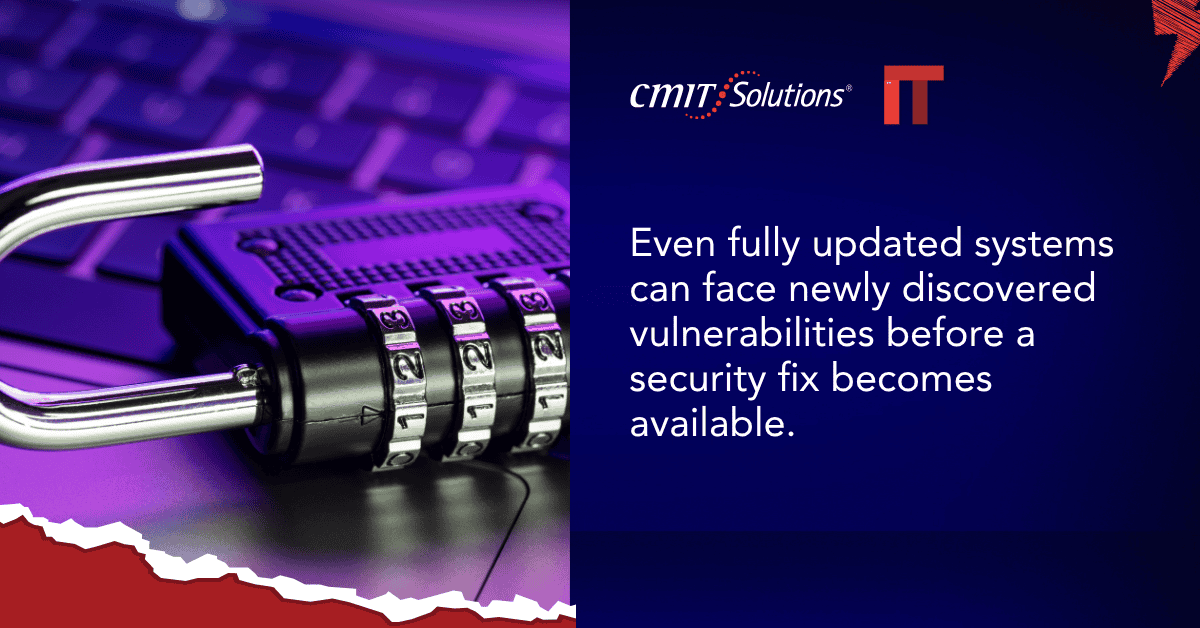
Most businesses assume that keeping software patched and up to date is enough to stay protected. It’s good advice, and it closes off a huge number of common attack paths. But it does not account for one of the most dangerous categories of cyber threats: zero-day vulnerabilities, flaws that attackers discover and exploit before the software vendor even knows they exist.
By definition, there is no patch available for a zero-day vulnerability at the moment it’s first exploited. That means a business running fully updated, properly maintained systems can still be breached through a flaw nobody, including the software maker, knew was there. Understanding how these attacks work, and what defenses actually matter when patching alone isn’t enough, is essential for any business serious about reducing its real-world risk.
This gap between “updated” and “safe” is exactly what makes zero-day threats so unsettling for business owners who have already invested heavily in security. It challenges the common assumption that diligent maintenance alone equals protection, and it explains why even well-resourced organizations occasionally find themselves breached despite doing everything considered best practice at the time.
What Makes a Vulnerability a “Zero-Day”
The term zero-day refers to the number of days a software vendor has had to fix a known flaw before it’s exploited: zero. Once a vulnerability is discovered by an attacker and used in the wild before a patch exists, it’s classified as a zero-day exploit. Once the vendor releases a fix, the same vulnerability is no longer considered a zero-day, even if many businesses haven’t yet applied the patch.
This distinction matters because it highlights the core problem: traditional patch management, while essential, is fundamentally reactive. It closes vulnerabilities after they’re known. Zero-day attacks exploit the gap that exists before anyone, including your IT team, knows there’s a problem to fix.
How Zero-Day Vulnerabilities Are Discovered and Exploited
Zero-day flaws are typically found through one of two paths, and the path determines how dangerous the vulnerability becomes.
Responsible disclosure. Security researchers who discover a flaw report it privately to the software vendor, giving them time to build and release a patch before any public details are shared. This is the ideal outcome, since the vulnerability gets fixed before attackers have a chance to exploit it widely.
Malicious discovery. Criminal groups or state-sponsored actors find the same type of flaw independently, but instead of reporting it, they develop an exploit and use it quietly, often for months, before anyone notices unusual activity. Some of these exploits are even sold on underground marketplaces, feeding into a broader dark web marketplace economy where working exploits can command significant prices from other criminal buyers.
Once an exploit becomes public, whether through responsible disclosure or after an attack is discovered, a race begins between defenders rushing to patch and opportunistic attackers rushing to exploit the same flaw against businesses that haven’t updated yet.
The Typical Zero-Day Attack Timeline
Understanding the sequence of events helps explain why zero-day threats are so difficult to defend against using patching alone.
- Discovery. A researcher or attacker identifies a previously unknown flaw in software or hardware.
- Exploit development. A working method to exploit the flaw is built, often quietly tested against real targets.
- Active exploitation. Attackers begin using the exploit against selected targets, frequently without detection for weeks or months.
- Public disclosure. The vulnerability becomes publicly known, either through researcher disclosure or after a high-profile breach is reported.
- Patch release. The software vendor issues a fix, typically within days to weeks of public disclosure.
- Patch adoption lag. Many businesses take additional weeks or months to actually apply the update across their systems.
That final stage, the patch adoption lag, is where a huge amount of ongoing risk lives. Even after a fix exists, businesses that delay applying it remain exposed to attackers actively scanning for unpatched systems.
Why “Fully Updated” Still Isn’t the Same as Fully Safe
Patch management remains one of the most important cybersecurity practices available, but it has an inherent limitation: it can only protect against vulnerabilities that are already known and fixed. A business can have flawless patching discipline and still be exposed during the window between when a flaw is first exploited and when a patch becomes available.
This is why reviewing alarming cyber trends each year matters, since the volume and sophistication of zero-day attacks continues to climb. Businesses that rely solely on patching as their primary defense are, in effect, only protecting against yesterday’s threats.
The Real-World Impact on Small and Mid-Sized Businesses
Zero-day attacks are sometimes associated with large enterprises and government targets, but small and mid-sized businesses are increasingly caught in the crossfire, both as direct targets and as indirect victims through widely used software and vendor platforms.
Consequences of a successful zero-day exploit can include:
- Unauthorized access to sensitive customer or financial data
- Ransomware deployment through a previously unknown entry point
- Extended dwell time, where attackers remain undetected for weeks
- Reputational damage once a breach becomes public
- Regulatory exposure if sensitive data is compromised
Because zero-day attacks often go undetected for longer periods than more common threats, the financial and operational impact tends to be more severe by the time the breach is discovered. Reviewing silent cyberattack risks helps illustrate why extended, undetected access is often more damaging than the initial point of entry itself.

Why Patch Management Alone Isn’t Enough
None of this means patching should be deprioritized. Quite the opposite. Fast, consistent patching closes the window of exposure as soon as a fix becomes available, which remains one of the most effective defenses against the majority of known threats. But because zero-day vulnerabilities exist specifically in the gap before a patch is available, businesses need additional layers of defense that don’t depend on knowing exactly what to look for in advance.
This is where the industry has shifted toward broader, behavior-based security strategies rather than relying purely on signature-based detection tools that only catch known threats.
How AI Is Changing Both Sides of the Zero-Day Equation
Artificial intelligence has become a double-edged sword in this space. On the offensive side, AI tools are helping attackers identify potential vulnerabilities faster and develop working exploits with less manual effort, contributing to a growing wave of AI powered threats that businesses need to account for in their security planning.
On the defensive side, security tools increasingly use AI and machine learning to detect unusual behavior patterns rather than relying solely on known threat signatures, which gives defenders a fighting chance against attacks that have never been seen before. Understanding evolving hacker tactics on both sides of this arms race is essential context for any business building a modern security strategy.
Defense in Depth: Layers That Matter Beyond Patching
Because zero-day threats can’t be fully prevented through patching alone, businesses need a layered defense strategy where multiple independent safeguards work together. If one layer misses an unknown threat, another layer has a chance to catch it.
Behavior-based endpoint detection
Modern endpoint protection tools monitor for suspicious behavior, such as a document unexpectedly trying to execute code, rather than only scanning for known malware signatures. This approach can catch zero-day exploits based on how they behave, even without knowing what the specific vulnerability is. A strong endpoint management strategy becomes especially important as remote and hybrid teams expand the number of devices that need this kind of monitoring.
Network segmentation
Dividing a network into isolated segments limits how far an attacker can move even after successfully exploiting a single system. If one device or application is compromised through a zero-day flaw, segmentation prevents that access from spreading freely across the entire environment. Reviewing current network security priorities with this lens helps identify where segmentation gaps might exist.
Zero trust architecture
Rather than assuming anything inside the network perimeter is automatically trustworthy, zero trust models verify every user, device, and request continuously. This approach directly limits the damage a zero-day exploit can cause, since gaining initial access through one flaw doesn’t automatically grant broad access to everything else. Adopting a zero trust framework has become one of the clearest industry responses to the limitations of perimeter-only security.
Identity-first security
Since compromised credentials often play a role in how attackers move after an initial zero-day breach, strong identity controls act as an additional checkpoint. Multi-factor authentication, conditional access policies, and continuous identity verification all reduce how effectively a single exploited vulnerability can be leveraged into broader access. Businesses adopting an identity first framework tend to contain incidents faster than those relying primarily on network-based defenses.
Secure access service edge
For businesses with hybrid or remote teams, securing access at the edge, rather than relying solely on a traditional network perimeter, closes gaps that traditional VPN-based approaches often miss. Exploring secure access edge technology has become increasingly relevant as more business activity happens outside a traditional office network.
Real-Time Threat Monitoring Is Non-Negotiable
Because zero-day exploits can’t be blocked through known signatures alone, continuous monitoring becomes critical for catching suspicious activity as early as possible, ideally before significant damage occurs. This is especially true for businesses handling sensitive financial or client data, where the cost of extended dwell time is particularly high.
Reviewing what real time threat detection actually involves helps clarify why 24/7 monitoring, rather than periodic scans, has become the standard for businesses serious about reducing their exposure window.
The Role of Automation and Predictive Analytics
Modern security operations increasingly rely on automation to process the enormous volume of activity across a business’s systems, far more than a human team could realistically review manually. Reviewing automated IT support approaches shows how automated triage and response can dramatically shorten the time between detecting a suspicious event and actually containing it.
Some organizations are also exploring predictive maintenance analytics to identify unusual patterns in system behavior before they escalate into a confirmed incident, extending the same predictive philosophy used for hardware failures into the security domain.
Building an Incident Response Plan Specifically for Unknown Threats
Because zero-day attacks by definition can’t be fully prevented in advance, having a tested incident response plan becomes especially important. A strong plan should assume that some threats will get through initial defenses and focus on rapid detection, containment, and recovery.
Key elements of an effective response plan include:
- Clear escalation procedures the moment unusual activity is detected
- Pre-established relationships with forensic investigators and legal counsel
- A documented ransomware response plan that applies regardless of how the initial compromise occurred
- Regular tabletop exercises to test how the team responds under pressure
- Tested backups that allow for recovery without paying a ransom or losing significant data

Cyber Insurance and Zero-Day Exposure
Not all cyber insurance policies treat zero-day related incidents the same way as more conventional breaches. Some policies include specific language around what qualifies as a preventable versus unpreventable incident, which can affect claims tied to a previously unknown vulnerability.
Reviewing ransomware policy coverage in detail, particularly around exclusions related to unpatched or newly disclosed vulnerabilities, helps avoid unpleasant surprises during an already stressful claims process.
Measuring Whether Your Defenses Are Actually Working
Because zero-day threats are, by nature, unpredictable, measuring defense effectiveness requires looking at broader indicators rather than waiting to see if a specific known vulnerability gets exploited. Useful indicators include:
- Average time to detect unusual activity across the network
- Average time to contain a confirmed incident once detected
- Percentage of endpoints covered by behavior-based detection tools
- Frequency of tested backup restoration exercises
Tracking cybersecurity performance metrics consistently gives leadership a clearer picture of whether security investments are actually reducing risk, rather than simply checking a compliance box.
Avoiding Alert Fatigue While Staying Vigilant
Layered, behavior-based security tools generate significantly more alerts than traditional signature-based tools, which can overwhelm a small IT team if not managed carefully. Addressing simplified security approach strategies directly, through prioritized alerting and automated triage, keeps teams focused on genuine threats rather than drowning in low-priority notifications.
What Employees Can Still Do to Reduce Risk
Even though zero-day vulnerabilities are technical in nature, employee behavior still plays a meaningful role in reducing overall exposure.
- Report unusual system behavior immediately, even if it seems minor
- Avoid opening unexpected attachments or links, even from familiar senders
- Keep personal devices used for work updated and properly secured
- Follow multi-factor authentication requirements without exception
- Report phishing attempts, since many zero-day exploits are delivered through convincing social engineering
None of these steps prevent a zero-day vulnerability from existing, but they reduce the likelihood that an exploit successfully reaches a vulnerable system in the first place.
A well-designed cyber training programs approach reinforces these habits consistently throughout the year rather than treating security awareness as a one-time onboarding checkbox, which matters given how often zero-day exploits arrive disguised as ordinary, everyday communication.
Practical Steps Businesses Can Take Starting Now
Businesses looking to strengthen their defenses against zero-day threats without a complete security overhaul can start with a focused set of priorities:
- Deploy behavior-based endpoint detection rather than relying solely on traditional antivirus
- Implement network segmentation to limit lateral movement after a breach
- Adopt multi-factor authentication across every business system
- Establish 24/7 monitoring, either internally or through a managed provider
- Test backup and incident response procedures at least twice a year
- Review cyber insurance coverage specifically for zero-day and unpatched vulnerability scenarios
Why a Managed Security Partner Matters for This Threat Category
Building and maintaining every layer of defense described above requires specialized tools, continuous monitoring, and dedicated expertise that most small and mid-sized businesses can’t realistically staff internally. A managed partner brings access to enterprise-grade cybersecurity protection services at a fraction of the cost of building an equivalent internal team, while also providing the round-the-clock monitoring that zero-day threats specifically require.
CMIT Solutions of Long Beach works with local businesses to build exactly this kind of layered defense, combining proactive monitoring, tested incident response planning, and modern managed IT solutions designed to catch threats that traditional patching alone would miss entirely.
Bringing the Full Environment Into the Defense Strategy
Protecting against zero-day threats works best when it’s part of a broader, coordinated technology strategy rather than an isolated security project. That includes resilient network management solutions that support segmentation and monitoring, tested data backup solutions that ensure recovery is possible without paying a ransom, and secure unified communication systems that reduce exposure across every channel employees use daily.
It also means aligning security investment with compliance management services requirements relevant to your industry, working with a partner on technology procurement services to select tools built for behavior-based detection, and standardizing on productivity software tools and cloud computing services that receive consistent security updates. Ongoing strategic IT guidance, paired with responsive responsive IT support, ensures your defenses evolve alongside a threat landscape that never stays still for long.
The Bottom Line
Zero-day vulnerabilities are a reminder that no amount of diligent patching can eliminate cyber risk entirely. Because these threats exploit flaws nobody yet knows about, the strongest defense is a layered strategy built around behavior-based detection, continuous monitoring, identity controls, and a tested incident response plan, not patching alone. CMIT Solutions of Long Beach helps local businesses build exactly this kind of layered protection, so a single unknown vulnerability never becomes a business-ending event.
Frequently Asked Questions