
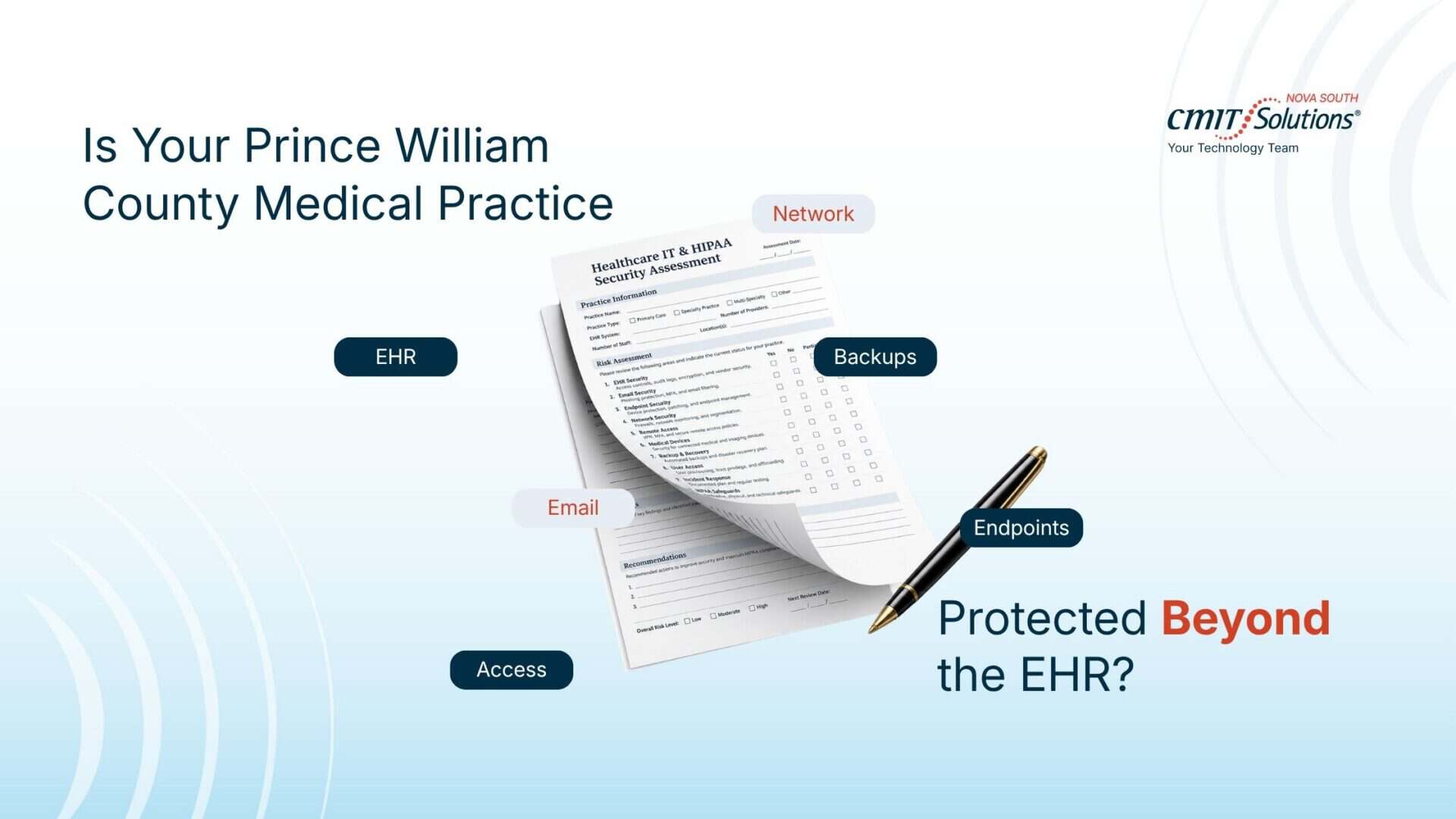
Imagine arriving at your practice on a Monday morning and you are unable to access patient schedules, process paperwork, collect payments, or retrieve information needed for an appointment. Patients are waiting. Appointments are being delayed. Staff are trying to keep the practice running while you figure out what went wrong. And in the middle of it all, you may still be asking: Is patient information safe?
The problem may not be the EHR at all. It could start with a compromised email account, an old user account that was never disabled, an unsecured device, or ransomware affecting systems outside the EHR. That is because patient information moves through far more than the EHR. Email, devices, networks, cloud applications, medical equipment, and third-party systems are all part of the environment that needs to be secured.
For medical practices, protecting patient information requires more than EHR security. It requires a broader approach to healthcare IT security, cybersecurity, and HIPAA safeguards across the entire technology environment.
Why EHR security is not enough to protect patient data
Modern EHR platforms have their own security controls. Depending on the system and configuration, those controls may include authentication, access management, encryption, audit logs, backups, and other safeguards.
But an EHR does not secure the entire environment around it.
A medical practice still has to secure:
- Employee laptops and workstations
- Email accounts
- Wi-Fi and network infrastructure
- Remote access and VPN connections
- Cloud applications
- Mobile devices
- Medical and imaging devices
- File-sharing platforms
- Billing and practice-management systems
- Backup and recovery systems
- Third-party vendors
- User accounts and administrative privileges
The HIPAA Security Rule establishes administrative, physical, and technical safeguards for protecting electronic protected health information (ePHI). It also requires regulated organizations to assess risks and vulnerabilities to the confidentiality, integrity, and availability of that information.
That means a medical practice cannot treat the EHR as the boundary of its cybersecurity program. The real boundary is the entire technology environment.
The technology around your EHR can become the way attackers get to patient data
Consider a common scenario. A provider receives an email that appears to come from a referral partner. They click a link and enter their Microsoft 365 credentials.
The attacker now has access to the provider’s mailbox. From there, they may find patient information, internal communications, documents, links to cloud applications, or information that helps them impersonate the provider. The EHR itself was never hacked. The initial weakness was somewhere else.
This is why cybersecurity for medical practices in Prince William County has to go beyond protecting the application where patient records are stored. It has to address the pathways that lead to those records.
1. Email is part of your healthcare security environment
Medical practices depend heavily on email.
Staff use it for referrals, scheduling, billing, vendor communication, internal coordination, and communication with patients and other providers.
That makes email an attractive target.
A compromised mailbox can expose sensitive information even when the EHR remains secure. Phishing can also lead to stolen credentials that attackers use to access other systems.
OCR’s enforcement activity shows how serious this can become. In April 2025, OCR settled an investigation involving PIH Health after a phishing attack compromised email accounts and exposed ePHI affecting nearly 200,000 individuals.
Ransomware can create an immediate operational problem as well. If critical systems are encrypted, providers may lose access to schedules, billing systems, imaging results, and patient information. That can disrupt patient care, delay appointments, and affect practice revenue.
The lesson for a smaller practice is straightforward:
Your EHR can be secure while your email becomes the way an attacker gets to patient information.
A healthcare cybersecurity program should therefore ask:
- Is MFA enabled on email and other critical accounts?
- Are suspicious messages being filtered?
- Are privileged accounts protected?
- Can unusual account activity be detected?
- What happens when an employee’s credentials are compromised?
- Can access be quickly revoked?
These are areas where cybersecurity services for medical practices can provide ongoing support.
2. Every device that touches patient data matters
A provider may access the EHR from a desktop in the office. A practice manager may use a laptop at home. A nurse may use a mobile device. A billing employee may access a cloud application from another workstation. Every one of those endpoints becomes part of the practice’s security environment.
If one device is compromised, attackers may be able to move further into the network or gain access to credentials and other systems.
This is why healthcare cybersecurity services need to include endpoint protection, patching, monitoring, access controls, and device management; not just EHR configuration.
HHS identifies access controls, audit controls, authentication, integrity protections, and transmission security among the technical safeguards addressed by the HIPAA Security Rule.
The question is not simply:
“Is our EHR secure?”
It is:
“Can we trust every device and connection being used to access our healthcare environment?”
3. Remote access creates another security consideration
Healthcare organizations increasingly rely on remote and hybrid work.
Employees may need to access systems from home. Providers may review information outside the office. Vendors may require remote access for support.
Convenience does not remove the security requirements.
A practice needs to understand:
- Who can access systems remotely
- What devices they can use
- How those users authenticate
- What information they can access
- How remote sessions are monitored
- How access is removed when someone’s role changes
A remote connection that was convenient when it was configured can become a vulnerability if nobody reviews it later.
For practices looking for medical practice IT services Prince William County, remote access management should be part of that conversation.
It is not enough to provide employees with a way to work remotely. The connection needs to be secured, monitored, and managed.
4. Medical devices are part of the IT environment too
Healthcare technology does not stop at computers.
Imaging systems, diagnostic equipment, connected devices, printers, servers, and other technology can all interact with a practice’s network.
That creates another reason healthcare IT security needs to extend beyond the EHR.
A device may perform an important clinical function while also running software, connecting to a network, exchanging information, or relying on another system.
If the practice does not know what is connected to its network, it becomes difficult to understand where vulnerabilities exist.
This is also why risk analysis matters.
HHS guidance explains that risk analysis should identify potential risks and vulnerabilities to ePHI throughout an organization’s environment, including where ePHI is created, received, maintained, or transmitted.
The goal is not to assume every device is dangerous.
The goal is to know what exists, what it connects to, what information it handles, and what safeguards are appropriate.
5. Backups are not just an IT issue
Imagine a practice opens on Monday morning and discovers that several systems are unavailable.
The EHR vendor is operating normally.
But the practice’s local file server, shared drives, or other critical systems have been encrypted by ransomware.
Now the issue is bigger than data security.
Appointments may be disrupted. Staff may lose access to operational information. Billing may stop. Providers may struggle to access what they need.
OCR’s recent enforcement activity shows why ransomware preparedness cannot be treated as an optional IT project.
In April 2025, OCR settled an investigation involving a small neurology practice after ransomware encrypted its IT network and ePHI, potentially affecting approximately 6,800 individuals. OCR found that the practice had failed to conduct an accurate and thorough risk analysis.
And in April 2026, OCR announced four additional ransomware settlements involving breaches affecting more than 427,000 individuals collectively. OCR again emphasized the importance of HIPAA Security Rule risk analysis and safeguards.
For a medical practice, the question should not be:
“Does our EHR vendor have backups?”
It should be:
“If our technology environment is disrupted tomorrow, what can we actually recover, how quickly can we recover it, and has that recovery process been tested?”
That is where cybersecurity services in Prince William County can become part of business continuity, not just threat prevention.
6. Employee access changes over time
Healthcare organizations have a constant flow of employees, contractors, providers, and other users. Someone joins the practice. Someone changes roles. Someone leaves. Someone needs temporary access. Someone needs administrative privileges. Every change creates an access-management question.
The HIPAA Security Rule requires organizations to implement policies and procedures around workforce security and information access management, including appropriate authorization for access to ePHI.
That makes user access management an important part of medical practice cybersecurity Prince William County.
A strong process should address:
- New-user provisioning
- Role-based access
- MFA
- Privileged accounts
- Authentication controls
- Access reviews
- Employee offboarding
- Device recovery
- Remote-access removal
The goal is simple: People should have the access they need, and no more than they need.
HIPAA compliance is bigger than documentation
It is easy to think about HIPAA compliance in Prince William County as a documentation exercise.
Policies matter.
Training matters.
Business associate agreements matter.
Documentation matters.
But HIPAA compliance also depends on whether the technology environment actually supports those policies.
HHS identifies risk analysis as a foundational part of the Security Rule. Organizations need to identify risks and vulnerabilities to ePHI and implement reasonable and appropriate safeguards based on those risks.
OCR’s recent enforcement activity reinforces the same point.
In the 2025 Comprehensive Neurology case, OCR found that the practice failed to conduct an accurate and thorough risk analysis of its ePHI environment before ransomware disrupted its systems. The resulting corrective action plan included risk analysis, risk management, revised policies and procedures, and workforce training.
So HIPAA compliance services for medical practices in Prince William County should not stop at policy templates.
The technology, people, processes, and documentation need to work together.
What medical practices should look for beyond their EHR
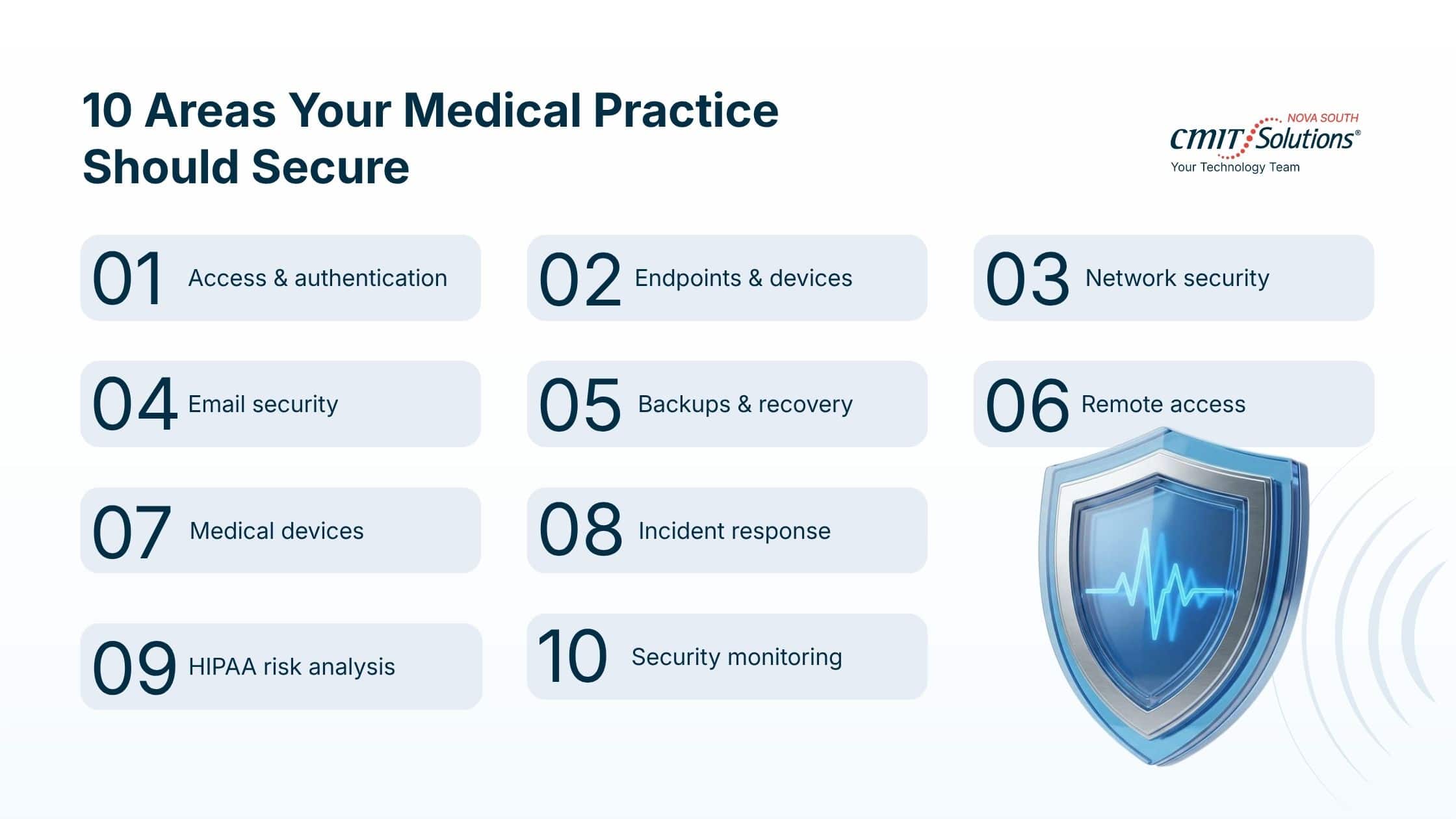
A healthcare-focused IT strategy should connect the pieces instead of treating them as separate projects.
That means looking at:
-
Access
Who can access patient information, from where, and using what authentication?
-
Endpoints
Are laptops, desktops, mobile devices, and other endpoints protected and monitored?
-
Network security
Can the practice detect unusual activity or unauthorized access?
-
Email security
Are phishing, credential theft, and suspicious messages being addressed?
-
Backups
Are critical systems and data backed up, protected, and recoverable?
-
Remote access
Can employees and vendors access systems securely outside the office?
-
Medical devices
Does the practice know which connected devices are on the network and what risks they create?
-
Monitoring
Who notices a potential security incident if it happens overnight or over the weekend?
-
Incident response
Does everyone know what happens when patient data may have been compromised?
-
Risk analysis
Has the practice assessed the risks across its entire environment, and not just its EHR?
These are the areas where managed IT services for medical practices can become more than a help desk.
The right provider can help connect day-to-day IT management with cybersecurity and HIPAA requirements.
How managed IT services help medical practices stay HIPAA compliant
A medical practice does not necessarily need a large internal IT department to build a stronger security environment.
Managed IT services for medical practices in Prince William County can provide an ongoing layer of technology management and security.
Depending on the practice’s needs, that can include:
- 24/7 monitoring
- Endpoint protection
- Email security
- MFA implementation
- Patch and update management
- Backup and disaster recovery
- Secure remote access
- Network management
- Access management
- Security awareness training
- Incident response
- HIPAA risk assessments
- Compliance documentation support
The important distinction is that managed IT should not operate separately from compliance.
HHS explains that regulated organizations should perform risk analysis, implement appropriate safeguards, document their policies and procedures, and periodically evaluate their security environment.
That makes ongoing IT management especially relevant for smaller healthcare organizations that may not have a full internal IT or security team.
What this means for medical practices in Prince William County
A medical practice does not need the IT budget of a large health system to take patient data security seriously.
But it does need to understand where its responsibility starts and where its technology vendors’ responsibility ends.
Your EHR vendor secures its platform.
Your practice is responsible for the broader environment in which that platform operates.
That includes the devices employees use to access it, the accounts they use, the network they connect through, the applications they use alongside it, the vendors they share information with, and the processes used when something goes wrong.
That is why cybersecurity for small medical practices cannot be reduced to buying another security product or asking an EHR vendor whether its software is HIPAA compliant.
The question is bigger:
Can your entire technology environment protect patient information before, during, and after a cyber incident?
For practices looking for HIPAA compliant IT services in Prince William County VA, that broader view is the place to start.
Building a stronger healthcare IT environment in Prince William County
Medical practices across Prince William County depend on technology for nearly every part of patient care and daily operations.
The EHR is central to that environment.
It is not the whole environment.
A practice can have a secure EHR and still have a vulnerable email account, an unmanaged laptop, excessive user access, an unprotected network, an untested backup, or a remote connection nobody reviews.
That is why healthcare cybersecurity services in Prince William County VA need to connect cybersecurity, IT management, and HIPAA requirements rather than treating them as separate concerns.
CMIT Solutions NOVA South provides medical practice IT support in Prince William County VA, combining managed IT, cybersecurity, and HIPAA-focused support for healthcare organizations.
For a practice evaluating its current environment, the first step is not buying another tool.
It is understanding what you have, where patient information moves, who can access it, and where the gaps are.
From there, you can build a security environment designed around how your practice actually operates.
Need to Know Where Your Practice Stands?
A security assessment can help uncover gaps across your EHR, email, endpoints, network, remote access, backups, and other systems that handle or connect to patient information.
If you are unsure whether your current IT environment is doing enough to protect patient data, start with the fundamentals. CMIT Solutions NOVA South provides healthcare cybersecurity services in Prince William County VA, managed IT support, and HIPAA-focused technology services for medical practices that need help identifying and addressing security risks around ePHI.
Frequently Asked Questions
1. Is an EHR system enough to protect patient data?
No. EHR security is an important part of protecting patient data, but an EHR does not secure every system surrounding it. Medical practices also need to protect email, endpoints, networks, remote access, cloud applications, connected devices, backups, user accounts, and third-party systems that may interact with ePHI.
HIPAA’s Security Rule applies to ePHI throughout the organization’s environment, not only information stored inside an EHR.
2. Why do medical practices in Prince William County need cybersecurity beyond their EHR?
Medical practices use many systems alongside their EHR. A compromised email account, laptop, network, remote-access connection, or other application can create security risks even when the EHR itself has not been breached.
That is why cybersecurity for medical practices in Prince William County should address the entire technology environment.
3. How does cybersecurity help medical practices maintain HIPAA compliance?
Cybersecurity helps practices implement safeguards that support HIPAA’s requirements for protecting the confidentiality, integrity, and availability of ePHI.
Depending on the organization’s risk assessment, this can include access controls, authentication, audit controls, encryption, endpoint protection, monitoring, backups, and incident-response procedures.
HIPAA compliance is an ongoing process. HHS recommends that regulated entities periodically evaluate their security measures and regularly reevaluate potential risks to ePHI.
4. What are the biggest cybersecurity threats facing medical practices?
Healthcare organizations face threats including ransomware, phishing, stolen credentials, unauthorized access, malware, and other forms of hacking.
OCR continues to identify hacking and ransomware as significant threats to electronic health information and has continued HIPAA ransomware enforcement activity through 2026.
5. Can managed IT services help protect patient data?
Yes. Managed IT services for medical practices can provide ongoing monitoring, endpoint protection, patch management, backup management, access controls, email security, network management, and other technology safeguards.
For healthcare organizations, managed IT can also help connect day-to-day technology management with HIPAA security requirements.
6. What should a medical practice do if patient data is compromised?
The practice should activate its incident-response process, contain the incident, preserve relevant information, determine what systems and information were affected, and assess its notification obligations.
Because HIPAA breach requirements can depend on the circumstances, practices should involve appropriate legal, compliance, and cybersecurity professionals rather than assuming every incident has the same notification requirements.
7. How can a medical practice improve its cybersecurity beyond EHR protection?
Start with an accurate risk analysis of the entire environment.
Identify where ePHI is created, received, maintained, and transmitted. Review users and access permissions. Evaluate endpoints, email, networks, remote access, connected devices, backups, vendors, and incident-response procedures. Then implement and regularly review safeguards based on the risks identified.
That broader assessment is the foundation of healthcare IT security, and the starting point for building a stronger cybersecurity program around your EHR rather than relying on the EHR alone.


