In late 2025, a private multi-specialty physician group serving a metro area in Florida discovered that attackers had broken into its network over the course of a few days. The intrusion exposed sensitive patient information, including Social Security numbers, driver’s license numbers, financial account details, and medical records. The practice later reported that more than 275,000 patients across its clinics had been affected.
That was an independent practice, not a hospital chain, and it carried the fallout on its own. Large hospital systems keep reserves, redundant systems, and response teams to ride out an attack. Many independent practices have none of that, and for some, a single serious breach could be the event that ends the business.
For an independent clinic in Prince William County, a ransomware event can put the survival of the business at risk. Somu Valliappan, Managing Partner of CMIT Solutions of NOVA South, understands these risks. Before entering the managed IT industry, he spent more than a decade building healthcare data systems and working with protected health information under HIPAA. He has watched small clinics take significant damage from cyberincidents that would barely register at a hospital.
Why a small clinic feels ransomware harder than a hospital
A hospital has layers of protection that a small practice rarely can afford. It runs a dedicated security team, keeps an incident response firm on retainer, carries cyber insurance, and holds enough cash to survive a bad month. When systems go down, a hospital has redundancy and staff to work around the outage.
An independent clinic operates on a different scale. Often one office manager handles the technology alongside a dozen other jobs. The practice depends on a single electronic health record system and a thin margin. When ransomware locks that system, the clinic cannot see patients, but the rent and the payroll do not pause. A week of downtime that a hospital can absorb can put a five-provider practice in real financial danger.
The compliance weight is identical either way. A solo family practice in Wood bridge answers to the same HIPAA Security Rule as a regional hospital, without the same budget to meet it. Attackers understand this imbalance. Smaller targets tend to have softer defenses and a stronger reason to pay quickly, because every day offline is a day negatively impacting patient care and revenue.
What the numbers show
Healthcare has been the most expensive industry for data breaches for more than a decade. IBM reported that the average healthcare breach cost $9.77 million in 2024, higher than any other sector.
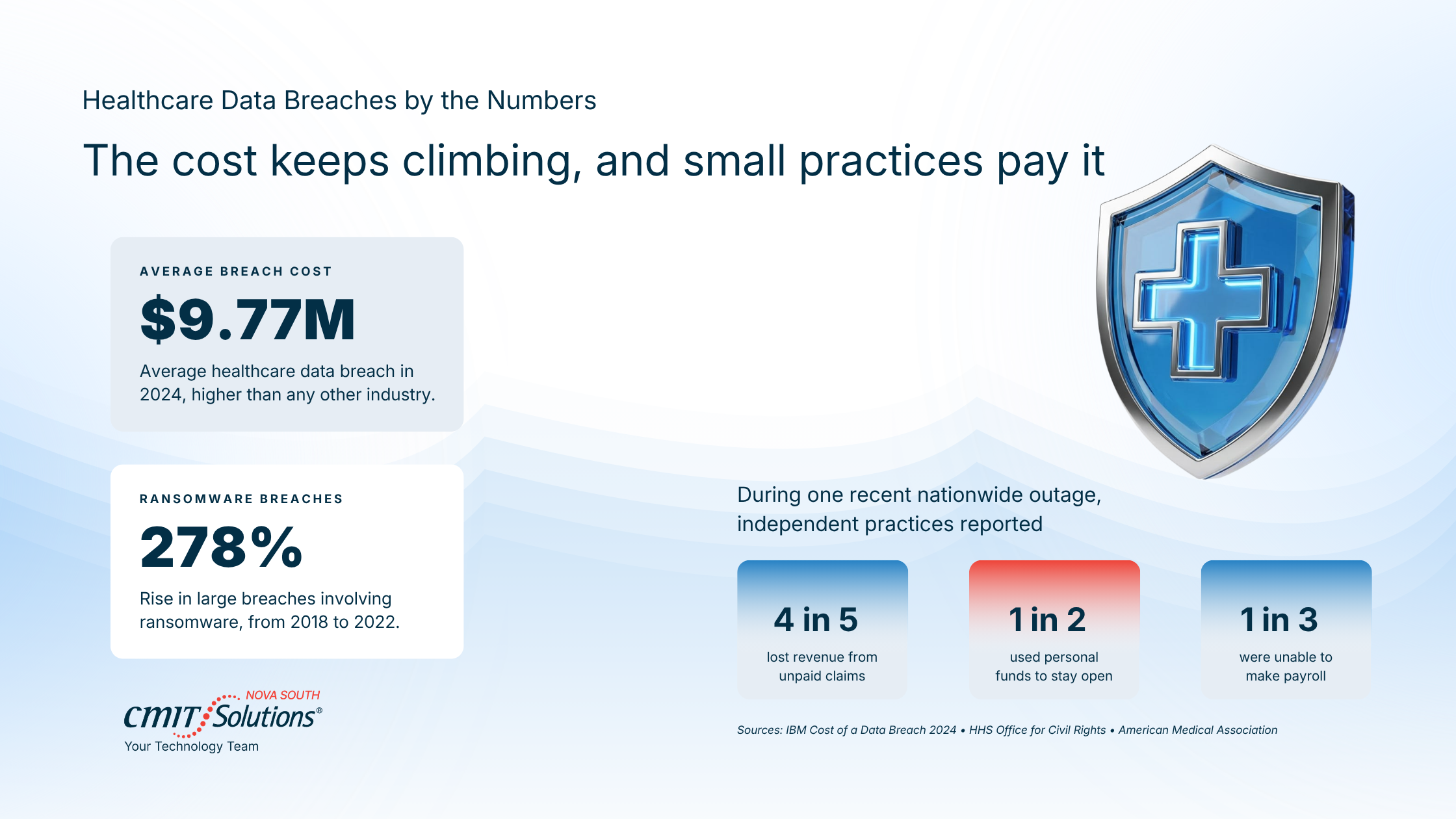
The volume is climbing too. The U.S. Department of Health and Human Services reported a 278 percent increase in large breaches involving ransomware between 2018 and 2022.
The fallout from that outage put the small-practice toll in plain view. In an American Medical Association survey taken during the disruption, four in five practices reported lost revenue from unpaid claims, more than half said they had tapped personal funds to keep the practice running, and roughly a third said they were unable to make payroll. Those are the kinds of problems that fall hardest on small practices.
How managed cybersecurity services change the odds
Effective ransomware protection for healthcare practices requires two capabilities: preventing attacks wherever possible and recovering quickly when prevention fails. Keep attackers out, and make sure that if one does get in, you can recover without paying. Managed cybersecurity services for Prince William practices are built to do both without the cost of an in-house security department.
The prevention side covers the common entry points. Multi-factor authentication on every account. Email filtering, since phishing is still how most ransomware arrives. Endpoint monitoring that flags unusual activity before it spreads. Regular patching so known holes are closed. Staff training so the front desk knows what a fake invoice looks like.
The recovery side is what actually saves a practice. Backups that are isolated from the main network and tested on a schedule mean a locked server becomes a bad day rather than a closed clinic. Somu has seen how often a small practice believes it has backups until the day it needs them and finds they never worked. Real healthcare data breach prevention includes being able to restore your records and keep seeing patients even after something gets through.
This is the work CMIT Solutions of NOVA South does for cybersecurity for small medical practices across Prince William County. Cybersecurity services for small businesses in Prince William, scaled and priced for a clinic rather than a hospital, backed by the CMIT national network of more than 300 offices.
Start with a cybersecurity risk assessment
You cannot protect what you have not measured. A cybersecurity risk assessment in Prince William gives a practice a clear picture of where it actually stands. It shows where protected health information lives, who can reach it, whether multi-factor authentication is turned on everywhere, and whether those backups truly restore.
A cybersecurity risk assessment for healthcare is also a HIPAA obligation, not an optional exercise. The Security Rule requires a risk analysis, yet many small practices have never completed a real one. That assessment is usually where the most dangerous gaps come to light, well before a criminal finds them first.
The goal is not to eliminate every cyberrisk, but to make sure a security incident becomes a manageable disruption instead of a business crisis.
Is Your Practice Prepared?
A ransomware attack should not be the event that decides whether your clinic survives. For an independent practice in Prince William County, the right preparation turns a potential catastrophe into a manageable incident. CMIT Solutions of NOVA South brings healthcare and compliance experience together with managed cybersecurity services built for small practices across Wood bridge, Manassas, and the wider Northern Virginia area. To find out where your defenses stand today, book a cybersecurity risk assessment with our team at cmitnovasouth.com or you can also call or text us on (571) 720-9555.
Frequently asked questions
Why are independent medical practices vulnerable to ransomware attacks?
They hold valuable patient data but usually lack a dedicated security team. Limited budgets and aging systems, combined with staff who already wear many hats, make small practices easier to breach than well-defended hospital networks.
Why can ransomware have a greater impact on small clinics than hospitals?
Hospitals have financial reserves, redundant systems, and incident response resources to absorb an outage. A small clinic often has none of that, so downtime quickly threatens its ability to pay staff and stay open.
How can Prince William County medical practices protect against ransomware?
Start with multi-factor authentication, email filtering, continuous monitoring, and isolated, tested backups. Pairing those measures with managed cybersecurity services gives a small practice enterprise-level protection at a workable cost.
What healthcare cybersecurity measures should independent clinics prioritize?
Tested offline backups, multi-factor authentication, email security, timely patching, and staff awareness training deliver the most protection for the money. Recoverable backups matter most during ransomware recovery, since they remove the pressure to pay a ransom.
How does a cybersecurity risk assessment help medical practices?
It identifies where patient data lives, who can access it, and which defenses are missing. It also satisfies the HIPAA compliance requirement for a risk analysis and gives the practice a prioritized plan to fix its biggest gaps.
Can managed cybersecurity services protect a clinic from ransomware?
Yes. A managed IT service provider for healthcare monitors systems around the clock, keeps defenses current, and maintains recoverable backups, which greatly reduces both the chance of an attack and the damage if one occurs.
What should a medical practice do immediately after a ransomware attack?
Disconnect affected systems to stop the spread, contact your IT or security provider and legal counsel, preserve evidence, and begin your breach notification obligations under HIPAA. Do not pay or negotiate before consulting professionals.