Cybercriminals intentionally strike during this time, knowing that many businesses run with fewer resources and limited oversight — making them easier to attack.
By working with cybersecurity consulting services, organizations can:
- Assess risks.
- Close security gaps.
- Align defenses with evolving threat landscapes.
This guide provides an actionable framework to fortify your defenses and protect your business operations — helping you move from a reactive to a prepared security posture. Let’s begin by highlighting the essential strategies for safeguarding your business.
How Do Businesses Protect Themselves From Cyberattacks?
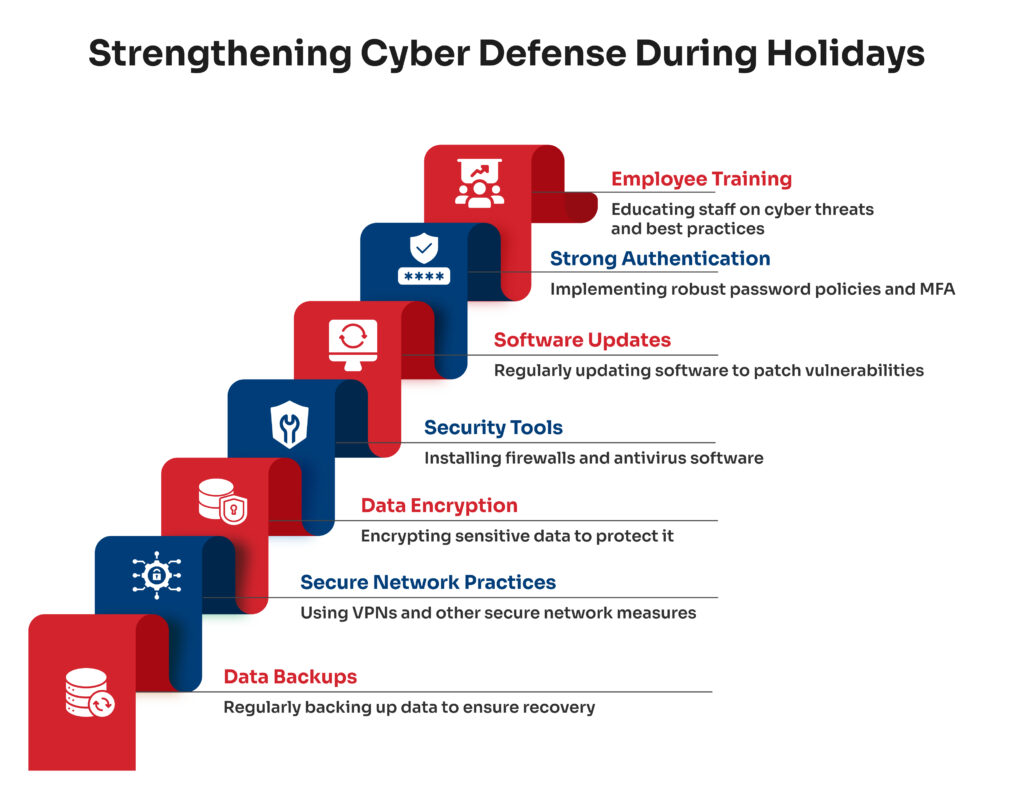
Therefore, to protect against cyberattacks during holidays, businesses follow a layered approach, including:
- Training employees
- Using strong passwords and Multi-Factor Authentication (MFA)
- Regularly updating software
- Installing firewalls and antivirus software
- Encrypting data
- Implementing secure network practices (like VPNs)
- Having regular data backups
While these measures form the foundation of a strong defense, it’s important to understand why ransomware threats escalate during the holiday season — let’s take a look at this next.
The Predictable Storm: Why Ransomware Threats Escalate During Holidays
The first major weakness they target is understaffed IT and security teams — a direct consequence of employee vacations.
- One study found that 78% of global companies cut their Security Operations Center (SOC) staffing by 50% or more during holidays.
- Hackers are fully aware of these skeletal crews and intentionally launch their holiday ransomware attacks on weekends and holidays to exploit the inevitable slowdown in detection and response.
- Research confirms this tactic, with recent findings showing that roughly half of ransomware attacks occur during weekends or holidays.
Beyond staffing shortages, another critical vulnerability is the distracted workforce.
- Preoccupied with holiday plans and festivities, employees are far less vigilant and more likely to unintentionally click on malicious links or fall for increasingly sophisticated phishing campaigns.
- Phishing attacks have risen significantly during this period, as threat actors weaponize legitimate services to impersonate common holiday activities.
- For example, tailored scams like fraudulent charity appeals, fake online order confirmations, and gift package delivery notifications specifically prey on the holiday spirit.
This time of year also sees a massive surge in online shopping and financial transactions across all sectors.
- This increase in digital commerce creates a much larger attack surface — providing cybercriminals with more opportunities to strike.
- Consequently, hackers operate on the belief that companies, facing operational paralysis during a critical revenue period, are more willing to pay a ransom to restore systems quickly.
Understanding these targeted strategies is the first step; the next is to build a resilient technical defense to counter them.
Also Read: Is Your Business Ready for AI-Powered Cyberattacks: Readiness Check
Essential Technical Preparations for Your Network Security
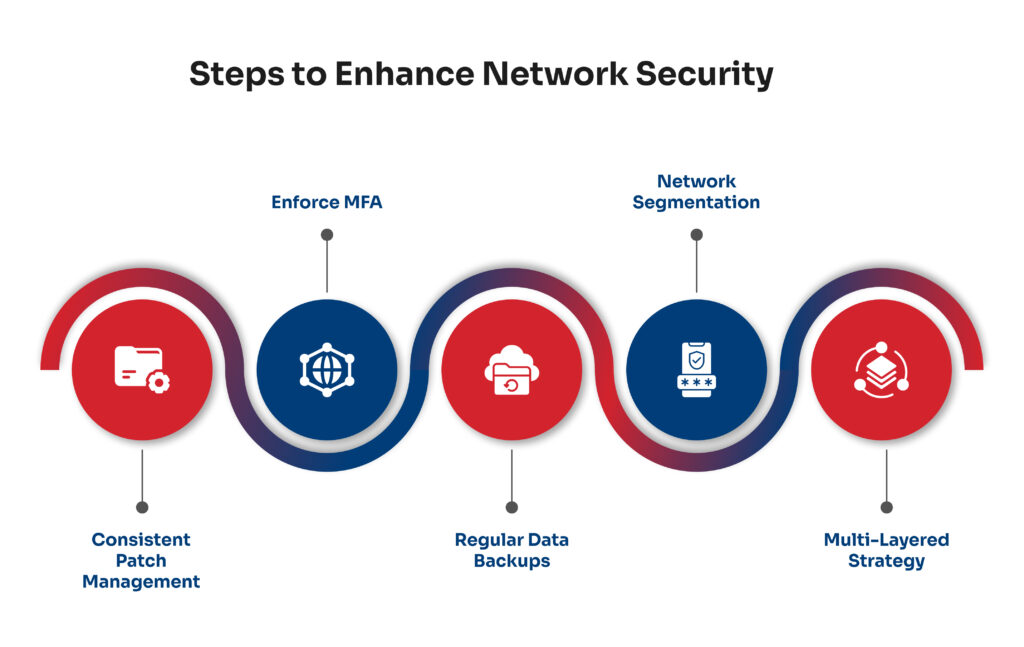
Your first line of defense is consistent patch management.
- Prioritize regular software updates to safeguard systems against known software vulnerabilities that attackers frequently exploit.
By regularly updating operating systems, browsers, and other applications, you close the very security loopholes that cybercriminals target.
However, as you fortify your software, threat actors shift tactics; they’re increasingly using stealthier, identity-based attacks that rely on compromised credentials or abused access rights to enter networks.
- One major cybersecurity report found that identity-based attacks dominated incident response cases last year, with nearly 70% of confirmed ransomware incidents beginning with valid accounts.
Therefore, enforcing MFA is a non-negotiable step to counter these identity-based attacks, as compromised credentials remain one of the most common entry points for cybercriminals.
- Activate MFA for all privileged accounts without exception.
While prevention is key, your ultimate safety net is regular data backups, which allow you to recover without paying a ransom.
- Follow the “3-2-1 backup” rule to provide a clear framework for data resilience. This rule means keeping three copies of your data on two separate storage types, with one copy stored offline and offsite.
Beyond these fundamentals, consider network segmentation. This advanced control is a powerful strategy to contain a potential breach.
- Divide the network into smaller, isolated segments to prevent ransomware from spreading to other critical systems if one part is compromised.
This raises a critical question: “What is the most effective way to protect against ransomware attacks?”
- The best ransomware protection is a “multi-layered strategy” focusing on prevention (updates, security software, user training) and resilience (offline, immutable data backups) — using tools like Windows Security, MFA, and email filters — to stop infections while ensuring you can restore data from clean backups if an attack succeeds.
However, technology alone isn’t enough to ensure resilience against holiday ransomware attacks. These technical defenses must be supported by a well-defined incident response plan, especially one designed to function with reduced holiday staffing — let’s explore this next.
Building a Resilient Holiday Response Plan for a Reduced Team
- Statistics show that one-third of organizations attacked during a holiday struggle to assemble their response team quickly.
With understaffed IT/security teams, the risk of an undetected breach increases sharply — potentially leading to critical data loss and extended downtime.
To avoid losing precious time, plan your holiday response team in advance.
- You don’t need a full staff — a dedicated skeleton crew on a documented on-call rotation is essential for emergencies. Every team member must know where to find documentation and what the escalation paths are.
- Establish clear escalation paths that can bypass normal approval chains — empowering your on-call team to act swiftly during a crisis.
Don’t forget the human element, which is often your greatest vulnerability.
- Employee burnout becomes a critical security risk during the holidays, as fatigued teams are more prone to errors.
- Ensure any team members pulled away from family time receive significant compensation or bonuses — this recognition is key to maintaining morale and preventing burnout.
No incident response plan is truly effective until it undergoes proper validation.
- The goal is to confirm your incident response plan is effective with a skeleton crew and to identify any single points of failure (personnel).
- Conduct tabletop exercises — the best way to see how your procedures hold up against a holiday ransomware attack. For example:
- Simulate an attack at 3 AM on Christmas Eve to test your reduced holiday team.
- Pre-identify and train secondary responders for every critical role.
- Confirm that your backup restoration procedures can be executed by junior staff if senior personnel are unavailable.
By addressing these critical human factors, you fortify your team alongside your technology — creating the comprehensive security posture needed to truly weather the holiday storm.
Secure Your Business Now for a Cyber Resilient Holiday Season
Ultimately, this proactive approach is not just about preventing ransomware — it’s about building genuine cyber resilience to ensure business continuity through any disruption.
Are you a business in Franklin Township, NJ, seeking a reliable IT services provider? At CMIT Solutions, Princeton, we help your business stay secure during high-risk periods like the holidays with proactive cybersecurity, ransomware protection, and rapid incident response.
Connect with us today for a comprehensive IT assessment!