
IT downtime can cost a small manufacturing business far more than the hours employees spend waiting for systems to come back online. A network failure, server outage, ransomware incident, or ERP disruption can stop production, delay shipments, increase labor costs, and affect customer relationships. The actual Manufacturing downtime cost depends on how many operations are affected, how long recovery takes, and whether the business can continue working without its technology.
For small manufacturers and distributors, even a relatively short technology disruption can create financial consequences that extend beyond the initial outage.
Why Does IT Downtime Matter for Manufacturers in Anaheim and San Bernardino County?
Manufacturing businesses across Anaheim, Orange County, and San Bernardino County depend on connected technology to coordinate production, inventory, procurement, shipping, and customer orders.
A typical manufacturing operation may rely on:
- ERP systems for production planning, purchasing, and inventory management.
- Manufacturing execution systems (MES) for monitoring production activities.
- Industrial networks connecting machines, sensors, and operational technology (OT).
- Warehouse management systems for inventory tracking and order fulfillment.
- Cloud applications for communication, documentation, and collaboration.
- Barcode scanners, label printers, and connected production equipment.
When one critical system becomes unavailable, other departments may lose access to the information they need. For example, a production team might be ready to begin an order, but an unavailable ERP system prevents employees from accessing updated work instructions or material requirements. Meanwhile, warehouse employees cannot confirm inventory availability, and shipping teams cannot prepare accurate delivery documentation. This is why the cost of IT downtime for small businesses should be evaluated across the entire operation, not just the department experiencing the initial technical problem.
Businesses looking for business IT support in San Bernardino should consider whether their technology provider understands manufacturing operations, connected infrastructure, and the systems that keep production moving. Specialized managed IT services for manufacturing can help businesses monitor critical infrastructure, maintain network reliability, and prepare for unexpected disruptions. Manufacturers requiring Manufacturing network support also need visibility into the connections between office networks, production equipment, warehouse systems, and business applications. For organizations in the region, managed IT services San Bernardino can provide an outsourced approach to monitoring, maintenance, cybersecurity, and recovery planning.
What Are the Main IT Downtime Costs for Small Manufacturers?
The financial impact of an outage usually comes from several sources. Some are immediately visible, while others appear later through delayed orders, overtime, and customer dissatisfaction.
Here are five major cost categories.
1. Lost Production and Revenue
When production equipment or supporting technology stops working, manufacturing output can decline or stop entirely. Employees may be unable to access production schedules, machine instructions, quality records, or inventory information. Even if the physical machinery remains operational, missing digital information can prevent work from continuing safely and efficiently. These IT downtime costs for small manufacturers can include lost production hours, delayed orders, reduced capacity, and missed delivery commitments.
2. Employee Labor Costs
Employees continue to represent a business expense during downtime. Machine operators, warehouse workers, supervisors, administrative staff, and production planners may have limited productive work while essential systems remain unavailable. Once systems return, employees may also need additional time to recover interrupted tasks, reconcile records, and complete delayed orders.
3. Supply Chain and Delivery Disruptions
Manufacturers rarely operate independently of suppliers, distributors, and customers. An outage affecting procurement or inventory management can delay material purchases and production schedules. Distributors may miss shipping windows, while customers may experience delayed deliveries. The consequences can include expedited shipping expenses, additional coordination, contractual penalties where applicable, and strained business relationships.
4. Recovery and Technical Expenses
Restoring technology after an outage may require emergency troubleshooting, hardware replacement, data recovery, external technical assistance, and additional labor. A cybersecurity incident can create further expenses if systems need to be isolated, investigated, cleaned, and restored from backups.
5. Customer Confidence and Future Business
Repeated delivery delays and communication problems can affect customer confidence. Manufacturers supplying larger businesses often work within established delivery schedules. If they cannot provide accurate order updates or meet agreed timelines, customers may reconsider future orders. These indirect consequences make Unplanned IT downtime costs for manufacturers difficult to calculate using lost production hours alone.
How Can You Calculate Manufacturing Downtime Cost?
A practical way to estimate downtime expenses is to calculate the direct operational losses first, then add recovery and indirect costs.
Use this formula:
Total downtime cost = Lost production value + Idle labor + Recovery expenses + Additional operating costs + Estimated indirect losses
Consider this hypothetical example of a small manufacturing facility experiencing a two-hour technology outage.
| Cost category | Illustrative cost |
|---|---|
| Lost production contribution | $1,500 |
| Idle employee labor | $700 |
| Emergency IT recovery | $400 |
| Rescheduling and additional operating costs | $250 |
| Estimated total | $2,850 |
This example is illustrative, not an industry average or a prediction of actual losses. The calculation also excludes potential longer-term consequences, such as lost customers or future orders.
To estimate your own Manufacturing downtime cost, document the following:
- Average production value or contribution per hour.
- Number of employees affected by the disruption.
- Critical systems that become unavailable.
- Additional expenses required to resume operations.
- Orders, shipments, or customer commitments affected.
Businesses should also distinguish between revenue and profit contribution. Counting an entire delayed order as lost revenue can overstate the actual financial impact if the order is eventually fulfilled.
Assess Your Manufacturing IT Downtime Risks
How Can Manufacturers Reduce Production Downtime?
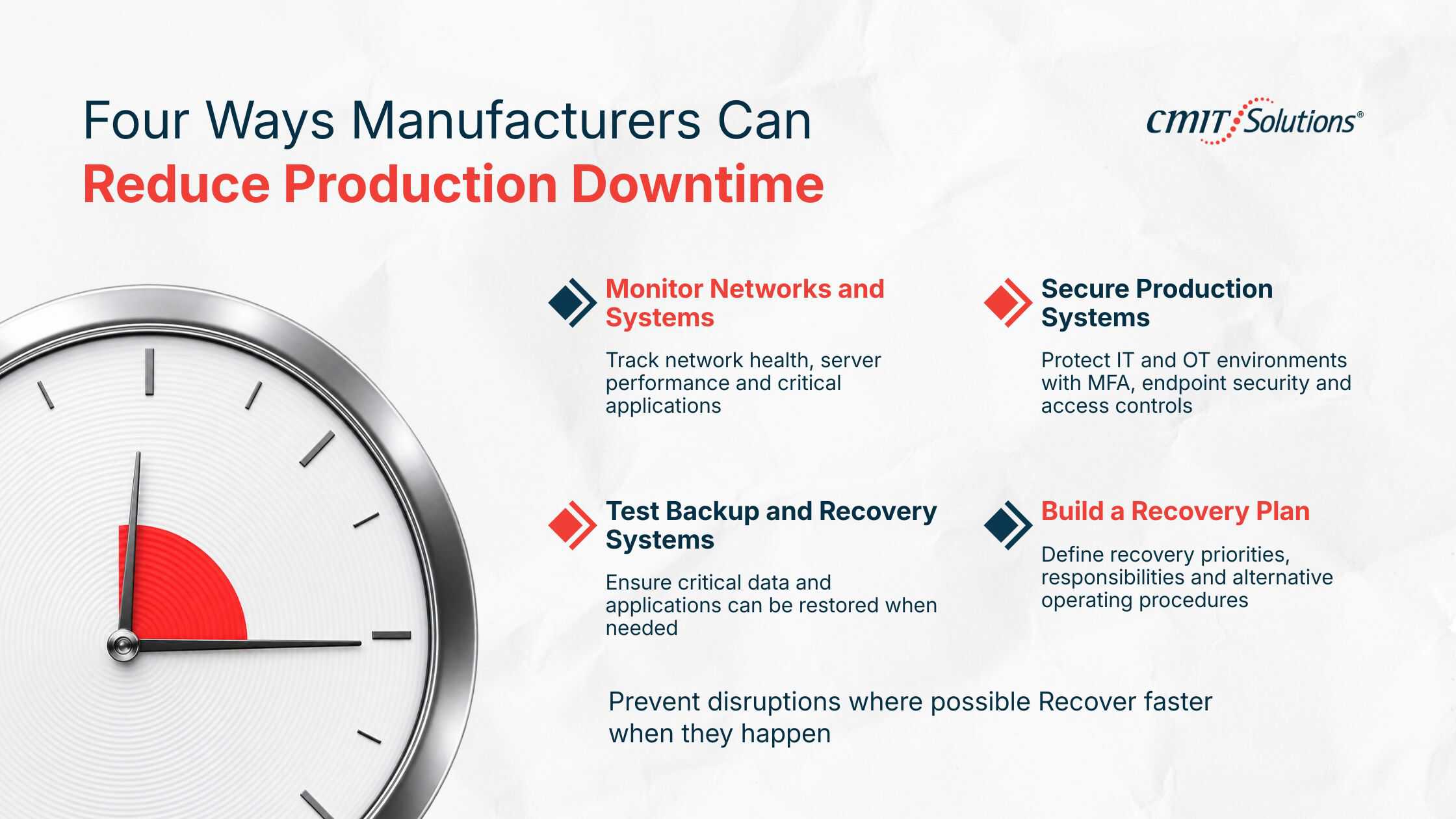
Preventing every technology failure is unrealistic. However, manufacturers can reduce the likelihood of disruptions and improve recovery when problems occur. Four practices deserve attention.
1. Monitor Networks and Critical Systems
Proactive monitoring helps identify unusual network activity, hardware performance issues, connectivity problems, and system failures before they interrupt operations.
Manufacturers should monitor:
- Network availability and bandwidth.
- Server and storage performance.
- Firewall and endpoint activity.
- Wireless connectivity across production and warehouse areas.
- Backup completion and system health.
- Critical application availability.
Read more about network monitoring best practices for preventing downtime.
2. Protect Production Systems From Cyber Threats
Manufacturing environments often connect business IT systems with operational technology. This creates additional security considerations. A compromised employee account, infected workstation, or poorly secured network connection could affect systems that support production.
Manufacturers should prioritize:
- Multi-factor authentication.
- Endpoint detection and protection.
- Regular security updates.
- Network segmentation between IT and OT environments.
- Restricted access to critical systems.
- Employee cybersecurity awareness.
- Documented incident response procedures.
The NIST NCCoE manufacturing cybersecurity guidance provides sector-specific resources for protecting connected manufacturing environments.
3. Maintain and Test Backup and Recovery Systems
Having backups does not automatically mean a business can recover quickly. Manufacturers should verify that critical production data, business applications, configuration files, and operational records can be restored. Recovery testing should establish whether backups are accessible, complete, and usable. Businesses should also document who is responsible for restoring systems and which applications must return first.
4. Establish a Business Continuity and Disaster Recovery Plan
A recovery plan should explain what employees must do when critical systems become unavailable. It should identify essential applications, recovery priorities, responsible personnel, backup procedures, and alternative operating arrangements. For more guidance, see business continuity planning for Orange County SMBs. NIST also provides specific guidance on responding to and recovering from a cyberattack in manufacturing.
When Should a Manufacturer Consider Managed IT Support?
Manufacturers should evaluate their IT support arrangements when technology problems repeatedly interrupt production, employees struggle to resolve recurring issues, or recovery procedures depend on one individual. A dedicated internal IT employee may not have the capacity or specialist knowledge to manage networking, cybersecurity, cloud infrastructure, backups, and OT-related dependencies simultaneously. This is where Managed IT services for manufacturing can provide additional operational support. CMIT Solutions Anaheim supports businesses with IT support and maintenance, network monitoring, cybersecurity, cloud solutions, and data backup and recovery services. Its service area includes Anaheim, Orange County, Los Angeles County, Riverside County, and San Bernardino County. For manufacturers and distributors, the priority should be an IT support arrangement that understands how technology failures affect production schedules, inventory accuracy, warehouse operations, and customer commitments. Businesses evaluating Manufacturing IT services , IT support for manufacturers , or Managed IT services for manufacturers in San Bernardino County should assess their provider’s monitoring capabilities, backup practices, recovery procedures, and understanding of manufacturing infrastructure. Explore CMIT Solutions Anaheim’s IT support services to understand how proactive IT support can help reduce technology-related disruptions.
If your manufacturing operation depends on technology to keep production and deliveries on schedule, review your current IT infrastructure before the next outage affects your business. Contact CMIT Solutions Anaheim to discuss your manufacturing IT support requirements.
Frequently Asked Questions
How does IT downtime affect supply chain operations?
IT downtime can interrupt purchasing, inventory tracking, production scheduling, order processing, and shipping. These disruptions can delay supplier coordination, affect delivery commitments, and create additional operating expenses.
Can a manufacturing business continue operating without internet access?
Sometimes. Local systems and equipment may continue functioning, but cloud applications, remote access, communications, and online integrations may become unavailable. Continuity depends on infrastructure design and offline procedures.
What is a good recovery time objective (RTO) for a manufacturing company?
There is no universal RTO. Manufacturers should establish recovery targets based on production dependencies, financial exposure, customer commitments, and the availability of alternative processes.
What is the difference between RTO and RPO in disaster recovery?
RTO measures the acceptable time required to restore a system. RPO defines how much data loss, measured in time, a business can tolerate after an incident.
How can manufacturers monitor network performance across multiple facilities?
Use centralized network monitoring to track connectivity, device health, bandwidth, server performance, and security alerts across locations. Configure alerts for critical systems and review recurring performance issues.
What should a manufacturing business include in an IT disaster recovery plan?
Include critical system inventories, recovery priorities, backup procedures, RTO and RPO targets, assigned responsibilities, communication procedures, vendor contacts, and regularly tested recovery steps.
Should small manufacturers hire an in-house IT team or outsource IT support?
It depends on operational complexity and internal resources. Outsourced IT can provide broader technical coverage, while larger operations may benefit from a hybrid model combining internal expertise with external support.
How can manufacturers prepare their IT systems for unexpected power outages?
Use appropriately sized UPS systems for critical equipment, maintain tested backups, protect network infrastructure, document safe shutdown procedures, and establish recovery priorities for essential production systems.


