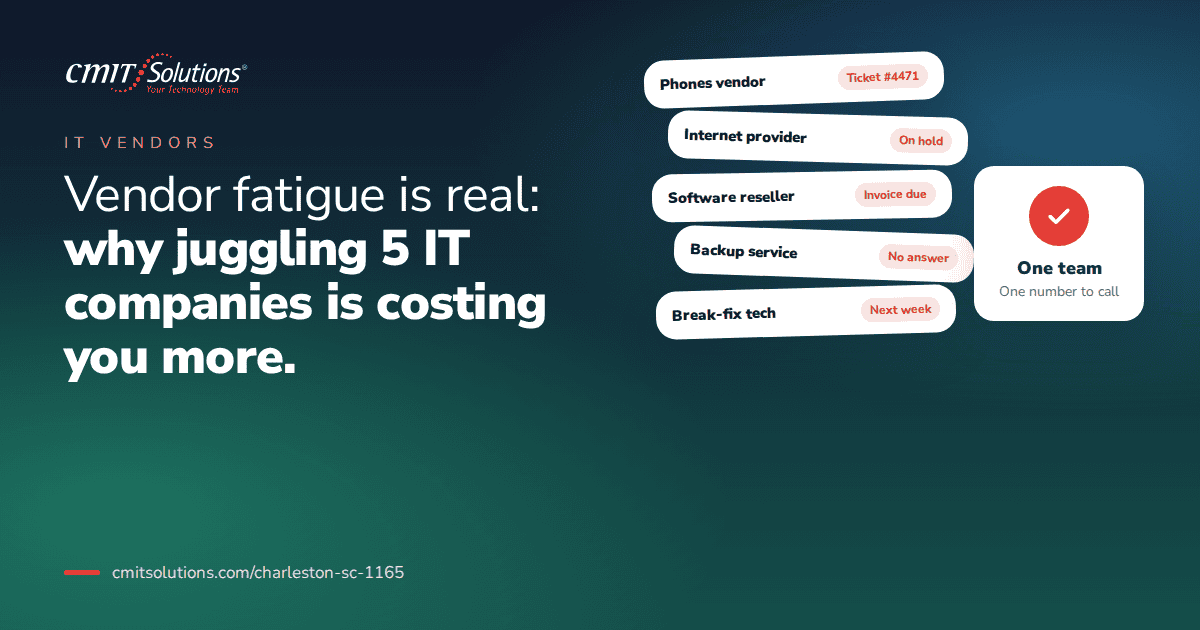
One company handles the network. Another manages the phones. A third takes care of cybersecurity, when anyone remembers to call them. A fourth handles the website, and a fifth shows up occasionally for hardware repairs. On paper, it looks like coverage. In practice, it’s a business owner spending Tuesday afternoons playing referee between five different vendors, none of whom fully understand what the others are doing.
This is vendor fatigue, and it’s one of the quietest, most expensive problems in small business technology. It doesn’t show up as a single bad invoice. It shows up as slow response times, finger-pointing during outages, and a technology budget that keeps growing without anyone being able to explain exactly why.
What Vendor Fatigue Actually Looks Like
Vendor fatigue rarely happens all at once. It builds gradually as a business adds tools, services, and providers over the years, each solving an immediate problem without anyone stepping back to look at the full picture.
Common signs of vendor fatigue include:
- No single point of contact who understands the entire technology environment
- Different vendors blaming each other when something breaks
- Overlapping services that quietly duplicate cost without anyone noticing
- Contracts renewing automatically with little review of whether they’re still needed
- Slower response times because no single provider feels fully accountable
- A business owner who has become the unofficial project manager between multiple companies
If several of these sound familiar, the business is likely paying more for less coordination than it realizes, a pattern closely tied to the broader issue explored in reactive IT problems.
How Businesses End Up With Five Different Vendors
Nobody sets out to build a fragmented vendor relationship. It happens gradually, usually driven by specific, reasonable decisions made at different points in time.
- A network issue prompted an emergency call to whoever answered the phone fastest
- A phone system upgrade came bundled with its own dedicated support contract
- A cybersecurity incident led to hiring a specialized firm just for that one problem
- A website redesign brought in a separate agency with no connection to internal systems
- Hardware purchases came with their own manufacturer support agreements
Each decision made sense in isolation. Together, they created an environment where nobody has full visibility, and the business owner is left holding the pieces together manually, a burden that a properly structured managed IT services relationship is specifically designed to eliminate.
The Hidden Costs of Managing Multiple Vendors
The financial impact of vendor fatigue rarely shows up as a single line item. Instead, it’s spread across wasted time, duplicated services, and slower resolution during critical moments.
- Time spent coordinating. Hours each month explaining the same problem to different providers who don’t talk to each other
- Duplicate services. Paying two vendors for overlapping monitoring, backup, or security tools without realizing it
- Slower incident response. Confusion over who’s responsible delays resolution during outages or security incidents
- Inconsistent security practices. Different vendors applying different standards, creating gaps between their areas of responsibility
- Higher emergency costs. Without a unified provider, urgent issues often require premium, one-off service rates
These hidden costs compound over time, and businesses often don’t realize how much they’re actually spending until they add it all up, a reality closely connected to the broader financial impact covered in cost of downtime.
Why Fragmented IT Creates Security Gaps
Beyond cost and convenience, vendor fatigue creates genuine security risk. When responsibility is split across multiple providers, it becomes easy for critical security tasks to fall into the gaps between them, with each vendor assuming another is handling it.
Common security gaps that emerge from fragmented IT include:
- No single provider responsible for overall patch management across every system
- Inconsistent multi-factor authentication enforcement across different platforms
- Security monitoring tools that don’t share information with each other
- No unified incident response plan, since no vendor has visibility into the full environment
- Backup systems managed separately from the rest of the network, with no coordinated testing
This kind of fragmentation is exactly what attackers look for, since a divided environment often lacks the proactive IT monitoring needed to catch threats before they escalate.
The “Who’s Responsible?” Problem
Perhaps the most frustrating aspect of vendor fatigue surfaces during an actual emergency, when speed matters most and clarity matters even more. A server goes down, and the business owner isn’t sure whether to call the network company, the hardware vendor, or the cybersecurity firm, since the issue could plausibly involve any of them.
This confusion plays out in predictable, costly ways:
- Precious time lost figuring out which vendor to contact first
- Vendors pointing to each other’s systems as the likely cause of the problem
- No single provider taking ownership of the full resolution process
- The business owner left manually relaying information between multiple companies
This exact scenario is covered in more detail in IT outage impact, where the confusion in the earliest hours of an incident often causes more damage than the technical problem itself.

Compliance Complications With Multiple Vendors
For businesses in regulated industries, vendor fragmentation creates additional headaches during audits and compliance reviews. Regulators and auditors expect clear documentation of who’s responsible for specific security controls, and that becomes significantly harder to produce when responsibility is scattered across five different companies.
Common compliance challenges include:
- No single source of truth for security policies and procedures
- Difficulty proving consistent access control enforcement across all systems
- Gaps in documentation when vendors change or contracts lapse
- Inconsistent breach notification procedures between different providers
A structured compliance support services approach becomes far more effective when it’s tied to a single, accountable technology partner rather than pieced together across multiple disconnected vendors, a challenge explored further in audit ready compliance.
Cybersecurity Insurance and the Vendor Fragmentation Problem
Cyber insurance applications increasingly ask specific, detailed questions about security controls, and fragmented vendor relationships make those questions surprisingly difficult to answer accurately. When no single provider has full visibility into the environment, it becomes harder to confirm whether MFA, backups, and monitoring are actually consistent across every system.
This gap often surfaces at the worst possible time, during a claims investigation after an incident has already occurred, a risk covered in more detail in ransomware backup protection. Insurers want clear, documented answers, and fragmented vendor relationships rarely provide them.
The Network Nobody Fully Understands
When multiple vendors have touched different parts of the network over the years, it’s common for nobody, including the business owner, to have a complete picture of how everything actually connects. This creates blind spots that make troubleshooting slower and security assessments less reliable.
Signs of this problem include:
- Undocumented changes made by previous vendors that current providers aren’t aware of
- Confusion over which devices are actively managed versus forgotten and unmonitored
- Inconsistent firewall or router configurations applied by different companies over time
- No single, current network diagram reflecting the actual environment
A unified network management services approach solves this by ensuring one team maintains full visibility and documentation of the entire network, rather than piecing together institutional knowledge from vendors who may no longer even be engaged.
Cloud Sprawl: Vendor Fatigue’s Digital Cousin
Vendor fatigue doesn’t just apply to service providers. It often extends into the cloud applications a business relies on, where different departments adopt different tools over time without any centralized oversight, a related risk covered in hidden cloud risks.
Common signs of cloud sprawl include:
- Multiple overlapping tools solving the same basic function
- No centralized visibility into which employees have access to which platforms
- Inconsistent permission settings across different cloud applications
- Forgotten trial accounts or unused licenses still being paid for
A centralized cloud services solutions strategy brings these scattered tools under coordinated management, reducing both cost and security risk in the process.
Communication Breakdown: The Underrated Cost
Beyond technical coordination, fragmented vendors often create communication breakdowns that affect the entire team, not just the business owner managing the relationships. Employees don’t know who to contact for different issues, leading to delayed support and unresolved problems that quietly drag down productivity.
Signs of this breakdown include:
- Employees unsure which company to contact for different types of issues
- Support tickets sitting unresolved because no vendor takes clear ownership
- Inconsistent communication tools used by different departments
- No centralized helpdesk tracking issues across the full technology environment
Reliable unified communications tools, paired with a single accountable IT partner, eliminate much of this confusion by giving employees one clear path for support instead of five different phone numbers to remember.
Why Consolidation Doesn’t Mean Losing Flexibility
Some business owners worry that consolidating vendors means losing specialized expertise or getting locked into a rigid, one-size-fits-all solution. In practice, a well-structured managed IT partner typically brings together the same range of specialized capabilities, network management, cybersecurity, cloud services, compliance, under one coordinated team rather than eliminating expertise.
Benefits of consolidation include:
- One point of contact who understands the entire technology environment
- Coordinated response during outages instead of finger-pointing between providers
- Consistent security standards applied across every system, not just select ones
- Simplified budgeting with fewer overlapping contracts and clearer overall costs
- Faster resolution times since no time is lost figuring out who’s responsible
Businesses exploring this shift often start by reviewing bundled custom IT packages designed to cover the full range of needs a growing business typically has, rather than assembling services piecemeal.
Evaluating Whether Your Current Setup Has a Vendor Problem
Before deciding whether consolidation makes sense, it helps to take an honest inventory of the current vendor relationships and how well they’re actually serving the business.
Questions worth asking include:
- How many companies currently touch some part of the IT environment
- Who would be contacted first during a major outage or security incident
- How often vendors communicate with each other about shared systems
- Whether any services overlap, with two vendors unknowingly covering the same function
- How much time is spent internally coordinating between different providers each month
If the answers reveal confusion, overlap, or significant time spent playing middleman, it’s a strong sign that a more consolidated approach could reduce both cost and risk.
The Transition Process: What Consolidation Actually Involves
Business owners often assume switching to a single, consolidated IT partner is a disruptive, risky process. In reality, a well-managed transition is typically far smoother than continuing to juggle multiple disconnected vendors indefinitely.
A proper transition usually includes:
- A full audit of the existing environment, documenting every system, account, and vendor relationship
- A prioritized migration plan that addresses the highest-risk gaps first
- Clear communication with existing vendors about the transition timeline
- Minimal disruption to daily operations through careful, phased implementation
- Ongoing documentation ensuring the new provider maintains full visibility going forward
Working with a partner who provides strategic IT guidance throughout this process helps ensure nothing falls through the cracks during the transition itself.

How Consolidated IT Improves Security Posture
Beyond convenience, bringing IT management under one accountable partner tends to significantly strengthen a business’s overall security posture. When one team has full visibility across the entire environment, gaps between systems become far easier to identify and close.
A consolidated approach typically improves:
- Consistent patch management applied uniformly across every system
- Unified multi-factor authentication enforcement without exceptions or gaps
- Centralized monitoring that catches issues regardless of which system they originate from
- Coordinated incident response with one team owning the full resolution process
This kind of unified oversight is difficult, if not impossible, to achieve when five different vendors are each managing their own small piece of the puzzle. A comprehensive cybersecurity protection services strategy works far more effectively when it’s applied consistently across the entire environment rather than fragmented across providers with different standards.
Choosing the Right Security Model Without Vendor Confusion
Consolidation also simplifies decisions around detection and response capabilities. Rather than trying to understand how five different vendors’ tools interact, a single partner can recommend and manage the right combination of protection based on the business’s actual risk profile, a comparison covered in right security model.
Procurement Without the Guesswork
Fragmented vendor relationships often lead to inconsistent, poorly planned technology purchases, since no single provider has full visibility into what’s actually needed versus what’s already in place. A coordinated IT procurement services approach ensures purchases fit into a broader strategy rather than solving one isolated problem while creating another.
Why This Matters More as Businesses Grow
Vendor fragmentation becomes exponentially more painful as a business scales. What felt manageable with a handful of employees and a few tools becomes chaotic once the team doubles, more systems are added, and remote or hybrid work expands the environment even further, a dynamic explored in remote team support.
Growing businesses often notice vendor fatigue accelerating through:
- Increasing help desk requests without a corresponding increase in coordinated support
- New locations or remote employees adding complexity that existing vendors weren’t built to handle
- Security requirements becoming stricter as the business handles more sensitive data
- Budget conversations becoming harder to track across multiple, overlapping contracts
Why Local, Consolidated Support Makes a Real Difference
National, fragmented vendor relationships often lack the responsiveness and understanding that a single, local partner can provide. When something goes wrong, businesses benefit enormously from working with a team that already knows their environment, rather than starting from scratch with an unfamiliar provider.
CMIT Solutions of Charleston works with business owners across the region to consolidate scattered vendor relationships into one coordinated, accountable partnership. The goal isn’t just reducing the number of invoices. It’s eliminating the confusion, delays, and security gaps that come from nobody having full ownership of the technology environment.
Whether the current setup involves two vendors or five, an honest review of what’s actually being paid for, and what’s actually being delivered, is often the first step toward a simpler, more secure, and more cost-effective approach.
The Bottom Line
Vendor fatigue rarely feels like a crisis in the moment. It feels like a series of minor annoyances: another phone call, another vendor blaming another, another invoice that doesn’t quite make sense. Over time, though, those minor annoyances add up to real cost, real risk, and real time lost that could be spent running the business instead of managing it.
Consolidating IT under one accountable partner isn’t about giving up specialized expertise. It’s about finally having someone who sees the whole picture, coordinates the response when something goes wrong, and takes ownership instead of pointing fingers.
If juggling multiple IT vendors has started to feel like a part-time job you never signed up for, it’s worth exploring what a consolidated approach could look like. Schedule a consultation to get a clear picture of where your current setup stands and how much simpler it could be.
Frequently Asked Questions