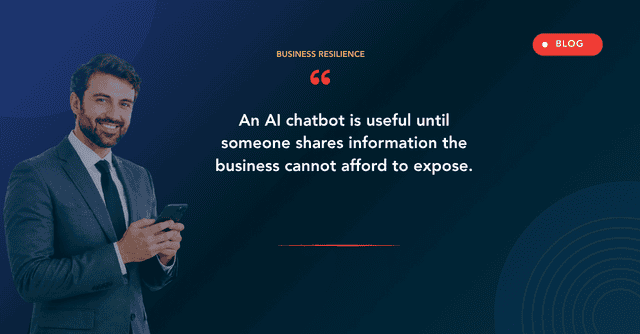
Somewhere in nearly every business right now, an employee is pasting a client contract into a chatbot to get a quick summary, asking an AI tool to draft a sensitive email, or feeding spreadsheet data into a free online assistant to save twenty minutes of manual work. None of this happens with any malicious intent. It happens because the tools are fast, free, and genuinely useful. It also happens almost entirely without the business’s knowledge, approval, or any understanding of where that data actually goes afterward.
AI chatbots have moved from novelty to daily habit faster than almost any workplace technology in recent memory. The upside is real: faster drafting, quicker research, and meaningful productivity gains across nearly every department. The risk is just as real, and far less visible. This article draws a clear line between where AI chatbot use genuinely helps a business and where it quietly starts creating exposure that most leadership teams have not fully accounted for.
Why This Conversation Is Happening Now
A few years ago, AI chatbots were a curiosity. Today they are embedded in browsers, productivity suites, customer service platforms, and increasingly, employees’ personal habits carried straight into the workplace. Adoption has outpaced governance almost everywhere, a pattern explored in this breakdown of how AI is no longer coming and is already influencing daily business operations, whether leadership has formally approved it or not.
This creates an unusual dynamic. Employees are not waiting for permission because the tools solve real problems immediately. Businesses, meanwhile, are often unaware of the scope of usage happening across their own teams, a gap directly tied to the broader issue of shadow AI tools operating without any formal review or oversight.
Where AI Chatbots Genuinely Help
Before drawing lines around risk, it is worth being honest about where these tools add real value. Dismissing AI chatbots outright ignores legitimate productivity gains that businesses would be foolish to walk away from.
Drafting and Editing Internal Content
AI chatbots are genuinely useful for:
- Drafting internal memos, meeting summaries, and process documentation
- Editing tone and clarity in routine business communication
- Brainstorming ideas for marketing content or internal training materials
- Generating first drafts of non-sensitive templates
Research and Information Synthesis
Employees regularly use AI tools to:
- Summarize publicly available industry reports or news
- Explain unfamiliar concepts or terminology quickly
- Compare general product categories or approaches
- Generate outlines for presentations or proposals
Coding and Technical Support
Development and IT teams frequently use AI chatbots to:
- Debug code snippets or explain error messages
- Generate boilerplate code for non-sensitive projects
- Draft documentation for internal technical processes
Customer-Facing Efficiency Tools
When properly implemented, AI-powered chat tools can also improve customer experience directly, a trend covered in this look at conversational AI agents transforming business operations and return on investment across multiple industries.
In each of these categories, the common thread is clear: the information involved is not sensitive, confidential, or regulated. This is exactly where the line starts to matter.
Where the Risk Actually Begins
The danger with AI chatbots rarely comes from the technology itself. It comes from what employees choose to put into it, often without realizing the implications.
Pasting Confidential Business Data
One of the most common and least understood risks is employees pasting sensitive information directly into a chatbot to get a quick answer. This might include:
- Client contracts or proposals
- Internal financial figures or budget details
- Employee personal information
- Proprietary business strategy or pricing models
- Source code containing business logic or credentials
Once that data is entered into a third-party AI tool, the business generally loses control over how it is stored, whether it is used to train the underlying model, and who else might eventually have access to it.

Sharing Client or Patient Information
For regulated industries, this risk escalates significantly. An employee summarizing patient notes or client financial records using a free AI chatbot may be creating a serious compliance violation without any awareness that they have done so, a concern detailed in this overview of healthcare compliance requirements that extend directly to how AI tools handle protected data.
Uploading Documents Without Reviewing Data Handling Terms
Many chatbot tools allow direct document uploads for summarization or analysis. Few employees stop to read the tool’s data retention policy before uploading a contract, spreadsheet, or internal report, often assuming that if the tool is popular or well-known, it must be safe by default.
Using AI Output Without Verification
A separate but related risk involves trusting AI-generated content without adequate review, particularly for client communication, contracts, or compliance-related material. AI chatbots can produce confident, well-written responses that are factually incorrect or legally imprecise, creating risk that has nothing to do with data privacy and everything to do with accuracy.
Using Personal AI Accounts for Business Tasks
Employees using free, personal AI chatbot accounts for work tasks introduce an additional layer of risk, since the business has no visibility or control over that account, its security settings, or what data has been entered into it over time.
Why This Is Different From Typical Shadow IT
Businesses have dealt with unauthorized software adoption for years, but AI chatbots introduce a distinct wrinkle: the data entered into these tools may be used to train underlying models, meaning information can persist and resurface in ways that traditional software risks do not typically involve. Deleting a chatbot account does not necessarily undo what has already been processed or potentially retained.
This distinction is explored further in this piece on how to properly secure AI for your business, which lays out the specific considerations that separate AI governance from traditional software policy.
Building a Practical AI Chatbot Policy
Businesses do not need to ban AI chatbots outright to manage this risk effectively. In most cases, an outright ban simply pushes usage further underground, making it harder to monitor rather than eliminating it. A more practical approach involves clear, specific policy guidance.
Define What Data Can and Cannot Be Entered
Rather than vague guidance like “be careful with sensitive information,” effective policies specify exactly what categories of data are off-limits, such as:
- Client names paired with financial or personal details
- Any information covered by a signed confidentiality agreement
- Employee personal or health information
- Proprietary pricing, strategy, or product development details
- Source code containing credentials or business logic
Approve Specific Tools for Business Use
Rather than leaving employees to choose whatever free tool they find first, businesses should identify and approve specific AI platforms that meet appropriate security and data handling standards, ideally ones offering business-tier accounts with stronger data protection guarantees than free consumer versions.
Require Business Accounts, Not Personal Ones
Employees using AI tools for work purposes should use business-provisioned accounts rather than personal ones, ensuring the business retains visibility, control, and the ability to revoke access when needed.
Establish Review Requirements for Client-Facing Output
Any AI-generated content headed toward a client, whether an email, proposal, or contract, should go through the same human review process applied to any other business communication, treating AI output as a draft rather than a finished product.
Provide Concrete Training, Not Just a Policy Document
A written policy alone rarely changes behavior. Employees need specific examples of what is and is not appropriate, ideally reinforced through regular training rather than a single onboarding session that gets forgotten within weeks.
How This Connects to Broader Cybersecurity Strategy
AI chatbot usage does not exist separately from a business’s overall security posture. It is simply the newest entry point for many of the same underlying risks businesses already manage elsewhere, a connection explored in this discussion of how one small security mistake can lead to a much larger breach, regardless of whether the mistake happens through email, a vendor, or an AI tool.
Businesses building modern security frameworks increasingly extend access control principles to cover AI tool usage as well, a shift discussed in this overview of zero trust security approaches that treat every data interaction, including AI tool usage, as requiring verification and control.

The Compliance Dimension
For regulated industries, AI chatbot usage carries specific compliance implications that go beyond general data privacy concerns.
Healthcare
Entering patient information into an unapproved AI tool can constitute a HIPAA violation regardless of intent, a risk covered in this piece on how HIPAA violations often originate from everyday employee actions rather than external attacks.
Legal Services
Law firms face particular exposure given the confidentiality obligations tied to client information, a concern detailed in this discussion of law firm data breaches and their professional consequences, which extend directly to how case details are handled through AI tools.
Financial Services
Firms handling sensitive financial data face similar exposure, particularly given the scrutiny already applied during high-volume periods, a topic covered in this overview of continuous threat monitoring for accounting firms during tax season.
Government Contractors
Businesses operating under defense or government contracts face formal restrictions around data handling that typically extend to AI tool usage, a requirement discussed in this look at defense contractor requirements that continue evolving under current frameworks.
What Leadership Often Gets Wrong About AI Chatbot Risk
Assuming It Is Not Happening
Many business owners assume AI chatbot usage across their team is minimal or nonexistent, when in reality it is often widespread and simply invisible to leadership. This disconnect is a defining feature of the shadow AI problem discussed earlier.
Treating This as Purely an IT Issue
AI chatbot governance works best as a cross-functional effort involving IT, legal, compliance, and department leaders, not something handled exclusively by the technical team without broader input on what data categories actually matter most to the business.
Waiting for a Clear Incident Before Acting
Businesses often delay building AI policy until something goes wrong, at which point the damage, whether a compliance violation or a data exposure event, has already occurred. Proactive policy development avoids this entirely predictable pattern, echoing the broader theme covered in this look at the IT decisions business owners delay and later regret not addressing sooner.
Underestimating the Pace of Adoption
AI tool adoption within businesses is accelerating faster than most policy development cycles can keep up with, making this an area where waiting even a few months to establish guidance can mean a significant gap in oversight, a pace reflected in this broader look at technology trends reshaping small and mid-sized businesses.
Signs a Business Needs a Formal AI Chatbot Policy Now
- Employees are already using AI tools for work tasks without any documented guidance
- No one in leadership can say which AI platforms are currently in use across departments
- Sensitive client or financial data may have already been entered into free AI tools
- Client-facing content is being drafted with AI assistance without a clear review process
- The business operates in a regulated industry with specific data handling obligations
- Leadership has not evaluated whether current AI tool use affects cyber insurance requirements
If several of these apply, the gap is likely already larger than leadership assumes, a pattern that frequently overlaps with the broader issue explored in this piece on the technology problem many business owners are reluctant to fully acknowledge.
Practical Steps to Get Ahead of the Risk
Conduct an AI Usage Audit
Start by understanding what AI tools are already in use across the organization, formally or informally. This often reveals a much broader footprint than leadership initially expects.
Classify Data Sensitivity Levels
Establish clear categories for what data can never be entered into a third-party AI tool, what requires approval first, and what is generally safe for AI-assisted work.
Select and Provision Approved Tools
Identify AI platforms that meet business security standards and provide employees with approved, business-tier access rather than leaving them to use personal accounts.
Build Review Checkpoints Into Workflows
Particularly for client-facing content, establish a clear human review step before AI-assisted drafts move forward, ensuring both accuracy and appropriateness before anything reaches a client or partner.
Revisit the Policy Regularly
AI tools and their capabilities are changing quickly. A policy written a year ago may already be outdated, making regular review an essential part of keeping guidance relevant rather than symbolic.
Why This Requires Ongoing Attention, Not a One-Time Fix
AI chatbot governance is not a project with a defined end date. It is an ongoing responsibility that should be built into a broader technology strategy, alongside other areas already covered by IT risk management, a connection detailed in this overview of essential IT risk management practices for growing businesses.
This ongoing oversight also fits naturally into a broader infrastructure review cycle, a point covered in this discussion of how often businesses should reassess IT infrastructure, which increasingly needs to account for AI tool usage as a standard category of review rather than an afterthought.
The Role of Strategic IT Guidance
Businesses without dedicated internal technology leadership often struggle to build and enforce AI governance policy effectively. This is an area where strategic guidance, whether from an internal leader or an outsourced partner, becomes particularly valuable, a role explored in this discussion of why more businesses are outsourcing their vCIO function rather than managing complex technology decisions like AI governance without dedicated expertise.
Strategic oversight in this area typically includes:
- Evaluating which AI tools meet business security requirements
- Building practical, enforceable usage policies tailored to the business’s actual risk profile
- Training employees on real-world scenarios rather than abstract guidelines
- Monitoring for emerging AI-related risks as the technology continues to evolve
This kind of guidance connects directly to broader IT service cybersecurity practices and compliance management support, ensuring AI governance fits within the business’s existing security framework rather than existing as a separate, disconnected concern.
What Getting This Right Looks Like
Businesses that build thoughtful AI chatbot governance typically see a specific pattern emerge. Employees continue to use AI tools productively, but within clear boundaries that protect sensitive information. Client-facing content maintains quality and accuracy because review checkpoints catch errors before they matter. Compliance obligations remain intact because sensitive data never reaches unapproved tools in the first place. And leadership gains visibility into a part of daily operations that previously existed almost entirely in the dark.
This balance, enabling productivity while protecting the business, reflects the same principle running through most effective technology governance: the goal is rarely to eliminate a tool’s use entirely, but to ensure its use aligns with what the business can actually afford to risk.
Bringing It All Together
AI chatbots are not going away, and businesses attempting to ban them outright are more likely to push usage into hidden corners than eliminate it entirely. The more effective path is drawing a clear, practical line between where these tools genuinely help and where they start creating exposure that most businesses have not fully accounted for. That line depends less on the technology itself and more on what data employees choose to share with it, and whether the business has given them clear guidance on where that boundary sits.
CMIT Solutions of Greenville works with businesses across healthcare, legal, manufacturing, and professional services to build practical AI governance policies that protect sensitive data without shutting down legitimate productivity gains. This includes helping businesses evaluate approved AI tools, train employees on real-world scenarios, and integrate AI oversight into a broader, already-established security framework. CMIT Solutions of Greenville treats this as part of an ongoing conversation about technology risk, not a one-time policy document that gets filed away and forgotten.
If your business has not yet established clear guidance on AI chatbot use, that gap is worth closing before sensitive data ends up somewhere it was never meant to go. You can schedule a consultation to talk through your current AI exposure, or explore available IT service packages and strategic IT guidance built to support safe, productive AI adoption
Frequently Asked Questions