There is a version of this conversation that happened five years ago. Back then, AI was something business owners read about in tech magazines. A future thing. A big-company thing. Something that would “eventually” change the way businesses operate but not yet. Not here. Not for a small business in Greenville, South Carolina.
That version of the conversation is over.
Artificial intelligence is not on its way. It is already here. It is already inside the tools your team uses every day. It is already influencing the emails you send, the decisions you make, the threats targeting your network, and the competitors you are up against. The only question that remains is whether you are aware of it and whether you are in control of it.
At CMIT Solutions of Greenville, we work with small and mid-sized businesses across the Upstate every day. And what we are seeing right now is one of the most significant technology shifts in the history of business. AI is no longer a horizon event. It is a present reality and how your business responds to it in the next twelve to twenty-four months will define your competitive position for the next decade.
This post is written for every business owner who has heard the AI conversation and wondered: What does this actually mean for me?
The answer is more urgent and more practical than most people realize.
The Quiet Revolution Already Inside Your Business
Most business owners who think they are not using AI are wrong.
When your email client suggests how to finish a sentence, that is AI. When your accounting software flags an unusual transaction, that is AI. When your customer relationship platform scores a lead or recommends a follow-up, that is AI. When your cybersecurity tools detect a suspicious login pattern before it becomes a breach, that is AI.
AI has been woven into the fabric of modern business software so seamlessly that most people never noticed it. It did not announce itself. It did not require a big implementation project or a board-level decision. It just showed up embedded in the tools you already pay for and started making micro-decisions about your business.
That is both remarkable and worth paying careful attention to.
Because AI that operates quietly in the background, without your awareness or oversight, is not the same as AI that you have intentionally deployed, properly configured, and actively managed. The first kind can create unexpected risks. The second kind is one of the most powerful competitive advantages available to a small business today.
The gap between those two realities is where managed IT services become critical. Having a trusted technology partner who understands how AI tools are operating inside your environment and who can help you configure, secure, and optimize them is no longer optional. It is foundational.
What AI Is Actually Doing in Small Businesses Right Now
Let us get specific. Here are the areas where AI is already actively shaping the operations of small and mid-sized businesses in 2026 whether those businesses know it or not.
Cybersecurity Threat Detection
This is arguably the most consequential place AI is operating in your business right now. Modern cybersecurity tools use AI and machine learning to analyze patterns across thousands of data points, login times, file access patterns, network traffic, email behavior and identify anomalies that indicate a potential attack.
The threats your business faces have also evolved. Phishing emails are now generated by AI, making them far more convincing than the obviously fake messages of a few years ago. Ransomware attacks use AI to identify the most valuable data in your system before encrypting it. Social engineering attacks leverage AI to research your business and craft highly targeted deception.
The result is an AI arms race and your business is on the front lines whether you know it or not. The businesses that are protected are the ones with AI-powered defenses actively managed by a team that knows what to look for.
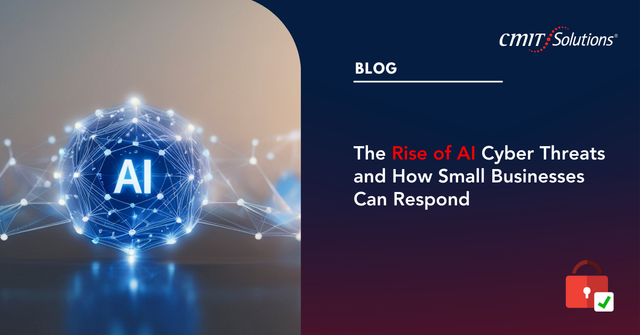
The rise of AI cyber threats is not a future trend to monitor. It is a present reality to address.
Business Communication and Productivity
Every major communication platform your team likely uses Microsoft 365, Google Workspace, Zoom, Slack now has AI deeply embedded in it. AI drafts emails, summarizes meetings, transcribes calls, suggests responses, and automates routine tasks that used to take hours.
This is genuinely good news for small businesses. AI-powered productivity applications allow a lean team to accomplish what previously required a much larger staff. The efficiency gains are real and measurable.
But these tools also introduce new questions. Who owns the data that AI is trained on? What happens when AI summarizes a confidential client meeting and stores that summary in a cloud environment you have not properly secured? What are the data privacy implications for your clients?
These are not hypothetical concerns. They are active governance questions that every business using modern productivity software needs to address.
Financial Operations and Fraud Detection
AI is deeply embedded in modern accounting software, payment processing platforms, and banking systems. It flags unusual transactions, identifies duplicate invoices, detects potential fraud, and can even forecast cash flow based on historical patterns.
This is enormously valuable but it also means that the financial data flowing through your business is being continuously analyzed by AI systems. Understanding how that data is stored, secured, and used is part of responsible business management in 2026.
Email and financial fraud targeting small businesses has become more sophisticated precisely because attackers are also using AI. Your defenses need to keep pace.
Customer Interaction and Sales
CRM platforms, customer service tools, and marketing automation systems have all integrated AI capabilities that analyze customer behavior, predict buying patterns, personalize communications, and automate follow-up sequences.
For small businesses, this levels the playing field significantly. An AI-powered CRM can help a two-person sales team operate with the efficiency of a much larger organization. But it requires intentional setup, proper data hygiene, and ongoing management to deliver those results.

IT Operations and Monitoring
Perhaps most relevant to our work with Greenville businesses: AI is now central to how IT environments are monitored and managed. AI-driven monitoring tools can detect performance degradation before it causes downtime, identify security vulnerabilities before they are exploited, and automate routine maintenance tasks that used to require manual intervention.
The rise of autonomous IT means that the businesses with the right IT partner are benefiting from AI-driven proactive management while businesses without that support are falling further behind.
The Hidden Risks Most Business Owners Are Missing
Here is where the conversation gets important.
AI tools are powerful. They are also, in many cases, operating in your business environment without the governance structures, security configurations, or employee training needed to use them safely and responsibly.
These are the risks we see most often.
Shadow AI
Just as “shadow IT” described employees using unauthorized personal devices and software, “shadow AI” is the emerging phenomenon of employees using AI tools ChatGPT, Claude, Gemini, and dozens of others without organizational awareness or approval.
The problem is not that these tools are bad. The problem is that when an employee pastes confidential client information, sensitive financial data, or proprietary business content into a public AI tool, that data may be retained, used for training, or exposed in ways the business never intended.
This is a real risk happening inside real businesses right now. And most owners have no idea it is occurring.
AI-Generated Misinformation in Internal Processes
AI tools can confidently generate inaccurate information. When employees rely on AI outputs without verification for client-facing documents, financial projections, compliance-related content, or legal matters the consequences can be significant.
Building a culture of AI literacy, where employees understand both the capabilities and the limitations of these tools, is essential.
Data Privacy and Compliance Exposure
For businesses in regulated industries healthcare, legal, financial services the use of AI tools introduces complex compliance questions. HIPAA, for example, places strict requirements on how patient data can be processed and shared. Using an AI tool that sends data to third-party servers without proper data processing agreements could constitute a compliance violation.
Our compliance services help businesses in regulated industries navigate these questions and build AI governance frameworks that protect them.
Vendor AI Features You Did Not Know You Turned On
Many software vendors have been quietly enabling AI features within existing products and in some cases, those features default to on. It is entirely possible that AI capabilities in your current software stack are processing your business data in ways you have never reviewed or approved.
A thorough technology audit part of the IT guidance we provide helps businesses understand exactly what is happening inside their technology environment.

AI as a Competitive Advantage: The Businesses Getting It Right
The goal of this post is not to frighten you. It is to inform you because the businesses that understand AI clearly are the ones using it to build genuine competitive advantages.
Here is what that looks like in practice for small and mid-sized businesses in Greenville.
Faster, Better Customer Service
AI-powered tools allow small businesses to respond to customer inquiries faster, personalize communications more effectively, and deliver a more consistent experience without adding headcount. In industries where responsiveness is a key differentiator, this matters enormously.
More Effective Cybersecurity at Lower Cost
AI-driven security operations what is increasingly called a Security Operations Center or SOC were once the exclusive domain of large enterprises with large budgets. Today, AI makes AI-powered cybersecurity operations accessible to small and mid-sized businesses. The protection that was once out of reach is now within reach with the right partner.
Smarter Backup and Recovery
AI is transforming data backup and disaster recovery by enabling smarter, faster recovery processes. AI can identify which data is most critical, prioritize restoration accordingly, and even predict infrastructure failures before they cause data loss. For a Greenville business, that means shorter recovery windows and significantly less risk.
Better Decision-Making
When AI is properly integrated into your business intelligence and reporting tools, it surfaces insights that would have taken a data analyst weeks to produce. Cash flow patterns, customer behavior trends, operational inefficiencies, staffing needs AI can highlight all of these in real time, allowing business owners to make faster and better-informed decisions.
Competitive Parity With Larger Competitors
Perhaps most importantly for small businesses: AI is a great equalizer. A well-configured AI-powered technology stack allows a 10-person Greenville business to operate with the efficiency, responsiveness, and professionalism of a much larger organization. That is a real competitive advantage and it is available right now.
What Business Owners Should Do Right Now
Understanding that AI is already inside your business is the first step. The second step is taking intentional action. Here is what we recommend for every small business owner in Greenville.
Step 1: Conduct an AI and Technology Audit
You cannot manage what you do not know about. Start by getting a clear picture of what AI tools are currently operating in your environment including the ones embedded in your existing software. A proper network management and technology review will surface these.
Step 2: Establish an AI Use Policy
Businesses of every size need a clear, written policy governing how employees can and cannot use AI tools. This includes which tools are approved, what types of data can be used with AI systems, and what verification processes are required for AI-generated outputs used in client-facing or compliance-sensitive contexts.
Step 3: Secure Your AI-Adjacent Data
The data that flows through AI tools needs to be properly secured. This means reviewing your cloud services configuration, ensuring proper access controls, implementing data loss prevention measures, and confirming that your backup and recovery processes account for AI-generated and AI-processed data.
Step 4: Train Your Team
AI literacy is rapidly becoming a core business competency. Employees who understand how to use AI tools effectively and who understand the risks of misuse are a competitive asset. Invest in training and ongoing education.
Step 5: Partner With an IT Provider Who Understands AI
This is not the era for a break-fix IT relationship. The complexity of the current technology landscape AI tools, evolving cyber threats, cloud environments, compliance requirements demands a proactive, knowledgeable partner who is staying ahead of the changes and helping you navigate them.
CMIT Solutions of Greenville has been helping Greenville businesses do exactly that. Whether you are just beginning to think about AI governance or you are ready to deploy AI tools strategically, we have the expertise to guide you.
The Bottom Line for Greenville Businesses
AI is not a trend to watch. It is a reality to manage.
The businesses that will thrive in the next five years are the ones that approach AI with clarity, intentionality, and the right support. They will use it to serve customers better, operate more efficiently, protect their data more effectively, and outmaneuver competitors who are slower to adapt.
The businesses that ignore it or that allow AI to operate inside their environment without proper oversight will face compounding risk and growing competitive disadvantage.
The question is not whether AI will affect your business. It already has. The question is whether you will be in control of it.
We are here to help you get there. Explore our service packages designed for Greenville businesses at every stage of growth, or reach out directly to start a conversation about what AI governance and modern IT management could mean for your organization.
Contact CMIT Solutions of Greenville today because the best time to get ahead of AI was yesterday. The second best time is right now.
Frequently Asked Questions
- Is AI really already affecting my small business in Greenville?
Yes, almost certainly. AI is embedded in most modern business software from email platforms and accounting tools to cybersecurity systems and CRM platforms. Most business owners are interacting with AI daily without realizing it. - What is “shadow AI” and why should I be concerned about it?
Shadow AI refers to employees using unauthorized or unapproved AI tools like public chatbots to complete work tasks. The risk is that sensitive business or client data may be shared with these tools without the business’s knowledge, creating data
privacy and security exposures - How are cybercriminals using AI to target small businesses?
Attackers are using AI to generate highly convincing phishing emails, conduct automated vulnerability scanning, craft targeted social engineering attacks, and deploy smarter ransomware that identifies the most valuable data before encrypting it. Our cybersecurity services are built to counter these threats. - What AI tools are considered safe for business use?
The safety of any AI tool depends on how it is configured, what data it processes, and whether it has appropriate data protection agreements in place. Rather than a blanket list, businesses need a governance framework that evaluates tools on a case-by-case basis. - Do I need an AI policy for my small business?
Yes. Even small businesses need a clear, written AI use policy that defines which tools are approved, what data can be used with AI systems, and how AI-generated outputs should be verified. This protects the business and sets clear expectations for employees. - How does AI improve cybersecurity for small businesses?
AI-powered security tools analyze patterns across your network in real time, detecting anomalies that indicate a potential attack before damage occurs. This kind of proactive threat detection was once only available to large enterprises today, it is accessible through managed IT services. - What are the compliance implications of using AI tools in healthcare or legal businesses?
Regulated industries face significant compliance risks if AI tools process protected data without proper data processing agreements and security controls. Our compliance services help healthcare and legal businesses use AI responsibly while meeting their regulatory obligations. - Can AI help my small business compete with larger companies?
Absolutely. AI-powered tools allow small teams to operate with far greater efficiency, responsiveness, and analytical capability than was previously possible. With the right technology stack and support, a small Greenville business can match the operational quality of much larger competitors. - How does AI affect data backup and disaster recovery?
AI is transforming data backup by enabling smarter prioritization of critical data, faster recovery processes, and predictive identification of infrastructure issues before they cause data loss. - What should I do if my employees are already using AI tools I did not approve of?
Start by conducting an AI audit to understand the scope of current usage. Then develop a clear policy, communicate it to your team, and implement approved alternatives that give employees the AI capabilities they need within a secure, governed framework. - How do I know which AI features in my current software are active?
This is harder than it sounds many AI features are enabled by default and not prominently disclosed. A comprehensive technology review, which we provide as part of our IT guidance services, will surface what is active in your environment. - Is AI a threat or an opportunity for small businesses?
Both and understanding the distinction is critical. AI deployed thoughtfully and managed properly is a significant opportunity. AI operating unmanaged in your environment, or AI-powered threats targeting your business without adequate defenses, represents real risk. The goal is to maximize the opportunity while managing the risk. - How do cloud services relate to AI in my business?
Most AI tools operate through cloud services, meaning the security and configuration of your cloud environment directly affects how safely AI tools can be used. Properly secured cloud infrastructure is essential for responsible AI adoption. - What is an AI-powered Security Operations Center (SOC)?
A SOC uses AI and machine learning to continuously monitor your network for threats, analyze security events, and respond to incidents in real time. It provides enterprise-grade security at a cost accessible to small and mid-sized businesses. - How does AI change the way phishing attacks work?
AI allows attackers to generate phishing emails that are highly personalized, grammatically perfect, and contextually relevant making them far harder to detect than traditional phishing attempts. Employee training and AI-powered email filtering are both essential defenses. - What IT procurement decisions should I consider with AI in mind?
When evaluating new software or hardware, ask vendors specifically how AI is used in their products, what data is processed by AI features, and what controls you have over AI functionality. Our IT procurement services include AI-aware vendor evaluation. - Can AI help improve my team’s collaboration and communication?
Yes. AI features in unified communications platforms can transcribe meetings, summarize action items, translate content, suggest responses, and automate routine communication tasks, freeing your team to focus on higher-value work. - What is the biggest AI mistake small businesses make?
The most common mistake is passive adoption allowing AI tools to operate inside the business without intentional governance, security review, or employee training. The second most common mistake is avoiding ignoring AI entirely and falling behind competitors who are using it effectively. - How does network management relate to AI security?
Your network is the environment through which all AI tools operate. Proper network management including segmentation, monitoring, access controls, and traffic analysis is foundational to using AI tools securely. - How do I get started with an AI readiness review for my business?
The easiest first step is a conversation with our team. We will assess your current technology environment, identify where AI is already operating, evaluate your exposure, and recommend a practical path forward. Contact us to schedule your consultation today.