Most business owners imagine cyberattacks as loud, disruptive events. Systems lock up. Files disappear. Ransom notes appear on screens.
But the more dangerous reality is quieter.
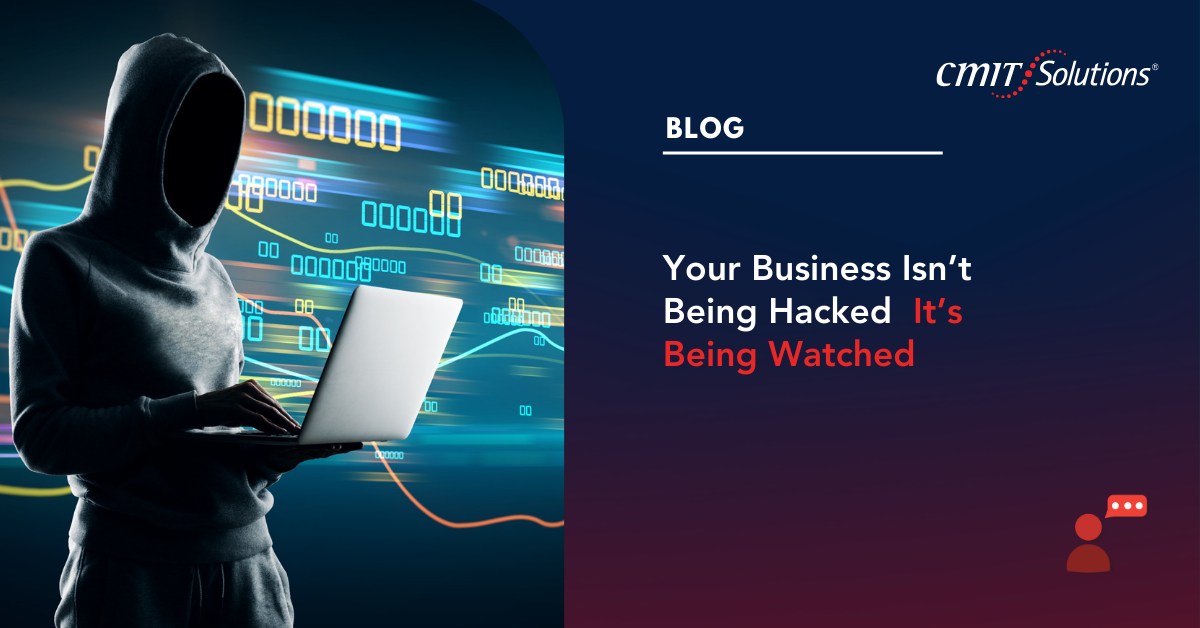
Long before a breach becomes visible, attackers are often watching. Mapping your systems. Studying employee behavior. Identifying weak access points. Testing login credentials. Observing traffic patterns.
By the time you realize you’ve been “hacked,” the observation phase may have been happening for weeks or months.
This isn’t paranoia. It’s how modern cybercrime works.
And if your organization isn’t built to detect that early surveillance activity, you’re not just vulnerable to attacks you’re unknowingly hosting them.
This article breaks down how passive cyber observation works, why it’s so common in small and mid-sized businesses, and how to stop being watched before you become the next headline.
The Silent Phase of a Cyberattack
Most breaches don’t begin with disruption. They begin with access.
An attacker gains entry through:
- A phishing email
- A reused password
- An unpatched vulnerability
- Exposed remote access
- A misconfigured cloud setting
Once inside, they rarely act immediately.
Instead, they escalate privileges quietly, identify high-value systems, monitor internal communications, track financial workflows, and observe vendor relationships.
The goal isn’t chaos it’s intelligence.
This reconnaissance phase allows attackers to plan targeted, profitable actions like business email compromise, ransomware deployment, and data exfiltration. As discussed in our article on the rise of AI cyber threats, modern attackers are becoming increasingly patient and strategic.
The longer they observe, the more precise the attack becomes.
Why Small and Mid-Sized Businesses Are Prime Targets
There’s a dangerous myth that only large enterprises get watched.
In reality, small and mid-sized businesses are often preferred targets because they typically have fewer internal IT resources, limited security monitoring, inconsistent patching practices, minimal log review, and no dedicated security operations oversight.
Attackers understand that many growing businesses focus on productivity first and security second. That gap creates opportunity.
Without proactive oversight like structured managed IT services, suspicious activity blends into normal system noise. Logins at unusual times. Repeated authentication attempts. Minor configuration changes. Small data transfers.
Individually, these events may look harmless. Together, they can signal early-stage compromise.
The Cost of Being Watched
Observation is not harmless.
When attackers watch your systems, they gain operational insight into approvals and financial workflows. They identify credential weaknesses and MFA gaps. They wait for payroll cycles or executive travel. They map critical infrastructure before launching ransomware.
Many Greenville business leaders underestimate how observation aligns with broader IT risk management strategies.
By the time the visible attack occurs, the groundwork is complete.
Breaches feel sudden. They aren’t sudden they’re executed.

What Early Warning Signs Actually Look Like
Modern threats don’t announce themselves. But they do leave indicators:
- Repeated failed login attempts
- Logins from unfamiliar locations
- Creation of new admin accounts
- Changes to email forwarding rules
- Small irregular data transfers
- Disabled security alerts
The issue isn’t the absence of warning signs.
It’s the absence of centralized monitoring something that becomes critical in maintaining resilient IT infrastructure.
Security tools may exist, but without coordination, they operate in isolation.
Why Basic Security Tools Aren’t Enough
Many organizations believe they are protected because they have antivirus software, firewalls, and email filtering.
These tools matter. But they don’t detect behavioral anomalies.
Cybercriminals now use legitimate credentials and approved access paths. They blend in using normal administrative tools.
That’s why modern protection requires layered IT cybersecurity services combined with centralized visibility.
Security isn’t just about building walls.
It’s about watching the watchers.
The Role of Patch Management in Preventing Surveillance
Unpatched systems remain one of the easiest entry points for attackers.
Automated scanning tools constantly search for exposed vulnerabilities. Once access is gained, silent observation begins.
Structured patching within professional IT support services closes these windows before exploitation occurs.
Effective patch management requires:
- Defined update schedules
- Visibility into patch status
- Documentation of exceptions
- Ongoing vulnerability scanning
Without oversight, businesses leave digital doors open.
Access Controls: Limiting What Observers Can See
If a single employee account is compromised, what systems become accessible?
Role-based permissions dramatically reduce exposure.
Strong access governance often falls under comprehensive IT guidance services, ensuring privileges align with job functions.
Observation becomes far less valuable when visibility is restricted.
Security Monitoring That Detects Behavior, Not Just Threats
The difference between being hacked and being watched comes down to monitoring maturity.
Proactive monitoring identifies anomalous login patterns, suspicious privilege escalation, lateral movement, and abnormal data access.
Cloud environments especially require visibility across platforms, which is why integrated cloud security solutions are critical for modern businesses.
Without centralized logs and oversight, surveillance activity can continue undetected.

Compliance and Incident Response Readiness
Regulated industries face even higher stakes.
Observation without detection can create serious compliance exposure, particularly in healthcare, legal, and financial sectors. Maintaining strong IT compliance standards ensures monitoring and documentation processes are structured and defensible.
Industries like law firms must integrate cybersecurity into broader digital transformation, as outlined in our discussion of data protection strategies for law firms.
Prepared organizations don’t panic when suspicious activity appears—they investigate systematically.
Proactive Cybersecurity in Practice
Organizations that prevent observation-based attacks share consistent characteristics:
- Automated patching
- Centralized monitoring
- Regular access reviews
- Validated backups
- Documented workflows
- Defined response plans
They also align procurement decisions with security objectives through structured IT procurement planning.
Security becomes operational not reactive.
How CMIT Solutions of Greenville and West Supports Proactive Defense
At CMIT Solutions of Greenville and West, cybersecurity is treated as a continuous operational discipline—not a one-time configuration.
Through comprehensive managed IT support, businesses gain:
- Structured patch oversight
- Centralized log visibility
- Continuous behavioral monitoring
- Strengthened access controls
- Documented security frameworks
Staying informed on evolving threats like those highlighted in our insights on cybersecurity trends for 2026 helps businesses remain ahead of emerging surveillance tactics.
The goal isn’t just preventing hacks.
It’s eliminating the quiet observation phase that makes them possible.
The Business Impact of Staying Ahead
When systems are actively monitored:
- Risk exposure decreases
- Downtime becomes less likely
- Compliance posture strengthens
- Leadership gains confidence
Security shifts from liability to competitive advantage.
And attackers lose the invisible window they depend on.
Conclusion: The Real Threat Is the One You Don’t See
Cyberattacks rarely begin with chaos.
They begin with watching.
The longer observation goes undetected, the more precise and damaging the eventual attack becomes.
Strong cybersecurity isn’t defined by how quickly you recover after a breach.
It’s defined by how effectively you prevent silent surveillance from turning into crisis.
If your organization lacks visibility into who is accessing what, when, and why, the risk isn’t theoretical.
It’s operational.
Ready to Stop Being Watched?
If you’re unsure whether your business has the monitoring, patching, and access controls needed to detect early-stage threats, now is the time to evaluate your environment.
Schedule a consultation through our contact page to assess your current defenses and strengthen your cybersecurity posture.
Because the safest systems aren’t the ones that recover quickly.
They’re the ones that never give attackers the chance to watch in the first place.