A message lands in an employee’s inbox from what looks exactly like a familiar vendor. The grammar is flawless, the formatting matches past correspondence, and the tone reads like it was written by someone who actually knows the business. Nothing about it feels like the clumsy, typo filled scam emails everyone learned to spot years ago. That is because it probably was not written by a person at all.
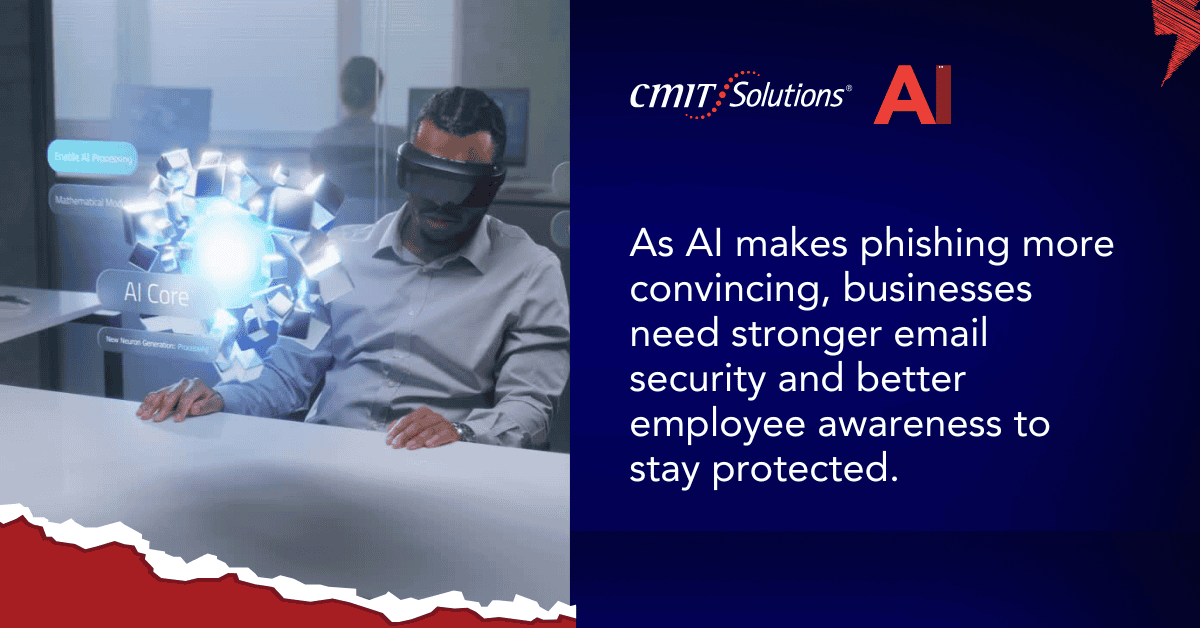
Generative AI tools have quietly rewritten the rules of phishing. The awkward phrasing, obvious grammar mistakes, and generic greetings that once made scam emails easy to spot have largely disappeared, replaced by polished, personalized messages that slip past traditional spam filters and past even careful, well trained employees. For businesses across Long Beach, this shift means the old advice about spotting bad spelling and broken English is no longer enough on its own.
Why Traditional Spam Filters Are Losing Ground
Spam filters were built to catch patterns. They flag messages with known malicious links, suspicious attachments, mismatched sender domains, or language patterns commonly seen in mass produced scam campaigns. For years, this approach worked reasonably well because most phishing emails were generated from the same templates, reused across thousands of targets with only small variations.
Generative AI breaks this pattern matching approach in a few key ways:
- Every message can be uniquely written, so there is no repeated template for a filter to recognize
- Grammar and spelling are consistently clean, removing one of the most reliable red flags filters and humans both relied on
- Tone and formatting can be tailored to match a specific industry, company, or even an individual writing style
- Messages can reference publicly available details, making them feel personally relevant rather than generic
- New variations can be generated instantly, letting attackers test and adjust faster than filter rules can be updated
This is part of a much larger shift covered in our comparison of AI driven cyberattacks, where automation is changing not just phishing but nearly every category of cybercrime aimed at small and mid sized businesses.
What Makes AI-Written Phishing Emails So Convincing
A handful of specific techniques explain why these messages succeed where older scams failed.
Flawless Language
Generative tools produce grammatically correct, natural sounding text by default. The broken English that used to be a dead giveaway is simply gone, removing one of the easiest tells employees were taught to look for.
Personalization at Scale
Attackers can feed publicly available information, a name, a job title, a recent company announcement, into an AI tool and generate a message that references those details naturally. This used to require real research time per target. Now it happens in seconds, for thousands of targets at once.
Matching Tone and Formatting
AI tools can mimic the writing style of a specific person or brand voice, closely matching the tone of previous legitimate emails. Combined with a spoofed or look alike domain, this creates messages that are difficult to distinguish from something a real colleague or vendor would send.
Rapid Variation
Where older phishing campaigns reused the same message thousands of times, AI lets attackers generate slightly different wording for each recipient. This defeats filters that rely on recognizing repeated, identical content across many inboxes.
The Business Risk Behind This Shift
The financial and operational consequences of a successful phishing attempt have not changed, only the odds of it succeeding have gone up. A convincing AI written message asking for a wire transfer, a password reset, or a fake invoice payment carries the same downstream risk as any other business email compromise attempt, just with a much higher chance of getting past both software and human scrutiny.
A detailed look at what these incidents actually cost once fraud, downtime, and recovery are factored in is available in our breakdown of real cost cyberattacks inflict on businesses that assumed their filters had it covered.

Industries Facing the Sharpest Increase in Risk
AI generated phishing does not target every business equally. Industries that regularly handle financial transactions, sensitive data, or high value client relationships tend to see the most convincing and frequent attempts.
Accounting and tax preparation firms are already a favorite target during filing season, and AI written messages have made these attempts noticeably harder to catch, a concern detailed in our article on ransomware protection tips and the broader threats accounting firms face year round. Our related piece on CPA firm cybersecurity covers what firms should be doing differently as these tools become more common.
Law firms handle time sensitive, high value communication involving settlements and client funds, making law firm data security a growing priority as AI written impersonation attempts become harder to distinguish from real client requests.
Healthcare practices exchange billing, scheduling, and patient related messages constantly, and a convincing AI written phishing attempt can lead to both financial loss and regulatory exposure, a challenge outlined in our piece on healthcare IT security for medical practices navigating 2026.
Engineering and design firms face a similar risk when it comes to protecting proprietary information, a concern explored in our article on engineering IP security in an increasingly AI driven landscape.
Construction companies coordinating large subcontractor and supplier payments by email are also seeing more convincing attempts, a pattern discussed in our overview of construction technology support moving away from reactive, unmonitored setups.
Finance and insurance providers face additional pressure as underwriting standards evolve, a shift detailed in our summary of cyber insurance requirements for 2026, many of which now specifically ask about phishing resistance and email filtering capability.
Why Employee Training Alone Is No Longer Enough
For years, the standard advice was to train employees to spot spelling errors, awkward phrasing, and generic greetings. That advice has not disappeared, but it has become far less reliable on its own, since AI written messages routinely pass every one of those checks. Training still matters, but it needs to shift toward different signals:
- Verifying unusual requests through a second channel, such as a phone call, rather than trusting the email alone
- Slowing down on any message that creates urgency around payment, credentials, or account changes
- Checking the actual sender address and domain closely, not just the display name
- Treating well written, professional sounding emails with the same scrutiny as poorly written ones
- Reporting suspicious messages even when nothing feels obviously wrong, since AI written attempts often only reveal themselves through small inconsistencies
Our broader guide on cybersecurity best practices walks through how to build these habits into daily routines without overwhelming staff with constant warnings, a balance covered further in our article on security fatigue solutions for teams that feel bombarded by alerts.
Modern Filtering Technology Built to Catch AI-Written Threats
Because AI generated phishing defeats pattern based filtering, modern email security tools have shifted toward behavior based and context aware detection instead. These systems look beyond spelling and known bad templates, analyzing:
- Sending patterns and relationship history between sender and recipient
- Subtle domain irregularities, including look alike characters and newly registered domains
- Unusual requests involving payment, credentials, or account changes, regardless of how well written the message is
- Login and access anomalies tied to the sender’s actual account, when available
- Cross referencing message content against known impersonation and business email compromise patterns
This kind of layered, intelligence driven filtering reflects the broader shift covered in our overview of managed intelligence providers, where security tools increasingly rely on behavioral analysis rather than static rule sets that AI generated content can easily slip past.
Fighting AI With AI
The same generative technology fueling more convincing phishing attempts is also being used defensively. Modern security platforms use machine learning to analyze massive volumes of email traffic, flagging subtle anomalies a human reviewer or a static filter would miss entirely. Our discussion of AI driven cyberattacks covers both sides of this arms race, and our look at how AI powered automation is reshaping IT help desk operations shows how the same underlying technology is being repurposed to strengthen day to day defenses rather than just accelerate attacks.
This shift is part of a broader pattern across many industries, where the practical use of AI is no longer optional for businesses that want to keep pace, whether that means improving efficiency internally or strengthening the defenses that protect client relationships from increasingly convincing scams.
A Realistic Walkthrough of an AI-Written Phishing Attempt
Picture a finance manager who receives an email that appears to come from a long standing vendor. The subject line references an actual invoice number from a recent project, the tone matches previous correspondence almost exactly, and the message politely explains that the vendor’s bank recently changed and asks for updated payment routing details before the next invoice is processed.
Nothing about the email trips a spelling check. Nothing about the formatting looks unusual. The attacker, using a generative AI tool, pulled the vendor’s public writing style from old newsletters and press releases, referenced a real invoice number found in a prior data leak, and generated a message tailored specifically to this one recipient in a matter of seconds. A traditional spam filter, built to catch known bad patterns and clumsy language, has nothing obvious to flag.
The only real warning sign is the request itself, a banking change delivered by email with no phone confirmation. This is exactly why verification habits matter more than ever, since the writing quality of a message can no longer be trusted as a reliable signal on its own.
Common Myths About AI-Generated Phishing
- Myth: perfect grammar means a message is safe. Reality: flawless writing is now the default for scam emails, not a sign of legitimacy
- Myth: our spam filter already blocks this. Reality: most default filtering was built for repeated, templated scams, not uniquely generated messages
- Myth: only large companies are targeted with this level of sophistication. Reality: generative tools make personalized attacks cheap enough to use against businesses of any size
- Myth: employees who have completed security training will always catch these. Reality: even well trained staff struggle when the usual red flags are missing
- Myth: this is a temporary trend that will fade. Reality: AI writing tools are becoming more accessible and more capable, not less, making this a long term shift rather than a passing spike
Why Leadership Should Treat This as a Strategic Issue
Phishing defense has traditionally been treated as a technical, IT level concern. The rise of AI generated attacks changes that calculus, since the financial and reputational exposure now touches every department that handles payments, client communication, or sensitive data. Leadership teams that fold phishing resistance into broader planning conversations, rather than leaving it entirely to IT, tend to respond faster and more effectively when an incident does occur.
This shift mirrors a broader pattern across the region, where technology decisions that once sat purely with IT departments are increasingly discussed at the leadership level as competitive and risk factors in their own right.

Building a Layered Defense Against AI-Written Phishing
No single tool fully solves this problem. A layered approach gives a business the best chance of catching an attempt that slips past any one layer on its own.
Advanced email filtering configured through cybersecurity services that goes beyond basic spam detection to include behavior based analysis and domain verification.
Identity based verification for any request involving payment or account changes, an approach explained further in our article on identity first security models.
Endpoint protection across every device employees use to read and send email, covered in our overview of endpoint security management for hybrid and remote teams.
Secure access controls for employees working outside the office, supported through the framework described in our guide to secure access edge technology for hybrid workforces.
Ongoing monitoring through network management solutions that can flag unusual activity tied to a compromised account after a successful phishing attempt.
Regular data backups through data backup solutions so a business can recover quickly if a phishing email leads to a broader compromise.
A documented incident response plan, developed as part of a broader cyber resilience strategy, so staff know exactly what to do the moment a suspicious message is identified.
Signs an Email Might Still Be an AI-Written Scam
Even flawless writing tends to leave a few small inconsistencies behind. Watch for:
- A reply to address that does not match the sender address shown
- A domain with a subtle misspelling or unfamiliar extension
- Requests to change payment details or credentials through email alone
- Urgency paired with a request that bypasses normal approval steps
- A slightly unusual phrase or reference that does not quite match how the real sender typically communicates
Reviewing these signals regularly, alongside a broader network security essentials review, helps catch what filtering software alone might miss. Our practical prevent cyberattacks guide covers additional day to day habits worth building into a team’s routine.
What to Do the Moment a Suspicious Message Is Identified
- Do not click any links or open attachments in the message
- Verify any payment or account change request by phone, using a number already on file, not one provided in the email
- Report the message to your IT provider immediately so filtering rules and monitoring can be adjusted
- Warn colleagues who may have received a similar message
- Document the incident, including headers and timestamps, for future reference
Businesses without a dedicated internal security team often lean on a managed IT services partner during exactly this kind of moment, since fast, correct action in the first hour makes a significant difference in limiting damage.
The Role of Agentic AI in Both Attack and Defense
As AI tools become more autonomous, some are now capable of carrying out multi step tasks with minimal human input, drafting a phishing email, researching a target, and even adjusting the message based on how a recipient responds. Our explainer on the rise of agentic AI in business operations covers what this shift means for both attackers and the defensive tools built to counter them.
Business leaders weighing how to respond to this shift often benefit from a broader strategic conversation rather than a single tool purchase. Our article on how Long Beach IT strategy leadership is adapting to these changes covers how executives are folding AI risk into overall technology planning rather than treating it as a standalone concern.
Keeping Communication Channels Consistent
As phishing awareness grows, some attackers have started shifting toward text messages and spoofed caller ID to reach the same targets through channels that feel less scrutinized than email. Businesses that centralize voice and messaging through unified communications systems gain more consistent visibility across these channels, rather than leaving them as an unmonitored gap next to a well filtered inbox.
Pairing this with consistent productivity software solutions licensing and properly configured cloud computing services ensures every employee has access to the same filtering and security features, rather than a patchwork of protection depending on which account or device happens to be in use.
Where Compliance Fits Into the Conversation
For regulated industries, a successful phishing attempt is not just a financial problem, it can trigger reporting obligations depending on what data was exposed or what an employee was tricked into sharing. A structured compliance solutions review helps businesses understand exactly where email filtering and phishing defense fit into their broader regulatory picture, a topic also covered in our detailed compliance overview for top IT challenges 2026 facing Long Beach businesses this year.
Getting the underlying technology sourced and configured correctly also matters. Businesses working through IT procurement services avoid the common trap of layering on overlapping tools, while ongoing strategic IT guidance keeps phishing defense aligned with the rest of a company’s broader plans for modernizing IT infrastructure as the business grows.
Getting Started With Stronger Phishing Protection
Most businesses only discover their filtering is behind the curve after an employee nearly falls for a convincing message, or worse, actually does. A quick technical review can usually determine, within a day, exactly how well current filtering tools are holding up against AI generated threats and where the gaps are.
CMIT Solutions of Long Beach helps businesses across every client facing industry, from law firms to healthcare practices to engineering companies, upgrade their email filtering and employee training before a convincing AI written scam reaches the wrong inbox at the wrong time. As a Long Beach IT provider working with companies of every size, CMIT Solutions of Long Beach treats modern phishing defense as a core part of everyday IT support, not an optional add-on layered in after something goes wrong.
If you are not certain your current filtering can catch a well written, AI generated scam, do not wait to find out the hard way. Schedule a consultation to get a clear picture of where your email security stands today and what it takes to close the gap.
Frequently Asked Questions