
Picture this. A vendor you trust with patient records contacts you to say that someone accessed its email accounts for more than a week last October. The break-in happened on the vendor’s side. You still have to write to thousands of your own patients and tell them their medical information and Social Security numbers may have been exposed.
That is what happened to two dental practices right here in Northern Virginia, just down I-95 from Prince William County in Stafford. HIPAA Journal reported in June 2026 that more than 12,000 of their patients were affected between them. It started with a phishing email, a fake message that tricked someone at the vendor.
After a breach, federal regulators ask what the practice had checked beforehand. Most practice managers in Manassas and Woodbridge know they need a risk assessment. Fewer know what happens once one starts. This article walks through a HIPAA risk assessment for medical practices in Prince William County, from the first planning call to the final report.
What the Enforcement Data Says
The numbers back that up. On April 23, 2026, the HHS Office for Civil Rights (OCR), the federal office that enforces HIPAA, announced four ransomware settlements. Ransomware is malicious software that locks your files until a ransom is paid. The four breaches affected more than 427,000 people, and the four organizations paid $1,165,000 between them.
One was a women’s health network with practices in five states. It paid $320,000, and HHS listed a single finding against it. It had failed to carry out an accurate and thorough risk analysis, which is the official name for a risk assessment. All four settlements cited that failure.
The largest of the four breaches affected 244,813 people at a medical imaging provider. The exposed records included lab results, medications, diagnoses, and treatment information.
The consequences also last. Each organization agreed to a list of required fixes, and OCR will check on its progress for two years. The women’s health network reported its breach in December 2020, and its settlement came in April 2026.
Those four cases sit inside a much larger count. HIPAA Journal’s half-year report lists 397 breaches of 500 or more records reported to OCR between January and June 2026. Healthcare providers accounted for 290 of them, and 343 of the 397 were hacking or IT incidents. Together, they exposed the health information of 33.77 million people.
The rules are also in motion. The HIPAA Security Rule is the part of HIPAA that covers electronic patient records. HHS proposed a stricter version in January 2025, then pushed its final decision to July 2027. The current rule still applies in full. It already requires a HIPAA risk assessment for healthcare providers, and OCR is enforcing that requirement now.
HIPAA Risk Assessment Prince William County: What the Process Looks Like
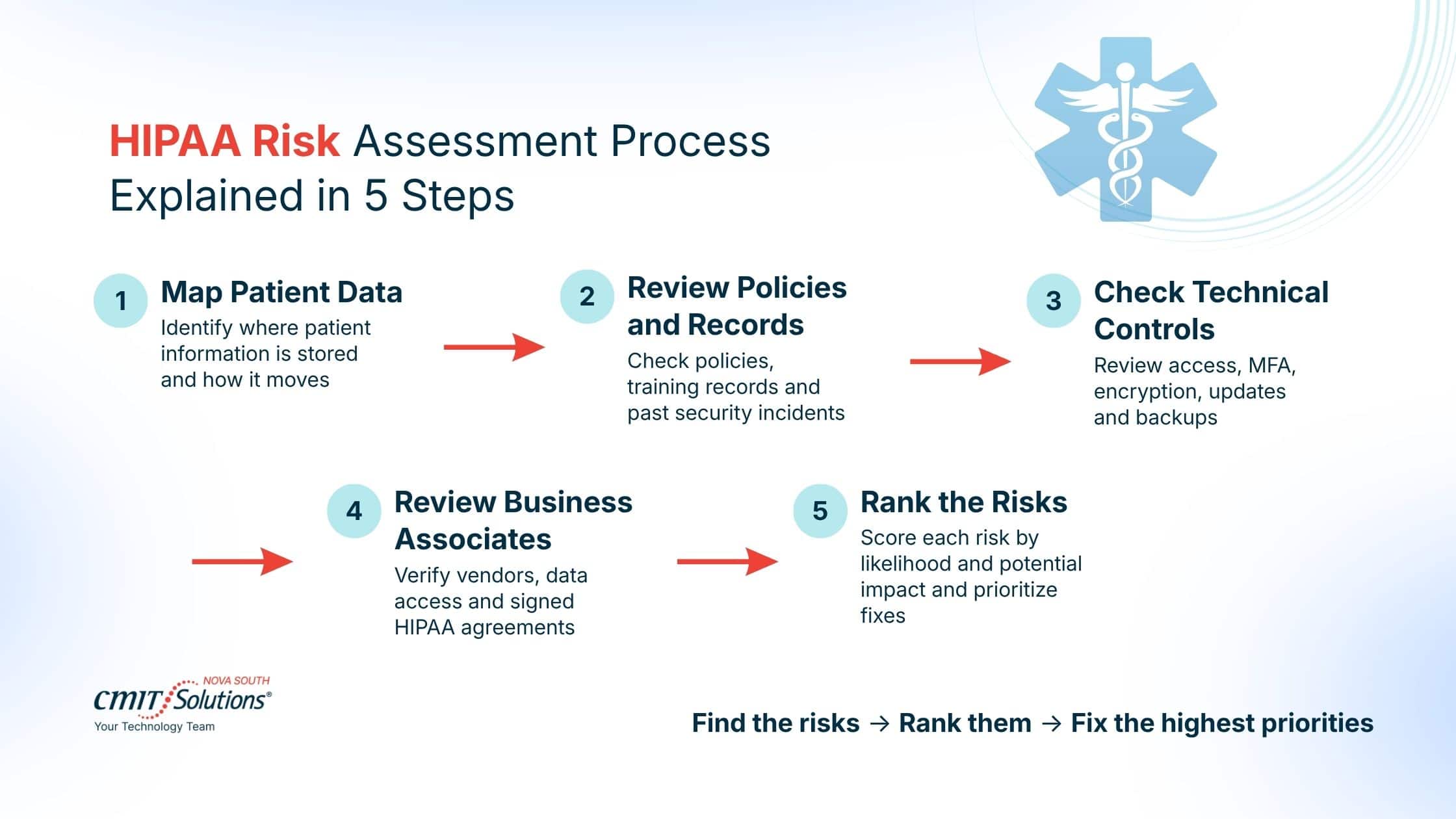
A HIPAA risk assessment for medical practices follows the steps set out in HHS guidance on risk analysis. For a single-location practice, the work usually spans a few weeks. Most of it happens around your clinic schedule. At CMIT Solutions of NOVA South, we help medical offices throughout Manassas, Woodbridge, and Prince William County complete HIPAA risk assessments and remediate identified gaps. Here’s what a typical assessment process looks like.
- Mapping your patient data. The assessor lists every place electronic patient information is kept. That includes your EHR, the billing system, email, imaging equipment, laptops, and phones. OCR’s first recommendation after the April settlements was to find where that information sits and how it moves through the practice.
- Interviews and paperwork. Expect questions for the front desk and the billing lead as well as the physicians. The assessor will ask for your written policies, staff training records, a record of any past security problems, and your last assessment if one exists.
- Technical check. This is the HIPAA cybersecurity risk assessment for medical practices that most people picture. It checks that software updates are installed and that each person sees only the records their job requires. It looks for a second login step, such as a code sent to your phone, and for encryption, which scrambles data so a stolen laptop cannot be read. It confirms that backups work and that the system records who opened which patient file. A general cybersecurity risk assessment for Prince William County businesses order covers similar ground. It does not tie its findings back to HIPAA.
- Vendors. Every outside company that handles your patient data gets listed. HIPAA calls these companies business associates and requires a signed agreement with each one. The assessor checks that those agreements exist. The Stafford breach shows why. So does one of the April settlements. A company that administers employee health benefits, itself a business associate, paid $225,000 after an attack that began with a phishing email.
- Risk rating. Each risk is scored by how likely it is and how much harm it would cause. The scores set the order of the fixes. An unencrypted laptop that leaves the office each night rates high on both. A computer that never leaves a locked room rates lower.
Your part is mostly access and answers. Someone has to pull the documents and free up staff for short interviews. The assessor also needs to see each system, either with a login or with someone walking them through it.
What You Should Have When It Ends
You should receive a written report and a ranked list of risks. A plan for fixing them should come with it, with a named person and a date for each fix.
Be careful with shortcuts. A HIPAA risk assessment checklist for medical practices is a useful way to prepare. It is a poor substitute for the analysis itself. OCR’s standard is an “accurate and thorough” assessment, and a ticked form rarely meets it.
Size does not change the obligation. The HIPAA risk assessment requirements for small medical practices come from the same rule that binds a hospital. A small practice can match its protections to its size, and it still has to do the assessment.
The report then becomes the working document for HIPAA compliance for medical practices. OCR expects a written plan that acts on what the assessment found.
Keep the report somewhere you can reach it fast. A breach affecting 500 or more patients has to be reported to HHS no later than 60 days after discovery, and both Stafford practices crossed that threshold. The imaging provider in the April settlements was also cited for notifying patients late. A current assessment shortens the time it takes to work out what was exposed.
What OCR Expects You to Act On
OCR closed its April announcement with a list of steps for every organization that HIPAA covers. A finished report should speak to each of them.
- Keep a record of who opens patient files, and review that record regularly.
- Make sure only approved staff can reach patient information.
- Encrypt patient information wherever it is stored and whenever it is sent.
- Give staff HIPAA training that fits their job duties.
- Use what you learn from past security problems to tighten your protections.
If your report is silent on any of these, ask the assessor why.
Questions to Ask Before You Choose an Assessor
The answers tell you what you are buying. Ask them before you sign.
- Does the review cover every office and device that holds patient data, or only the EHR?
- Will you check our actual systems, or is the assessment a questionnaire?
- Does the report tie each finding to the HIPAA requirement it relates to?
- Who writes the plan to fix the problems, and who carries it out?
Ask one more thing about timing. A practice that adds a second office in Woodbridge or changes its billing vendor has changed where its patient data lives. OCR’s advice is to update the assessment as needed, so find out whether updates are part of the service.
Healthcare Cybersecurity Services Prince William County Practices Can Lean On
Many companies deliver a report and leave the implementation to someone else. We provide both the HIPAA risk assessment and the technical remediation needed to address identified risks, allowing practices to move from assessment to compliance with a single partner. Somu Valliappan, our Managing Partner, spent more than ten years building data systems for CMS and NIH, where protecting patient information under HIPAA was daily work.
Most findings turn out to be IT work. Software updates, the second login step, protected backups, and watching for unusual activity all fall under the managed IT services Prince William County practices get from us. Training staff to spot fake emails and reviewing your vendors sit alongside them.
Once the report is in, we turn the ranked list into a schedule. The highest risks go first, and each fix has a named person responsible for it.
Day to day, that means IT support for medical practices Prince William County staff can reach when the EHR stalls mid-clinic. It also means a cybersecurity service Prince William County offices can call when an email looks wrong.
Know What You Are Agreeing To Before It Starts
A risk assessment should hold no surprises. Before work begins, you should know which systems will be reviewed and what the report will contain.
To see that scope in writing for your practice, book a call with CMIT Solutions of NOVA South. We will walk you through it before you commit to anything.
Frequently Asked Questions
What is a HIPAA risk assessment for a medical practice?
It is a written review that the HIPAA Security Rule requires. The practice looks for ways its electronic patient information could be seen by the wrong person, changed, or lost. HHS calls it a risk analysis. Both terms describe the same work.
What does a HIPAA risk assessment actually include?
A list of where patient data is kept, what could go wrong with it, the protections already in place, and a rating for each risk. It covers office procedures and physical security as well as computers. Door locks and staff training are part of it.
How often should a medical practice conduct a HIPAA risk assessment?
The current rule sets no fixed schedule. HHS guidance says to review and update the assessment as the practice changes. Many practices do it once a year, and again after a new EHR or an office move. The proposed rule would require it every year.
What does a HIPAA risk assessment look for in a medical practice?
Gaps between how patient data is supposed to be handled and how it is handled day to day. Typical findings include staff sharing one login, laptops that are not encrypted, former employees whose accounts still work, and backups nobody has tested.
What happens after a HIPAA risk assessment identifies security gaps?
Each gap goes into a written plan with a named person and a deadline. Some fixes take a day, such as turning on a second login step. Others have to wait for next year’s budget. Write down every decision, because OCR expects a plan that deals with the risks you found.
Does a small medical practice need a HIPAA risk assessment?
Yes. The requirement applies to every practice that HIPAA covers, whatever its size. A very small practice can start with the free Security Risk Assessment Tool from HHS. It is a questionnaire you fill in yourself, and it does not check your systems.
How can medical practices in Prince William County prepare for a HIPAA risk assessment?
A HIPAA risk assessment checklist for medical practices helps here. Gather your policies and a list of your vendors with their signed HIPAA agreements. Add a list of every device that touches patient data, and tell staff that interviews are coming. If you have offices in both Manassas and Woodbridge, include each site. A HIPAA risk assessment that Prince William County practices have prepared for takes less staff time.


