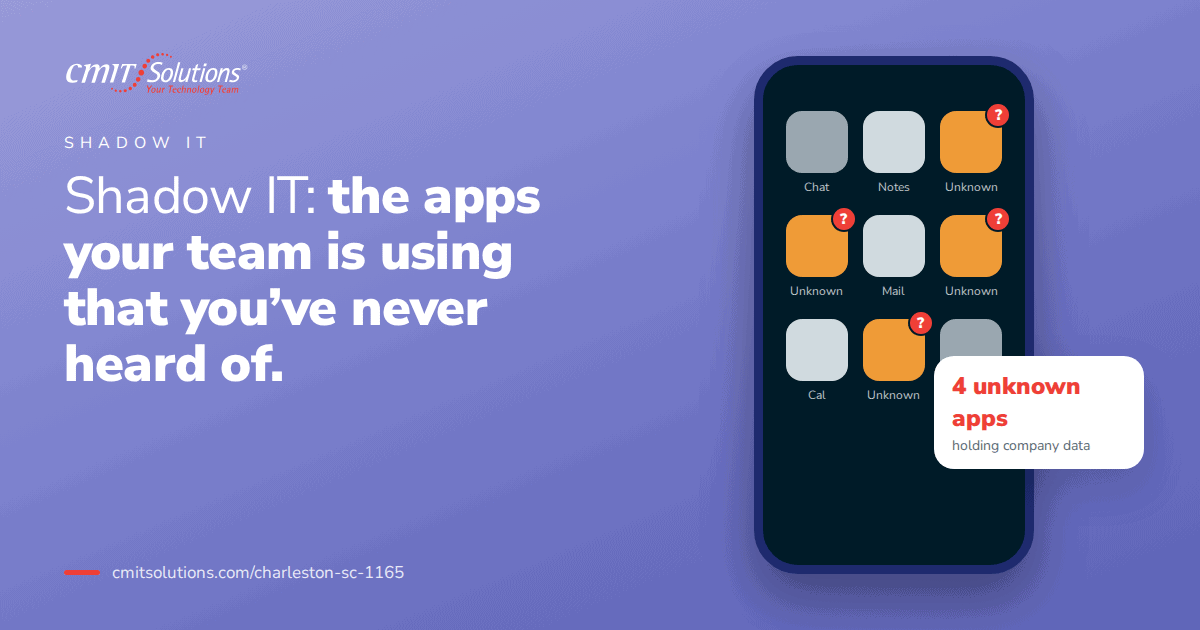
Open the expense reports at most companies and you will find software subscriptions nobody remembers approving. Open a laptop’s browser extensions and you will find tools nobody in IT installed. Ask five employees what applications they use to get work done, and you will get five different lists, several of which never touched a procurement process.
This is shadow IT: every application, account, and service employees adopt to do their jobs without the knowledge or approval of the people responsible for securing the business. It is not rare. It is not a sign of a poorly run company. It is close to universal, and it grows quietly in every organization that has not deliberately gone looking for it.
The name makes it sound sinister. It usually is not. Shadow IT is almost never malicious. It is a marketing coordinator signing up for a free design tool because the approved software took too long to request. It is a sales rep connecting a scheduling app to their calendar because coordinating meetings manually was slowing down deals. It is an entire department standardizing on a messaging app because email felt too slow, without anyone mentioning it to IT.
Good intentions built this problem. That does not make it any less risky.
Why Shadow IT Exists in the First Place
Shadow IT is not primarily a technology problem. It is a friction problem. Employees adopt unapproved tools because the approved path is slower, more restrictive, or simply absent.
The approval process is slow. When getting new software approved takes weeks, and a deadline is measured in days, employees route around the process rather than through it.
The existing tools do not do what is needed. When approved software lacks a feature someone needs today, they find something that has it, often in minutes, often for free.
Nobody asked. Most employees do not think of signing up for a free trial as a security decision. It feels like using a stapler. The connection between “app I found helpful” and “company data now sits with a third party” is not obvious to someone outside IT.
Free tools are frictionless. A free account requires no purchase order, no manager approval, and no conversation. It requires an email address and thirty seconds.
Remote and hybrid work removed the water cooler check. In a physical office, a coworker might mention what they are using and someone would notice. Distributed teams lose that ambient visibility entirely.
Recognizing this is the necessary first step, because a policy built on the assumption of malicious intent will fail. A policy built on the assumption of reasonable people solving problems quickly will actually work, a distinction explored further in unmonitored technology risks.
Where Shadow IT Actually Hides
Shadow IT is not one category of problem. It shows up in several distinct forms, each with its own risk profile.
Browser extensions
Extensions install in seconds and request permissions most users never read. Many request the ability to read and modify data on every website visited, which in practice means access to email, CRM records, internal tools, and anything else viewed in that browser.
Free SaaS accounts
Project management tools, design platforms, file converters, and note taking apps signed up for with a work or personal email, often holding real business data within days of adoption.
AI tools
A rapidly growing category on its own. Meeting assistants, writing tools, summarizers, and image generators frequently process the most sensitive content a business produces, a pattern examined closely in free AI tool risks and shadow AI adoption.
Personal cloud storage
Files moved to a personal cloud drive for convenience, often to work from home or share with someone outside a restricted system, placing company data entirely outside company control.
Messaging and collaboration apps
Group chats and channels created on platforms never sanctioned for business communication, sometimes carrying client information, financial detail, or personnel discussions.
Personal devices
Phones and tablets checking company email, accessing shared drives, or storing downloaded files, frequently without any of the security controls applied to managed company equipment.
Third party app connections
Calendar tools, scheduling assistants, and automation platforms granted access to email or cloud storage through a simple authorization click, rather than a formal integration.
Each of these categories individually feels minor. Combined across a team of twenty or thirty people over a year or two, they add up to a substantial, undocumented footprint of company data scattered across services nobody is tracking.
The Real Risk Profile
The danger of shadow IT is not any single tool. It is the aggregate exposure created when dozens of ungoverned services each hold a piece of the business.
Data goes where nobody can retrieve it
When an employee leaves, IT deactivates known accounts: email, VPN, core business systems. Shadow IT accounts are, by definition, not on that list. Company data uploaded to a personal account under a personal email address can leave with the employee and never be recoverable, whether or not that was ever the intent.

Security controls stop at the edge of what is visible
Multifactor authentication, endpoint monitoring, and access logging only protect systems that are known to exist. A shadow account sits entirely outside that perimeter, often protected by nothing stronger than a reused personal password. This is the exact blind spot addressed by proper endpoint protection coverage.
Compliance obligations do not pause for convenience
If regulated data, health records, financial details, or payment information ends up in an unapproved tool, the regulatory exposure is identical to a formal system breach. The business remains fully responsible, regardless of whether leadership knew the tool existed. Sector specific requirements are covered in HIPAA compliance clarity and PCI DSS handling standards.
Vendor security is completely unknown
An approved vendor goes through evaluation before adoption. A shadow tool goes through nothing. Its encryption practices, breach history, subprocessor list, and data retention policy are unknown quantities, and a breach at that vendor becomes a breach of your data with no advance warning.
Attack surface grows without anyone tracking it
Every additional account is an additional password that can be phished, guessed, or reused from a previous breach. Every extension is additional code running with broad permissions inside the browser. Every unapproved connection is one more path into the business that security tooling never accounted for.
Duplicate and conflicting data creates its own mess
When three team members solve the same problem with three different tools, the business ends up with fragmented, inconsistent, and sometimes contradictory versions of the same information, none of which is backed up according to any defined standard.
A Realistic Discovery Exercise
Most leadership teams underestimate shadow IT by a wide margin, typically because they are working from memory rather than evidence. A structured discovery exercise consistently reveals more than expected.
Review financial records. Search expense reports, corporate card statements, and accounting software for recurring software charges. Anything unrecognized deserves a follow up conversation.
Audit browser extensions across managed devices. Extension inventories are often the single largest surprise, particularly the scope of permissions already granted.
Check cloud application authorizations. Google Workspace and Microsoft 365 both maintain logs of third party applications granted access, frequently listing services nobody remembers approving.
Ask directly, without penalty attached. A short, blame free survey asking what tools people actually use to get work done routinely surfaces more than technical scanning alone, precisely because it removes the fear that honesty will be punished.
Review network traffic patterns. Unusual or unexpected destinations in traffic logs often point to services never formally adopted.
This is the same discipline behind continuous threat exposure management: you cannot secure what you have not found, and finding it requires deliberate effort rather than assumption.

Building a Response That Actually Works
The instinct after a discovery exercise is often to lock everything down immediately. That approach tends to fail, because it treats the symptom while leaving the underlying cause, friction, fully intact. Employees who lose an unapproved tool without a viable alternative will simply find a different one, this time perhaps more carefully hidden.
Start with visibility, not punishment
The first conversation should focus on understanding why a tool was adopted rather than penalizing its use. Most answers reveal a legitimate gap: a missing feature, a slow process, or an unmet need. That information is genuinely useful for building a better approved stack.
Create a fast, realistic approval path
If getting a new tool approved takes six weeks, shadow IT will always win. A lightweight review process, even a same day or same week turnaround for low risk tools, keeps decisions inside a governed process instead of pushing them underground.
Build an approved list that actually covers real needs
An approved tool list built only around what IT already knows will miss the genuine gaps driving shadow adoption. Include the discovery findings when building it, because the tools employees already reached for are the clearest evidence of what the business actually needs.
Classify data before classifying tools
Not all information carries the same risk. Public marketing material can move through a wider range of platforms than a client contract or a patient record. A practical framework:
- Public data: minimal restriction
- Internal data: approved general business tools only
- Confidential data: contractually governed platforms only
- Regulated data: platforms under a signed data processing or business associate agreement, with no exceptions
Put the policy in writing, briefly
A usable shadow IT policy fits on a page or two and covers what is approved, what data classification applies where, how to request a new tool, and who to ask when unsure. The broader case for a written framework is made in clear AI usage policy, and the same logic applies to every category of shadow software.
Enforce technically, not only on paper
Written policy alone relies entirely on memory and goodwill. Real enforcement includes browser extension allow lists managed centrally, conditional access tied to identity, alerts on new third party application authorizations, and blocking of known high risk services at the network layer, all standard components of network security management.
Formalize offboarding to include shadow accounts
Departure checklists should explicitly ask what tools the employee used beyond the standard company list, closing the exact gap where data most often walks out the door unnoticed.
Review on a recurring schedule
Shadow IT is not a project with an end date. New tools launch constantly, and the environment shifts every quarter. Recurring review, ideally aligned with regular IT strategy sessions, keeps the picture current rather than accurate only on the day it was drawn.
Where This Intersects With Compliance
For regulated industries, shadow IT is not just an operational inefficiency. It is a direct compliance exposure.
Healthcare organizations face particular risk when patient information moves into unapproved scheduling, messaging, or file sharing tools, an issue detailed in healthcare data protection strategies.
Financial and accounting firms carry safeguard obligations that extend to every service touching client financial data, formal or shadow, covered in accounting firm safeguards and shadow AI in finance.
Law firms hold client confidentiality obligations that do not distinguish between an approved case management platform and a personal file sharing account used out of convenience, discussed in law firm digital confidentiality.
Any business carrying cyber insurance should assume that underwriting and claims review increasingly account for unmanaged software exposure, a shift outlined in evolving insurer requirements.
Formal governance structures for this exact problem are addressed in comprehensive compliance management.
Why This Has Accelerated Recently
Shadow IT has existed for as long as employees have had internet access, but three trends have expanded it considerably in a short period.
AI adoption moved faster than governance. Free AI tools spread through teams before most companies had written a single sentence of policy governing their use, a gap explored in reshaping small business IT.
Remote work normalized personal device use. Boundaries between personal and professional technology blurred considerably once work routinely happened from home.
SaaS adoption barriers disappeared. Nearly every business tool now offers instant signup with no procurement conversation required, compared to the formal purchasing processes of a decade ago.
None of these trends are reversing. Governance has to adapt to that reality rather than wait for it to slow down.
What Good Governance Actually Feels Like
Businesses that manage this well do not eliminate flexibility. They redirect it. Employees still get to solve problems quickly. They simply do it within a framework that keeps data visible, contracts in place, and security controls intact.
That balance is difficult to sustain without dedicated attention, which is exactly the gap filled by managed IT services, layered cybersecurity protection, and properly licensed productivity application management. When employees have fast access to capable, approved tools, the incentive to go around IT largely disappears on its own.
At CMIT Solutions of Charleston, shadow IT discovery consistently turns up more than clients expect, not because their teams are careless, but because invisible growth is simply what happens when nobody has looked deliberately in a while.
Conclusion
Shadow IT is not a failure of any single employee’s judgment. It is what happens naturally when approved processes are slower than the problems people need to solve, and it grows in every organization that has not deliberately looked for it. The apps hiding in browser extensions, expense reports, and personal cloud accounts were not adopted out of carelessness. They were adopted because they worked, quickly, for whoever needed them at the time.
That is precisely why the fix cannot be prohibition alone. A faster approved path, genuine visibility into what is actually in use, and data classification that matches protection to sensitivity will do more than any policy document that nobody reads. The businesses that manage this well are not the ones with zero shadow IT. They are the ones who found it, understood why it existed, and built a system flexible enough that employees stopped needing to go around it.
If you are unsure what applications, extensions, and accounts are currently touching your business data, that uncertainty is the starting point worth addressing. Our team supports organizations across the Lowcountry as their Charleston managed technology partner in bringing exactly this kind of hidden risk into view, and the full range of support is outlined on our Charleston IT services overview.
Curious what shadow IT might already be running in your business? Schedule a consultation with CMIT Solutions of Charleston for a clear, judgment free look at what’s really connected to your systems.
Frequently Asked Questions