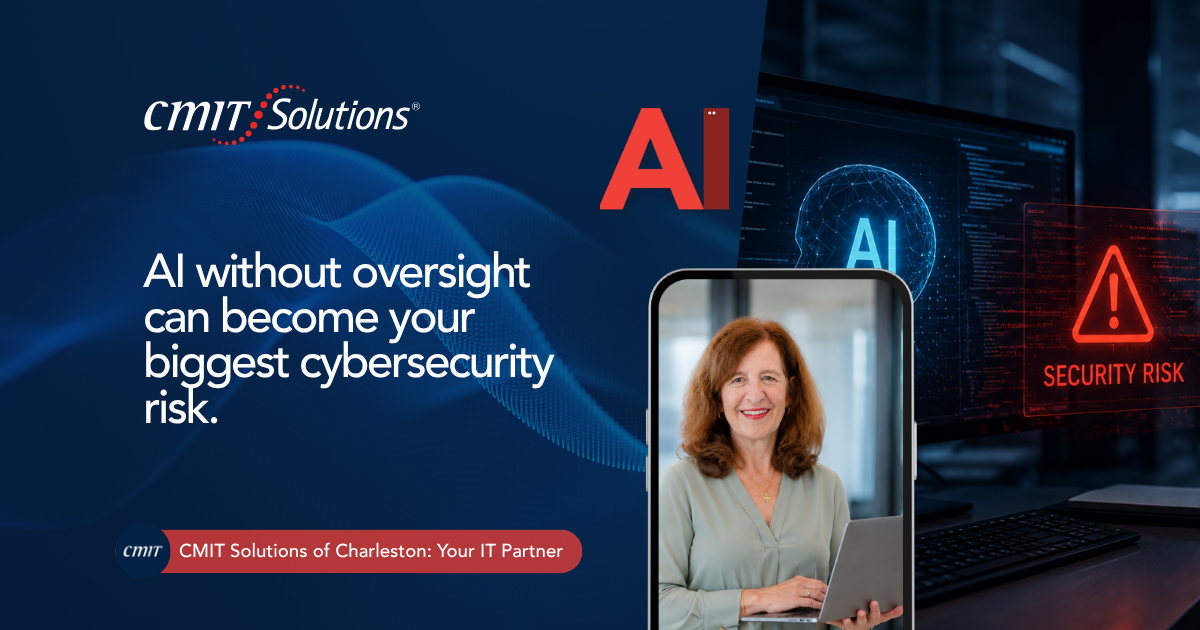
Walk through almost any office today and you will find employees quietly using AI tools that IT never approved. Someone is pasting a client contract into a chatbot to summarize it. Someone else is using a free writing assistant to draft an email that includes internal financial figures. A sales rep is uploading a spreadsheet of customer contacts to generate a marketing message faster. None of this is malicious. It is simply employees trying to work faster with tools that are free, easy to access, and genuinely helpful.
This behavior has a name: shadow AI. It refers to the use of artificial intelligence tools by staff without the knowledge, approval, or monitoring of the IT department. It is one of the fastest-growing risks facing small and mid-sized businesses right now, and most owners have no idea how widespread it already is inside their own company.
CMIT Solutions of Charleston works with local businesses that are only beginning to grapple with this issue. The tools themselves are not the problem. The problem is that they are being used without any visibility, policy, or safeguards in place. This article walks through exactly what is at stake, why it matters, and what business owners can do about it.
What Is Shadow AI, Exactly?
Shadow AI is a subset of a broader issue known as shadow IT, which refers to any technology used within an organization without formal approval from the IT department. AI has made this problem worse because the barrier to entry is so low. Employees do not need to install anything or request access from a system administrator. Many AI tools are available instantly through a web browser, often for free.
Common examples of shadow AI use inside businesses include:
- Pasting internal documents into public chatbots to summarize or rewrite them
- Using AI writing tools to draft client communications containing sensitive details
- Uploading spreadsheets or reports to AI platforms for quick analysis
- Using AI image or design tools that store uploaded content on external servers
- Relying on browser extensions with built-in AI features that scan page content automatically
None of these actions typically feel risky to the employee doing them. That is exactly what makes shadow AI such a difficult problem to manage. It grows quietly, one small shortcut at a time.
Why This Trend Is Accelerating
A few factors are pushing shadow AI adoption faster than most IT departments can keep up with:
- AI tools are now embedded directly into browsers, operating systems, and everyday apps
- Free tiers make experimentation effortless, with no purchasing approval required
- Employees are under pressure to work faster and see AI as an easy way to save time
- Many staff members genuinely do not realize that pasting company data into a public tool means that data may leave the company’s control entirely
Understanding the broader evolving threat environment helps explain why this particular risk deserves attention now rather than later. Attackers are already looking for gaps created by unmanaged tools, and shadow AI is exactly the kind of gap they exploit.
The Real Risks of Unmonitored AI Use
Data Leakage and Loss of Control
The most immediate risk is data leaving the company without anyone knowing. Once information is entered into a public AI tool, the business generally loses control over how that data is stored, used, or potentially reused to train future versions of the tool. This can include:
- Client names, contact details, and contract terms
- Financial figures and internal reports
- Proprietary processes, pricing strategies, or product plans
- Employee records or HR-related information
For businesses that rely on reliable backup systems to protect their information, it is worth remembering that backups only protect data that stays within controlled systems. They do nothing to prevent data from being copied into external tools by well-meaning staff.
Compliance Violations
Many industries have strict rules about how customer or patient data can be stored, transmitted, and processed. When an employee pastes sensitive information into an unapproved AI tool, that action can trigger a compliance violation without anyone realizing it happened.
Healthcare providers need to be especially careful, since healthcare data rules apply regardless of which tool an employee happens to be using. Businesses in other regulated industries should also understand compliance framework basics so that AI usage policies align with existing legal obligations rather than creating new exposure.
Security Vulnerabilities
Unapproved tools have not gone through any security review. IT has no way of knowing whether a given AI platform encrypts data properly, stores it securely, or has ever suffered a breach of its own. Some free tools have weak security practices precisely because they are not charging users enough to invest heavily in protection.
This creates a gap in understanding security layers across the business, since even the strongest firewall or endpoint protection cannot stop data from walking out the front door through a browser tab. Businesses that have invested in layered security stack protection often overlook this exact blind spot.
Inconsistent and Unreliable Outputs
AI tools can produce confident-sounding answers that are simply wrong. This is often referred to as hallucination, where the tool generates information that sounds plausible but has no basis in fact. Employees who trust these outputs without verification can introduce errors into client communications, reports, or decision-making.
- Incorrect figures included in client-facing documents
- Fabricated citations or sources used in research
- Flawed logic embedded into automated recommendations
- Inconsistent tone or messaging across different departments using different tools
Without any preventive support approach guiding how these tools are used, errors like these often go unnoticed until a client or customer catches them first.

Intellectual Property Risk
Some AI platforms retain the content submitted to them and may use it to improve their own models. This raises serious questions about who owns the output and whether proprietary business information has effectively been shared with a third party permanently. For businesses built around unique processes, formulas, or creative work, this risk deserves serious attention.
Increased Exposure to Phishing and Social Engineering
Attackers are aware that employees are experimenting with AI tools, and they are exploiting that trend. Fake AI tools, malicious browser extensions disguised as productivity assistants, and phishing emails referencing popular AI platforms are all on the rise. Businesses should study convincing phishing scams to understand how attackers are using the same AI trend to make their own campaigns more effective.
The broader pattern of increasing ransomware risk shows how attackers often use a single point of unmanaged access, such as a compromised browser extension or shadow AI tool, as their entry point into a larger network.
Fragmented Vendor Risk
Every unapproved AI tool represents a new vendor relationship that IT never vetted. Multiply this across dozens of employees each choosing their own favorite tools, and a business can end up with data scattered across a wide range of platforms, each with different terms of service, security practices, and data retention policies. This fragmentation makes it nearly impossible to answer basic questions like where company data actually lives.
Why Traditional IT Policies Are Not Enough
Many businesses still operate with outdated acceptable use policies that never mention AI at all. Even businesses with strong general cybersecurity practices can be caught off guard because shadow AI does not look like a typical security incident. There is no malware alert, no failed login attempt, no obvious red flag. It simply looks like an employee getting their work done faster.
This is why the gaps between apps that businesses already use tend to be where shadow AI thrives. Data moves between approved systems and unapproved tools without ever triggering a traditional security alert, since the tools themselves are not inherently malicious.
Building an AI Governance Framework That Actually Works
The goal is not to ban AI outright. Employees will find workarounds, and banning useful tools often just pushes the behavior further underground where it becomes even harder to monitor. Instead, businesses need a framework that channels AI use through approved, secure paths.
A practical governance framework typically includes:
- A clear, written AI usage policy. Define which tools are approved, what data can and cannot be entered into them, and who to contact with questions.
- An approved tool list. Give employees legitimate, secured alternatives so they are not forced to choose unapproved options out of necessity.
- Data classification guidelines. Make clear which types of information should never leave internal systems, regardless of the tool involved.
- Employee training. Most shadow AI use comes from a lack of awareness, not bad intent, so training closes that gap quickly.
- Monitoring and visibility tools. IT needs a way to see which cloud applications and browser extensions are actually being used across the network.
- Regular policy reviews. AI tools change quickly, and policies need to be revisited often enough to stay relevant.
Businesses without dedicated internal IT staff often benefit from expert technology guidance to help draft and enforce these policies in a way that fits their size and industry, rather than adopting a generic template that does not match how the business actually operates.
Practical Steps Business Owners Can Take Today
- Conduct an inventory of AI tools currently in use across departments, even informally
- Review assess ai readiness to understand where governance gaps currently exist
- Set up business network oversight that provides visibility into what applications and services employees are accessing
- Ensure secure cloud infrastructure is in place so approved AI tools operate within a properly managed environment
- Provide workplace productivity tools with built-in AI features that have already been vetted for security and compliance
- Strengthen cybersecurity protection plans to include monitoring for unauthorized cloud application use, not just traditional malware

Balancing Productivity Gains With Oversight
It is worth acknowledging that the employees using these tools are usually trying to do good work. AI genuinely helps people draft emails faster, summarize long documents, and handle repetitive tasks with less effort. The goal of governance is not to eliminate that benefit but to make sure it does not come at the cost of data security or compliance.
Businesses that get this balance right tend to see real gains. Reviewing outsourced it advantages shows how bringing in outside expertise can help strike that balance without slowing teams down. Companies also benefit from staying current on practical ai use cases that have already been tested and approved, giving employees safe options that meet the same needs shadow tools were filling.
Selecting the Right Tools and Partners
Choosing which AI tools to formally approve requires the same rigor as any other technology purchase. Business owners should look for vendors with clear data handling policies, strong encryption practices, and a track record of security compliance.
When outside expertise is needed to evaluate options, selecting security partners offers a useful framework for vetting any technology vendor, not just security-specific ones. Businesses should also make sure their overall approach to protecting sensitive data accounts for AI tools specifically, since older compliance frameworks were not written with generative AI in mind.
For businesses planning new hardware or software purchases as part of an AI governance rollout, reviewing hardware software procurement options ahead of time helps avoid rushed decisions made under pressure.
Why This Matters for Charleston Businesses Specifically
Local businesses are not immune to this trend simply because of their size. In fact, smaller companies are often more exposed, since they typically lack a dedicated IT security team monitoring cloud application use around the clock. Many Charleston companies are already rethinking approach decisions specifically because of how quickly AI tools have entered daily workflows.
Companies experiencing local business expansion are especially at risk, since fast growth often means onboarding new employees faster than policies and training can keep pace. It also helps to understand facing tech hurdles common to similarly sized businesses so that AI governance efforts address realistic, local challenges rather than generic advice.
Businesses working through changing operational workflows should build governance into the process from the start rather than trying to retrofit policies after tools are already in widespread, unmanaged use. Reviewing how peers are working smarter cloud adoption can also offer a helpful benchmark for what secure, well-managed AI integration actually looks like in practice.
Conclusion
Shadow AI is not going away, and pretending it is not happening inside your business is not a strategy. Employees will keep finding tools that make their jobs easier, and the businesses that succeed will be the ones that get ahead of this trend with clear policies, proper training, and real technical oversight rather than reacting after a data leak or compliance issue occurs.
Building this kind of governance takes time, but it does not have to be built alone. With the right guidance, businesses can capture the real productivity benefits of AI while closing the gaps that put sensitive data, compliance standing, and customer trust at risk. Staying current with ongoing AI insights is one practical way to keep policies aligned with how quickly these tools continue to change, and reviewing budgeting tools resource options can help plan the investment needed to bring shadow AI under control before it becomes a bigger problem.
Frequently Asked Questions