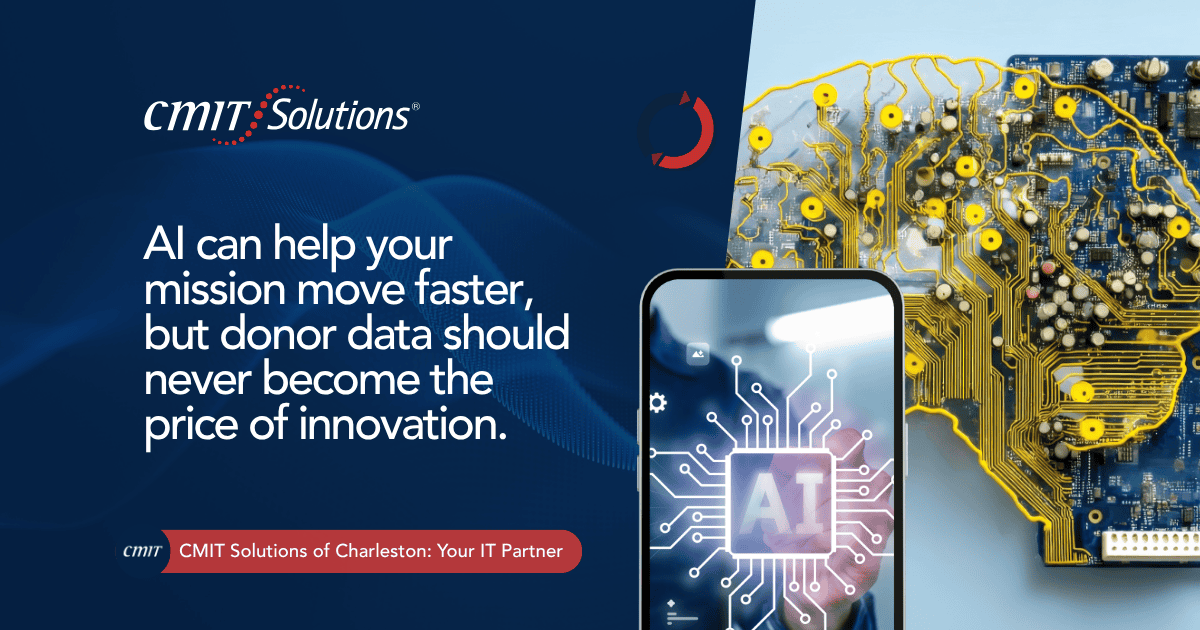
Every sector is experimenting with AI agents right now, and non-profits are no exception. Grant writing assistants, donor communication bots, automated outreach tools, and AI powered CRM features are showing up in fundraising platforms faster than most organizations can evaluate them. The appeal is obvious. Small teams with limited staff can suddenly do the work of a much larger department.
But there is a catch that many non-profits are discovering too late. Donor data is some of the most sensitive information an organization holds, including names, addresses, giving history, payment details, and sometimes personal notes about a donor’s circumstances or relationships. Feeding that data into AI tools without a clear policy in place can expose an organization to privacy violations, donor distrust, and in some cases regulatory consequences.
CMIT Solutions of Charleston works with non-profit organizations across the Lowcountry that are trying to balance the real benefits of AI adoption against the very real risks of losing control over sensitive donor information. This guide walks through what AI agents actually are, where the risk shows up, and how organizations can adopt these tools responsibly.
What Are AI Agents, Exactly
AI agents are different from the chatbots most people are used to. Instead of just answering a question, an agent can take actions on its own, such as drafting and sending an email, updating a record in a CRM, scheduling a follow up call, or pulling data from one system and inserting it into another. This autonomy is what makes agents powerful, and it is also what makes them risky when they are given access to sensitive systems without proper guardrails.
Non-profits are adopting agents in a few common areas:
- Donor communication and personalized outreach
- Grant research and proposal drafting
- Volunteer coordination and scheduling
- Social media content generation
- Data entry and CRM updates
- Donor segmentation and giving pattern analysis
Each of these use cases touches donor data in some way, which is exactly why a thoughtful approach matters before rolling any of it out organization wide.
Why Donor Data Deserves Special Attention
Donor records are not just contact information. They often include giving history, payment methods, communication preferences, and sometimes sensitive personal context tied to why someone gives, such as a connection to an illness, a loss, or a cause tied to their own life experience.
A breach or misuse of this information does more than create a compliance headache. It damages the trust that fundraising depends on entirely. Donors give because they believe an organization will handle their information responsibly, and a single mishandled data exposure can permanently change that relationship.
Reviewing how data privacy expectations have shifted in recent years shows this is not unique to non-profits either. Donors, like customers, increasingly expect organizations to demonstrate real accountability, not just a privacy policy buried on a website.
Where AI Adoption Commonly Goes Wrong
Most data exposure incidents involving AI tools do not happen because of a sophisticated attack. They happen because well meaning staff use a tool without understanding what happens to the data they input.
Common mistakes include:
- Pasting donor lists into a free AI writing tool to generate personalized appeal letters
- Connecting a CRM to a third party AI plugin without reviewing its data handling terms
- Using AI note taking tools during board meetings that discuss sensitive donor relationships
- Allowing staff to use personal AI accounts for organizational work
- Adopting an AI feature bundled into existing software without reading how it processes data
This pattern, often called shadow AI, happens when staff adopt tools independently without IT or leadership approval. Understanding shadow AI risks is one of the first steps toward building a policy that actually reflects how staff are using these tools in practice, rather than how leadership assumes they are being used.
Building an AI Usage Policy Before Adopting New Tools
The single most effective step a non-profit can take is putting a written AI usage policy in place before staff start experimenting with new tools on their own. Waiting until after adoption makes it much harder to correct course.
A solid policy should address:
- Which AI tools are approved for organizational use
- What types of data can and cannot be entered into those tools
- Who approves new AI tools before they are adopted
- How donor data must be anonymized or minimized before use in any AI system
- What happens if a staff member accidentally exposes sensitive information
Organizations that have not yet formalized this should review why AI usage policy development matters, since the guidance applies just as directly to non-profits managing donor records as it does to businesses managing customer data.
Understanding the Compliance Landscape
Non-profits are not exempt from data privacy regulation simply because they are mission driven organizations. Depending on where donors are located and what type of data is collected, several overlapping frameworks may apply.
Organizations with international donors, particularly those in Europe, should be familiar with GDPR compliance guide requirements, since these rules apply based on donor location rather than organizational headquarters.
Similarly, organizations with California based donors need to understand CCPA compliance requirements, which govern how personal information must be disclosed, protected, and, in some cases, deleted upon request.
AI tools complicate compliance further because data entered into a third party AI system may be stored, used for model training, or shared with subprocessors depending on the vendor’s terms. Reviewing AI data privacy considerations before adopting any new tool helps organizations avoid unknowingly violating these obligations.
Evaluating AI Vendors Before Granting Access
Not all AI tools are built the same way, and the fine print matters enormously when donor data is involved. Before granting any AI tool access to organizational systems, non-profits should ask vendors directly:
- Where is data stored, and is it encrypted at rest and in transit
- Is donor data used to train the vendor’s AI models
- Can data be permanently deleted upon request
- Does the vendor undergo independent security audits
- What happens to data if the organization cancels the subscription
Vendors unwilling or unable to answer these questions clearly should be treated as a red flag, regardless of how impressive the tool’s features appear during a demo.
The Risk of Generative AI Tools Specifically
Generative AI tools, the kind used for drafting emails, grant proposals, or social media posts, present a particular risk because staff often paste large blocks of text directly from donor records or internal documents to get better output. This is one of the most common ways sensitive information ends up outside an organization’s controlled systems.
A broader look at generative AI risks highlights how this exact pattern is playing out across industries, not just within the non-profit sector, and why organizations of every size need clear boundaries around what information can be shared with these tools.
AI Agents and the Rise of Autonomous Data Access
Unlike a simple chatbot, an AI agent connected to a CRM or donor database can act on its own, pulling records, sending communications, and updating fields without a human reviewing every action first. This level of autonomy is powerful for efficiency, but it also means a misconfigured agent can expose or mishandle data at a much larger scale than a single staff mistake ever could.
Organizations exploring this technology should review how agentic AI trends are evolving, since the same autonomous capabilities driving efficiency gains in the business world carry parallel risks when applied to donor management systems without proper oversight.

Practical Steps for Safe AI Adoption
Non-profits do not need to avoid AI altogether to protect donor data. A structured, cautious approach allows organizations to capture the benefits while keeping sensitive information under control.
Start With Low Risk Use Cases
Begin with AI applications that do not touch sensitive data directly, such as drafting general content, summarizing publicly available research, or generating social media ideas. This allows staff to build familiarity with the technology before it touches anything sensitive.
Limit Data Access by Role
Not every staff member needs access to full donor records, and not every AI tool needs a connection to the full database. Role based access limits exposure if a single account or tool is compromised.
Anonymize or Minimize Data Before Use
Whenever possible, remove personally identifying details before information is entered into an AI system. Aggregated giving trends can often accomplish the same analytical goal without exposing individual donor identities.
Require Human Review Before Actions Are Finalized
AI generated donor communications, especially anything referencing giving history or personal circumstances, should be reviewed by a staff member before being sent. This catches errors and prevents inappropriate or inaccurate content from reaching donors directly.
Train Staff Regularly, Not Just Once
AI tools and their risks evolve quickly, and a single onboarding session is not enough. Reinforcing expectations through ongoing security awareness training keeps staff alert to new risks as tools and threats continue to change.

Identifying Which Processes Are Actually Ready for AI
Not every workflow benefits from AI adoption, and rushing to automate everything at once increases risk without necessarily improving outcomes. Taking time to evaluate AI automation readiness helps organizations prioritize the areas where AI adds genuine value, such as reducing repetitive administrative work, while leaving more sensitive donor facing processes under closer human control for now.
Moving From Hype to Practical Results
Many non-profits feel pressure to adopt AI simply because everyone else seems to be doing it, without a clear plan for how it fits their actual operations. This kind of rushed adoption is exactly where data control problems tend to start. Learning from practical AI integration approaches helps organizations focus on tools that solve real problems rather than adopting technology simply to keep pace with trends.
AI as Augmentation, Not Replacement
The most successful non-profit AI adoption stories tend to treat these tools as support for staff rather than a replacement for human judgment, particularly when donor relationships are involved. Understanding the shift from AI workforce augmentation reinforces why keeping a human in the loop on donor facing decisions protects both data integrity and the relationship itself.
The Threat Side of AI Cannot Be Ignored
While much of this conversation focuses on responsible internal use, non-profits also need to consider how AI is changing the threats they face from outside the organization. Donor databases are attractive targets, and criminals are using the same AI advances to make their attacks more convincing.
Phishing emails impersonating donors, board members, or grant officers have become significantly harder to detect. Reviewing how AI powered phishing tactics work helps staff recognize that traditional red flags like poor grammar are no longer reliable indicators of a fraudulent message.
More broadly, understanding AI driven threats gives non-profit leadership a fuller picture of why data protection cannot be treated as a one time project, but rather an ongoing part of how the organization operates.
Building defenses against these evolving tactics requires the same layered thinking applied to internal AI policy. Reviewing strategies for AI cyber defense gives organizations a starting point for aligning both sides of the equation, safe internal use and protection from external AI enabled attacks.
Rethinking IT Strategy Around AI
AI adoption is prompting many organizations, non-profits included, to reconsider their broader technology strategy rather than bolting AI tools onto outdated systems. Reviewing why organizations are modern IT strategy planning around AI shows how thoughtful infrastructure decisions now can prevent much larger headaches later as AI tools become even more deeply embedded in daily operations.
Done correctly, AI can genuinely help smaller organizations compete for attention and resources against much larger institutions. Exploring how organizations can see real AI adoption benefits offers a useful reminder that the goal is not to avoid AI out of fear, but to adopt it with the right safeguards in place from the start.
Building the Right Infrastructure to Support Safe AI Use
None of this policy work matters if the underlying technology infrastructure is not equipped to support it. Non-profits need reliable systems and expert oversight to implement these safeguards effectively.
A properly managed cybersecurity solutions team can help organizations evaluate AI tools, configure access controls, and monitor for suspicious activity tied to donor systems.
Cloud based donor management platforms are common across the sector, and secure cloud infrastructure services ensure that data stored and processed through these platforms remains properly protected.
Reliable data protection solutions give organizations a safety net in case an AI integration or third party tool causes unexpected data loss or corruption.
Regulatory obligations tied to donor data also benefit from dedicated attention. Ongoing regulatory compliance support helps non-profits document their practices in a way that satisfies both donor expectations and applicable privacy laws.
Day to day technical issues should never distract staff from mission focused work. Dependable dependable IT support keeps systems running smoothly so staff can focus on programs and fundraising rather than troubleshooting.
Non-profits operating across multiple offices or program sites also need consistent connectivity. Well configured network monitoring services reduce the risk of outages disrupting time sensitive donor campaigns or events.
Software tools used for grant writing, donor management, and program tracking need ongoing oversight as well. Reliable productivity software support keeps these systems properly configured and updated as AI features continue to roll out across common platforms.
Communication across staff, board members, and volunteers also plays a role in overall data security. Consolidated communication platform solutions reduce the number of separate tools staff rely on, lowering the number of potential points where sensitive information could be mishandled.
Organizations unsure where their current setup stands often benefit from an outside review before rolling out new AI tools. Independent IT consulting services can identify gaps in donor data protection before they become a larger problem.
New hardware or software purchases tied to AI adoption should be sourced and configured correctly from the outset. Streamlined hardware procurement services help organizations avoid costly missteps when investing in new technology.
For non-profits looking for a coordinated approach across all of these areas, bundled comprehensive IT packages often provide better value and more consistent protection than managing multiple vendors separately.
And for organizations building a long term technology strategy that supports safe AI adoption across every program and location, broader managed technology services provide the consistent oversight needed to keep donor data protected as AI tools continue to expand across the sector.
Moving Forward With Confidence
AI agents are not going away, and the pressure to adopt them will only grow as more platforms build these capabilities directly into everyday tools. Non-profits do not need to choose between innovation and donor trust. With a clear policy, careful vendor vetting, role based access controls, and ongoing staff training, organizations can capture the real benefits of AI while keeping donor data firmly under their own control.
CMIT Solutions of Charleston works with non-profit organizations throughout the Lowcountry to build practical, mission appropriate technology strategies that protect donor trust while supporting growth. If your organization is exploring AI tools without a clear data protection plan in place, now is the time to get one. Schedule a consultation to talk through where your current systems stand and how to move forward safely.
Frequently Asked Questions