An AI acceptable use policy is a set of internal rules that defines how your employees can use AI tools at work, what data they can input, which tools are approved, and how usage is reviewed and enforced.
CMIT Solutions works as a trusted technology advisor to small and mid-sized businesses, helping them protect sensitive data, support compliance, and let teams adopt AI with confidence.
Download an AI acceptable use policy template for your business
Fill out the form below to download:
What an AI acceptable use policy actually does
An AI acceptable use policy gives your team clear answers to three questions:
- Which AI tools are approved
- What data is off-limits
- What happens when someone needs a new tool
Without those answers in writing, every employee makes their own judgment call, and cybersecurity uncertainty fills the gap.
Most of the risk inside an SMB lives in those judgment calls. The policy is not a document for lawyers to admire; it is an operational tool that enables staff to use AI productively without exposing customer data, intellectual property, regulated information, or credentials to platforms your business has not vetted.
A workable SMB policy typically does five things:
- Defines scope and ownership: Specifies who the policy covers, including employees, contractors, and vendors, and names the person or team responsible for reviewing AI tools and handling exceptions.
- Lists approved AI tools: Identifies which platforms are sanctioned for business use, what each one can be used for, and which versions of those platforms are acceptable (for example, an enterprise tier with no model training on company data).
- Sets clear data handling rules: States what categories of data must never be entered into any AI tool, including customer records, payment information, protected health information, controlled unclassified information, source code, and financial data.
- Establishes a request process: Provides a simple path for employees to request new tools, with a defined review window to prevent people from waiting indefinitely.
- Defines consequences and oversight: Explains how policy violations are reported, who reviews them, and how AI-generated content gets verified before it leaves the business.
CMIT Solutions builds AI policies that work this way by design, embedding clear operational guardrails into a security-first IT environment so businesses can replace guesswork with rules their teams will actually follow.
Why SMBs need an AI acceptable use policy now
The risk facing most small and mid-sized businesses is not that AI is dangerous. It is that AI usage is already happening inside your business, and you almost certainly do not have visibility into all of it.
Staff are pasting customer information into ChatGPT, using Copilot to draft internal documents, and trying free AI plugins inside browsers, often without anyone reviewing the data handling implications. This pattern is known as shadow AI, and it is now one of the most common cybersecurity exposures in SMB environments.
The challenge is not the technology itself. The challenge is that AI tools accept any input an employee gives them, then store, transmit, or train on that data in ways the employee cannot see.
Three risks come up repeatedly:
- Data exposure: Sensitive business or customer data entered into a public AI tool may be used to train the underlying model, retained in vendor logs, or made available to other users. The data may never come back, and you may never know it left.
- Compliance violations: AI usage that touches regulated data can trigger violations under HIPAA, CMMC, PCI-DSS, SOX, GDPR, CPRA, and FISMA. Penalties scale quickly when the exposure includes patient records, controlled unclassified information, or payment data.
- Operational disruption: AI-generated errors that go uncaught can produce flawed contracts, inaccurate financial figures, or misleading customer communications. The cost of correcting these errors often exceeds the time the AI tool saved.
Download an AI acceptable use policy template for your business today.

The five essential components of an SMB AI acceptable use policy
Most SMB AI policies that fail share the same problem. They were copied from enterprise templates that assume dedicated security teams, formal change management processes, and legal review for every new tool, none of which scales down to a 25-person business juggling growing IT complexity without the benefit of trusted long-term technology guidance.
The five components below are what CMIT builds into SMB AI policies as part of its work as a strategic technology advisor, designed to function in practice rather than sit in a binder.
1. Scope, ownership, and definitions
The policy needs to state clearly who is covered, what counts as an AI tool, and who owns the policy. For most SMBs, the policy covers all employees, contractors, and any third parties who handle company data on the business’s behalf.
Ownership should sit with one named person or role, even if that role consults with others. A policy with no clear owner does not get updated, and outdated AI policies are nearly as risky as no policy at all.
2. Approved tools and prohibited uses
This is the operational heart of the policy. It should include a list of currently approved AI tools, what each one is approved for, and what data classifications each tool is permitted to handle.
It should also include a clear list of prohibited actions. Approved use examples might include drafting internal communications, summarizing meeting notes, generating first-draft marketing copy, and conducting general research, while prohibited actions typically include entering customer records, financial data, source code, or regulated information into any consumer-grade AI tool.
3. Data classification and handling rules
Every SMB has at least three categories of data:
- Public
- Internal
- Sensitive
The policy needs to state which categories can be used with which AI tools.
For example, public marketing copy may be acceptable to process with a consumer AI tool, while sensitive customer or compliance data must only be handled through an approved enterprise platform with appropriate data protection commitments.
4. Tool request and approval workflow
Employees will encounter useful new AI tools faster than any approval process can vet them. The policy needs a clear, lightweight request workflow so people do not bypass it out of frustration.
A workable SMB process includes a simple submission form, a defined review window (typically five to ten business days), and clear decision criteria covering data handling, vendor stability, and integration with existing systems.
5. Monitoring, review, and enforcement
The policy needs to address how AI usage is monitored, how violations are reported, and how the policy itself is reviewed and updated. AI tools shift quickly, and a policy that is not reviewed at least twice a year falls behind reality.
Enforcement does not need to be punitive. For most SMBs, the goal is education first, escalation second, with formal consequences reserved for serious or repeated violations involving sensitive data.

A practical structure for your SMB AI acceptable use policy
The structure below is a working outline most SMBs can adapt without legal review for the first version. It is designed to be readable in under ten minutes and short enough that employees will actually finish it.
| Section | Purpose | Typical length |
| Policy purpose and scope | Defines who the policy applies to and what it covers | 1 paragraph |
| Definitions | Clarifies what counts as an AI tool, sensitive data, and approved use | Half a page |
| Approved AI tools list | Lists current sanctioned tools and their permitted uses | 1 page (updated quarterly) |
| Prohibited actions | States what data and activities are off-limits | 1 page |
| Data handling rules | Connects AI usage to existing data classification | 1 to 2 pages |
| Tool request and approval workflow | Explains how employees request new tools | Half a page |
| Monitoring and oversight | States how AI usage is reviewed and audited | Half a page |
| Reporting violations | Provides reporting channels and confidentiality | Half a page |
| Acknowledgment | Confirms each employee has read and accepted the policy | 1 paragraph |
Download our ready-to-use AI acceptable use policy to help employees use AI securely, responsibly, and consistently.
Approved versus prohibited AI use cases for SMBs
The table below shows realistic examples of approved and prohibited AI use cases for a typical small or mid-sized business. Without clear rules in either direction, even well-intentioned staff can trigger data exposure or compliance violations in a single prompt.
The specifics will vary by industry, but the pattern is consistent: approved uses involve non-sensitive content or sanctioned platforms with appropriate data protections, while prohibited uses involve sensitive data and consumer-grade AI tools.
| Business function | Approved use | Prohibited use |
| Sales | Drafting outbound email templates using public information | Pasting prospect lists or CRM exports into a public AI tool |
| Marketing | Generating first-draft blog copy on general industry topics | Entering customer survey data containing personal information |
| HR | Drafting generic job descriptions and interview questions | Uploading resumes, applicant data, or performance reviews |
| Finance | Summarizing publicly available market reports | Pasting financial statements, payroll data, or banking information |
| Legal | Drafting internal communications about general topics | Uploading contracts, NDAs, or any client communications |
| IT | Generating example code snippets for non-proprietary work | Pasting internal source code, API keys, or system configurations |
| Customer service | Drafting general response templates | Including customer records, account numbers, or PII in prompts |
Industry-specific scenarios where AI policy matters most
The risk of unmanaged AI use is not theoretical. The following hypothetical scenarios illustrate how AI exposures typically unfold inside SMBs across different sectors.
Note: These are illustrative examples, not real CMIT client engagements.
Healthcare practice
A medical office staff member in a healthcare practice uses ChatGPT to summarize patient notes before adding them to the chart. The notes contain names, dates of birth, and clinical details.
Under HIPAA, this transmission of protected health information to a third-party AI tool without a business associate agreement is a reportable breach. A clear AI acceptable use policy would have flagged this tool as prohibited for any PHI handling and pointed staff toward a HIPAA-compliant alternative.
Government contractor
A program manager in a government entity preparing a federal proposal uses a free AI assistant to help draft technical sections. The draft includes controlled unclassified information from a current contract.
Under CMMC, transmitting CUI to an unaccredited platform creates a compliance violation that could affect contract eligibility. A policy with clear data handling rules and an approved-tools list would prevent this from happening.
Retail business
A customer service representative for a retail business pastes a customer’s full name, email, payment card number, and purchase history into an AI chatbot to generate a refund script. The data may now be retained by the AI vendor and falls outside PCI-DSS data handling requirements.
A policy that prohibits payment data input would have steered the representative toward an approved internal tool.
Finance firm
An accountant uses a personal AI assistant to help reconcile quarterly figures, then cannot reproduce a clear audit trail of which calculations the AI generated versus which the accountant performed. During a routine review, this creates documentation gaps under SOX.
A policy requiring AI usage to be logged in approved systems would have preserved the trail.
Hospitality business
A marketing coordinator at a multi-location hospitality chain uses AI to generate social media copy that inadvertently includes language similar to an existing competitor’s trademarked tagline. Without a review workflow, the post goes live and triggers a complaint.
A policy requiring human review of AI-generated public content would have caught the issue before publication.
CMIT works with SMBs across these industries through a nationwide network of IT and cybersecurity professionals, drawing on shared expertise to build AI policies that anticipate the exposures most relevant to each business’s data, compliance obligations, and the way their teams actually use technology day to day.
For government contractors handling controlled unclassified information, see how CMIT supports compliance with security-first CMMC compliance services.
How an AI policy connects to your existing compliance work
For SMBs in regulated industries, an AI acceptable use policy is not a standalone document. When AI governance is treated as a separate maintenance task rather than as part of the broader compliance program, gaps appear quickly and become difficult to close after the fact.
The policy needs to connect to the compliance frameworks the business already operates within.
The connections most commonly required include:
- HIPAA and HITECH: AI tools handling any protected health information require business associate agreements and data handling controls equivalent to other PHI systems.
- CMMC: AI tools touching controlled unclassified information must meet the same data protection requirements as the rest of the contractor’s environment.
- PCI-DSS: AI tools that process or could be exposed to payment card data fall under the same scope as other systems handling cardholder data.
- SOX: AI usage in financial reporting workflows must be auditable and traceable to maintain internal control documentation.
- GDPR and CPRA: AI tools processing personal data must comply with the same consent, retention, and subject rights requirements as any other data system.
- FISMA: AI usage in federal information system contexts is subject to federal data handling standards.
The CMIT team integrates AI governance into existing compliance programs as part of a layered protection approach, so businesses can adopt AI without creating new audit gaps or compliance risk.

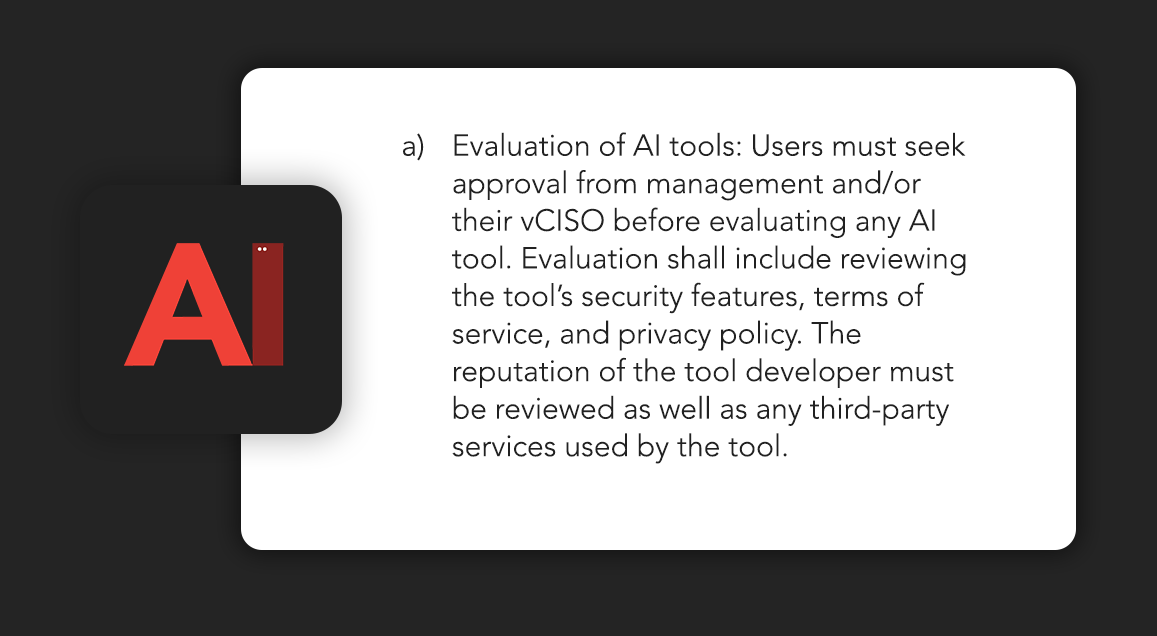
Vetting new AI tools before approval
A good policy includes a tool review process. Without one, AI tools enter the business through individual employees, multiple vendors stack up, and accountability gaps form between marketing, sales, finance, and IT, with no one team tracking what is in use or what data it touches.
The process does not need to be complex, but it does need to cover the things that matter most for SMB risk.
When reviewing a new AI tool, the questions worth answering include:
- Data handling: Does the vendor’s terms of service permit them to use your inputs to train their models? Is there an enterprise tier that disables training? Where is your data stored geographically?
- Vendor stability: Has the vendor been operating long enough to evaluate financial and operational stability? What happens to your data if they shut down?
- Security posture: Does the vendor publish a current SOC 2 report or equivalent? Have they had any disclosed breaches?
- Integration risk: Does the tool integrate with systems that hold sensitive data? If so, what permissions does it request?
- Output reliability: What is the vendor’s stance on accuracy, bias, and error correction? Does the tool clearly mark AI-generated content?
The U.S. National Institute of Standards and Technology AI Risk Management Framework, available at nist.gov, provides a public reference for the vendor evaluation criteria most SMBs should consider. CMIT applies these same criteria when reviewing AI tools on behalf of clients, drawing on a nationwide network of cybersecurity professionals so businesses get enterprise-level vetting with the personalized support of a local provider.
Many businesses assume their cyber insurance will cover the fallout from an AI-driven incident, but insurers increasingly require specific security controls, including governance over emerging technologies, before issuing or renewing coverage.
Use our insurance readiness assessment to see whether your current security environment aligns with modern insurer expectations.
Common mistakes SMBs make with their first AI policy
The first version of an AI policy is almost always wrong somewhere. SMBs that draft their policy in isolation, without trusted long-term technology guidance, tend to repeat the same handful of mistakes that surface during audits, renewals, or incident reviews.
The common mistakes worth avoiding from the start include:
- Treating the policy as a one-time project: AI tools change monthly. A policy that is not on a review cycle becomes obsolete almost immediately.
- Copying an enterprise template: Enterprise policies assume resources SMBs do not have, and the result is a policy that everyone ignores because it is impossible to follow.
- Banning everything by default: Overly restrictive policies push usage further underground. The goal is to channel AI usage toward approved tools, not eliminate it.
- Forgetting to communicate: A signed policy that no employee remembers is functionally no policy. Annual training and short reminders matter more than the document length.
- Skipping the request workflow: Without a clear way to request new tools, employees default to shadow AI. The request workflow is what makes the policy work in practice.
CMIT guides SMBs around these mistakes from the outset, working as an ongoing technology advisor to balance AI innovation with strong cybersecurity protections as both the tools and the threats evolve.
💡 Additional reading: AI vs automation
Build an AI acceptable use policy you can actually enforce
Most SMBs do not need a perfect AI policy on day one. They need a working policy that covers the highest-risk activities, sits on a defined review cycle, and connects to the rest of their cybersecurity and compliance work.
CMIT Solutions has more than 30 years of experience helping small and mid-sized businesses adopt new technology safely and strategically, working as trusted technology advisors who align IT decisions with each client’s operational goals. With a nationwide network of more than 900 IT and cybersecurity professionals delivering responsive local support, the team helps businesses build AI acceptable use policies that fit their industry, scale with their operations, and align with the compliance frameworks they already work within.
The work starts with understanding how AI is already being used inside your business. From there, CMIT designs a policy that brings shadow AI usage into approved channels, builds a tool review workflow staff will actually use, and connects AI governance to a layered, security-first cybersecurity posture so the policy stays current as both the tools and the threats evolve.
For a look at how CMIT supports multi-location businesses through complex IT and security challenges, see the Optyx case study. The story shows how CMIT helped a national eyewear retailer unify IT across dozens of locations while keeping security and operational support consistent across the business.
Additional reading: managed AI services
Complete our free AI self assessment to identify gaps across security, productivity, automation, technology, and team adoption.
FAQs
How long does it take to build an AI acceptable use policy?
Most SMBs can put a working first version in place in two to four weeks. The slowest part is usually taking stock of which AI tools employees are already using, since shadow AI rarely shows up on any official list. Once that picture is clear, the actual drafting and rollout typically takes 10 to 15 hours of focused work.
Can the AI policy sit inside our general IT acceptable use policy?
Usually not. AI tools introduce risks around model training, prompt logging, and output reliability that general IT policies were never built to address. A standalone AI policy gives staff clearer rules and gives the business a defensible record of AI governance during audits, insurance applications, and compliance reviews.
What should we do about AI usage that already happened?
Start with a no-blame inventory. Ask staff which tools they have been using and what data they put into them, then assess any potential exposure tied to regulated information. The goal is to surface risks honestly so the new policy can address them, not to punish people for working in a gray area nobody had defined yet.
Who needs to approve the AI acceptable use policy?
Sign-off in most SMBs involves three roles: the business owner or executive sponsor, the person responsible for IT and security, and a legal reviewer for any business with regulatory exposure. Every employee then acknowledges the policy in writing, since signed acknowledgments are what make the policy enforceable during compliance reviews.
Does an AI policy affect cyber insurance coverage?
Yes, and the effect is increasingly positive. Cyber insurers now ask about AI governance during underwriting, and a documented acceptable use policy signals that the business is managing emerging risk actively. That evidence can support smoother applications, better renewal terms, and stronger coverage outcomes for SMBs across regulated industries