The team at CMIT Solutions has put together these top benefits of AI in the workplace for productivity:
- Automating routine and repetitive work
- Faster, better-supported decisions
- Better customer service and response times
- Smarter marketing and content creation
- Improved data analysis without a data team
- Streamlined hiring and HR workflows
- Stronger cybersecurity and threat detection
- Better collaboration across distributed teams
- Predictive insights for operations and planning
- More time for strategic, high-value work
Artificial intelligence is no longer reserved for enterprise teams with dedicated data scientists. SMBs are using AI to handle routine work, surface insights from their own data, and free up staff for the projects that actually move the company forward.
The catch is that the gains only stick when AI is adopted safely.
At CMIT Solutions, we help small and mid-sized businesses adopt AI for productivity in a way that is practical, secure, and built around how their teams actually work.
Talk to CMIT about our managed AI services and how to roll AI out across your team without putting your business at risk.
More details on the 10 benefits of AI in the workplace for SMBs
Below are ten benefits that show up consistently when SMBs adopt business-grade AI tools with proper oversight. Each benefit assumes the underlying tools are secure, governed, and aligned with the business.
1. Automating routine and repetitive work
AI handles the high-volume, low-value tasks that drain hours from small teams. Data entry, file renaming, document formatting, scheduling, and routine reporting can run in the background while staff focus on higher-impact work.
For an SMB with three administrative employees, even a 20 percent reduction in routine workload returns meaningful time to the business. That recovered time often goes toward customer follow-up, business development, or process improvements that would otherwise be deferred.
💡 Additional reading: AI automation tools
2. Faster, better-supported decisions
AI can analyze large datasets quickly and surface patterns a person would not catch by skimming a spreadsheet. For SMBs, this means faster answers to questions like which products are trending, which customers are at risk of churning, and where margins are slipping.
The decisions themselves still belong to the people running the business. AI provides the analysis, and the owner, manager, or department lead applies judgment and context.
3. Better customer service and response times
AI-powered chatbots and customer support tools can handle common questions around the clock, route complex issues to the right person, and pull up relevant account history before a human ever touches the conversation.
This is especially valuable for SMBs that cannot afford a 24-hour support team. Customers get faster answers, and staff focus on the conversations that require a human touch.
4. Smarter marketing and content creation
AI tools draft email copy, generate first passes of social media content, summarize long documents into customer-facing summaries, and help teams produce more without sacrificing brand consistency. A marketing coordinator who used to spend half a day on a newsletter can now spend an hour reviewing and refining an AI-generated draft.
The risk is publishing AI content without human review. CMIT helps SMBs put the right review workflows in place so brand voice, factual accuracy, and compliance stay intact, particularly in regulated industries.

5. Improved data analysis without a data team
Most SMBs sit on more data than they realize. Sales records, customer interactions, inventory logs, and operational metrics often live in different tools and rarely get analyzed together.
AI lowers the barrier by extracting insights without requiring a full-time analyst.
A small finance firm, for example, can use AI to identify trends in client portfolios across years of records, surfacing opportunities that would otherwise stay buried in spreadsheets.
6. Streamlined hiring and HR workflows
AI can screen resumes, generate first drafts of job descriptions, summarize candidate interviews, and handle the administrative side of onboarding. For SMBs without a dedicated HR department, this turns weeks of work into days.
Hiring decisions, of course, should never be left to AI alone. CMIT helps SMBs document the human review steps in their AI usage policy so bias, fairness, and legal compliance are addressed before the first resume is screened.
7. Stronger cybersecurity and threat detection
AI plays both sides of the cybersecurity field. Attackers use it to scale phishing and social engineering, while defenders use it to detect anomalies, flag suspicious behavior, and respond to threats faster than a human analyst could.
For an SMB, AI-driven security capabilities are typically delivered through a managed IT partner rather than purchased and maintained in-house. CMIT combines AI-assisted threat detection with continuous monitoring and layered protection across your systems, users, and data, so suspicious activity is identified and contained before it disrupts the business.
Many businesses assume their cyber insurance will cover them after an incident, but insurers increasingly require specific security controls before issuing or renewing coverage.
Use our insurance readiness assessment to see whether your current security environment aligns with modern insurer expectations.
8. Better collaboration across distributed teams
AI assistants embedded in collaboration tools can summarize meetings, draft follow-up notes, surface relevant documents during conversations, and translate languages in real time. For SMBs with remote or multi-location teams, this closes the gap between staff who would otherwise lose context between meetings.
The benefit compounds when AI is integrated cleanly into the tools the business already uses, such as Microsoft 365, Google Workspace, or Slack, rather than bolted on as a separate platform. For multi-location and distributed teams, CMIT delivers consistent tools, standards, and support across every site so AI rolls out the same way no matter where staff work.
9. Predictive insights for operations and planning
AI can forecast inventory needs, predict equipment maintenance, anticipate seasonal demand, and identify operational bottlenecks before they become problems. For an SMB, every hour of unplanned downtime or supply disruption pulls revenue and momentum out of the business, so the ability to predict and prevent issues is often the difference between reacting to problems and avoiding them entirely.
A small manufacturer, for instance, can use AI to predict when machinery is likely to need service, reducing unplanned downtime and the lost revenue that comes with it.
Curious what unplanned downtime is actually costing your business? Try our IT downtime calculator to estimate the impact on your operations.
10. More time for strategic, high-value work
This is the real point of every benefit above. When AI removes the routine, what remains is the work that actually grows the business: customer relationships, strategic decisions, new offerings, and process improvements.
The businesses getting the most out of AI are not the ones using the most AI. They are the ones using it to clear space for the work that requires human judgment.
How AI changes day-to-day work in a small business
For most SMBs, the day-to-day reality is too much work for too few people. Routine tasks, documentation, communication, and reporting consume hours that could go toward customers, growth, or strategy.
AI does not replace the people doing this work. It removes the friction around it.
The shift looks different depending on the business. A healthcare practice might use AI to summarize internal documentation, a government contractor might use AI to draft proposal sections, and a retail operation might use AI to forecast inventory.
The common thread is that AI gives small teams the capacity they did not have before, provided the tools are properly chosen, configured, and governed.

What good AI adoption looks like for an SMB
Productivity gains do not happen automatically. They depend on adopting the right tools the right way, supported by cybersecurity-informed guidance from people who understand both the technology and the business.
The NIST AI Risk Management Framework provides a widely adopted baseline that SMBs can scale down to their own size and needs.
A practical, secure AI adoption framework for SMBs
Most SMBs do not need a complex AI strategy. They need a practical sequence of decisions:
- Identify the actual problem. Start with the workflow, not the tool. What is currently slow, repetitive, or error-prone?
- Choose business-grade tools. Consumer AI tools often retain prompts for training. Business-grade tools provide data handling commitments that consumer versions do not.
- Define what data can and cannot go into AI. Customer records, payment information, employee data, and any regulated data should be classified before AI is introduced.
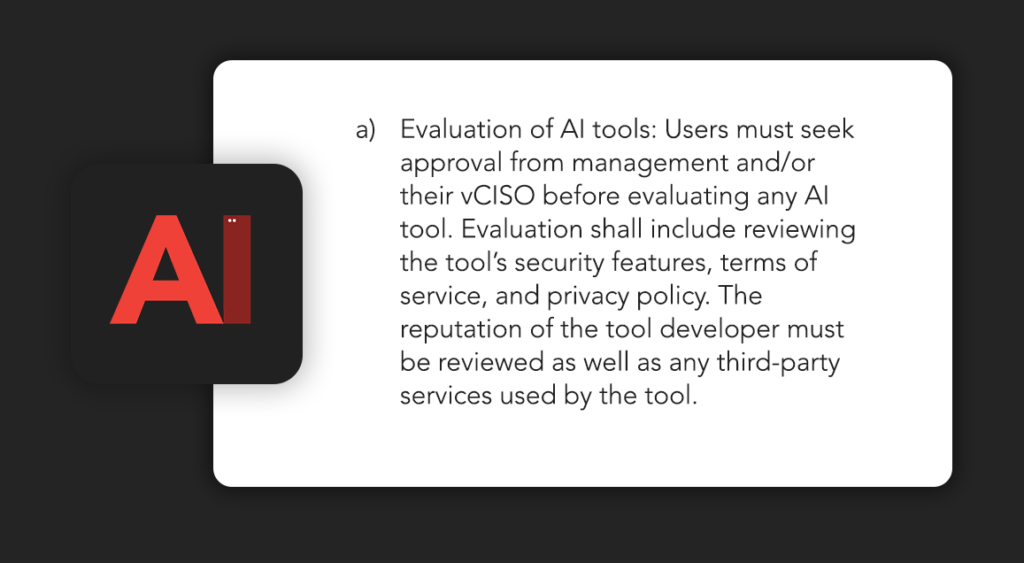
- Set an acceptable use policy. Even a one-page document is better than nothing.
- Train the people who will use it. Most AI risk comes from how employees use the tools, not from the tools themselves.
- Monitor and review. AI usage should be visible to the people responsible for IT and security, not hidden in shadow tools.
Help your team use approved AI tools without exposing sensitive business data. Download our ready-to-use AI acceptable use policy and adapt it to your workplace.
Sanctioned vs unsanctioned AI use: what an SMB policy should cover
A practical acceptable use policy does not need to be long. It needs to be clear, and the table below shows what a basic structure looks like.
| Category | Sanctioned use | Unsanctioned use |
| Tools | Approved business-grade AI tools provisioned by the company | Personal accounts on consumer AI services |
| Data input | General business questions, public information, internal drafts | Customer PII, payment data, PHI, CUI, financial records, passwords |
| Review | Human review of all AI-generated content before client or public use | Publishing AI output without review |
| Documentation | AI uses logged-in approved tools where required | Untracked use of unapproved tools (shadow AI) |
| Training | All staff complete basic AI usage training | Use of AI tools without completing training |
A hypothetical scenario: where AI productivity goes wrong
Consider a hypothetical mid-sized healthcare practice. A clinical staff member, trying to save time, pastes a block of patient notes into a free consumer chatbot to summarize them.
The summary is helpful. The data, however, may now be retained by a third party that has no business associate agreement with the practice.
Under guidance from the HHS Office for Civil Rights, that constitutes a HIPAA exposure.
The same productivity gain could have been achieved with a business-grade AI tool configured for PHI handling, sitting inside the practice’s Microsoft 365 environment, governed by a written acceptable use policy.
The benefit is the same. The risk is not.
This is the distinction that matters for SMBs. Productivity gains and security failures often come from the same action, separated only by which tool was used and how.
Risks SMBs need to manage as they adopt AI
The benefits above are real, but so are the risks. The good news is that SMB-scale AI risks are well understood and manageable with the right approach.
Data exposure and shadow AI
When employees use consumer AI tools without company oversight, sensitive data can leave the business in ways that are difficult to track. This is the single most common AI risk facing SMBs today.
CMIT helps businesses replace shadow AI with provisioned, approved business-grade tools that staff actually want to use, paired with clear guidance on what does and does not belong in AI.
Compliance overlap
For SMBs in healthcare, government contracting, finance, retail, and other regulated sectors, AI usage intersects with frameworks like HIPAA, CMMC, PCI-DSS, SOX, GDPR, and CPRA.
Compliance obligations do not pause because the tool is new. AI inputs and outputs that touch regulated data fall under the same rules as any other handling of that data.
If your business handles controlled unclassified information for the Department of Defense, learn how our CMMC compliance services help defense contractors meet certification requirements.
Vendor and model risk
Not all AI vendors are equal. A business-grade tool with documented data handling, audit logs, and a clear contract is very different from a free consumer tool with terms of service that permit training on user inputs.
Vendor evaluation matters more for AI than for most other software categories.
Lack of human review
AI can produce content that is well-written but factually wrong. A small business that publishes AI output without review can damage its credibility quickly.
CMIT works with SMBs to build review workflows and training into their AI usage policies so staff know what to check before content goes out.
💡 Additional reading: AI safety
Adopt AI productively with a partner who understands SMBs
Adopting AI productively is not just about picking a tool. It is about building the underlying environment so the tools can be used safely, monitored properly, and integrated with the rest of the business.
That is the work CMIT Solutions does for small and mid-sized businesses every day.
With more than 30 years of experience and a nationwide network of 900+ IT and cybersecurity professionals, we help SMBs evaluate AI vendors, configure business-grade tools securely, build acceptable use policies, train staff, and provide continuous monitoring so AI usage stays aligned with the same security standards we apply to the rest of the IT environment.
Our Optyx case study shows how this works in practice. CMIT helped Optyx, a multi-location optical retailer, unify and secure their IT across every storefront with consistent infrastructure, centralized management, and the kind of reliable support distributed teams need to operate confidently.
Our approach reflects how we work across every service: security-first IT by design, responsive locally delivered support backed by a nationwide network of experts, and strategic technology guidance that turns AI into a driver of business growth rather than another source of risk.
Complete our free AI self assessment to evaluate productivity, security, tools, automation, and team readiness.
FAQs
How quickly do small businesses see results from AI?
Most small businesses see measurable productivity gains within 60 to 90 days when AI is rolled out with a clear use case and basic staff training. Larger gains typically take six months as the business refines which workflows benefit most. Quick wins usually come from automating routine tasks like document summarization and email drafting.
Does an SMB need to hire someone to manage AI?
No, most SMBs do not need a dedicated AI manager. Typically, an existing operations or office lead owns AI policy, while a managed IT partner handles the technical configuration, security oversight, and ongoing monitoring. This avoids a full-time hire while ensuring AI is governed properly inside the business.
What is the difference between consumer AI and business AI tools?
Business AI tools include documented data handling, administrative controls, audit logs, and contractual protections that consumer tools lack. Consumer tools like the free version of ChatGPT may retain user inputs for model training. For any AI use involving company, customer, employee, or regulated data, business-grade tools are the correct choice.
How much does AI cost for a small business?
Most small businesses start with AI features already included in their productivity suite, such as Microsoft 365 Copilot at roughly $30 per user per month or Google Workspace AI add-ons. Specialized AI tools for marketing, customer support, or analytics typically range from $20 to $200 per user per month, depending on the use case.
What should a business do if an employee leaks data through AI?
The first step is identifying what was shared, with which tool, and whether that tool retains inputs. Depending on what was exposed, the business may need to notify affected parties, document the incident, update policies, and retrain staff. A managed IT partner can guide the response and reduce the chance of repeat exposures.