AI safety in the workplace is the practice of protecting your data, employees, and operations from the risks that come with using artificial intelligence tools at work.
At CMIT Solutions, we help small and mid-sized businesses put AI safety programs in place that build governance, employee usage controls, vendor evaluation, and continuous monitoring into the way they adopt AI from the start, rather than bolting it on after a problem.
AI safety covers the policies, controls, and oversight that keep AI tools from exposing sensitive information, creating compliance gaps, or making decisions your business cannot audit. For SMBs, the challenge is rarely theoretical. Employees are already using ChatGPT, Copilot, and other AI assistants, whether or not leadership has formally approved them.
Talk to our team about managed AI services built for your business.
Why AI safety matters for small and mid-sized businesses
Most SMBs do not have an in-house AI specialist, a dedicated security team, or the budget to absorb a serious incident. A single staff member pasting client information into a public chatbot can create a compliance issue, a contract breach, or a data exposure event in seconds.
The pressure to adopt AI is real. Employees want faster ways to draft, summarize, and research, and leadership wants productivity gains. But AI usage that runs ahead of governance leaves SMBs exposed in ways they cannot always see.
Three patterns are common among the businesses we work with:
- Shadow AI use: Employees sign up for free AI tools using personal accounts, outside any IT oversight.
- Untrained inputs: Staff pastes customer data, financial records, or proprietary documents into AI tools without realizing where that data goes or how it is retained.
- Vendor sprawl: Multiple AI tools accumulate across departments with no central record of what is approved, what data each tool accesses, or what happens when an account is no longer needed.
Our advisors help businesses replace this guesswork with strategic technology guidance and a clear, defensible approach to AI usage.
💡 Additional reading: AI in the workplace
The core elements of AI safety at work
AI adds another layer to an IT environment that is already growing more complex for most SMBs. A workable AI safety program rests on a small number of practical elements rather than abstract principles. Each one addresses a specific point where AI tools can introduce risk into a business.
The five core elements we work with most often:
- Data governance: Knowing what information can and cannot be entered into AI tools, including customer data, PHI, payment data, and controlled unclassified information.
- Acceptable use policies: A written policy that defines approved tools, prohibited inputs, review workflows, and consequences for misuse.
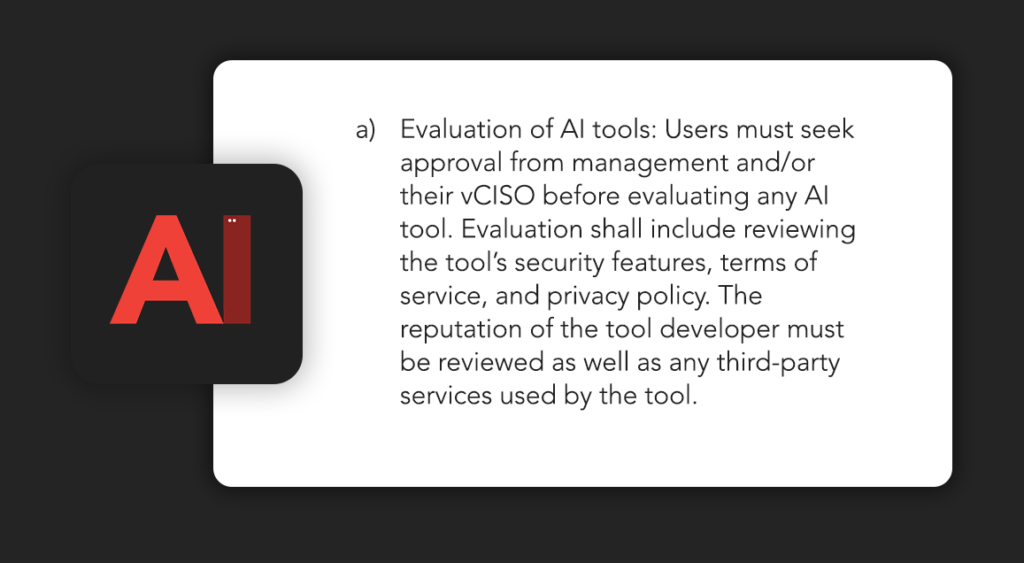
- Vendor evaluation: A process for assessing AI vendors before adoption, including how they handle data, whether they train on user inputs, and what security controls they provide.
- Monitoring and logging: Visibility into which AI tools are being used across the business, so leadership can spot shadow AI and respond to misuse.
- Employee training: Practical guidance that helps staff use AI tools productively while avoiding the most common mistakes.
Our team builds these five elements into a single coordinated approach so policy, training, and monitoring reinforce each other rather than sitting in separate silos.
See how operational disruption affects your bottom line with our IT downtime calculator.
Common AI risks SMBs face
Most AI incidents at SMBs do not come from sophisticated attacks. They come from everyday workflows where staff use AI tools to move faster without realizing what they are exposing.
The categories below cover the situations seen most often in SMB environments:
- Data exposure: Sensitive information entered into public AI tools may be stored, reviewed, or used for model training, depending on the vendor.
- Compliance gaps: AI usage that touches PHI, payment data, or controlled unclassified information can create violations under HIPAA, PCI-DSS, or CMMC, even when the underlying work is routine.
- Inaccurate outputs: AI tools can produce confident answers that are factually wrong, and staff who trust those outputs without review can act on bad information.
- Prompt injection and manipulation: AI tools connected to email, documents, or business systems can be manipulated by malicious inputs hidden in source material.
- Account and access risks: Personal AI accounts used for work create offboarding gaps when employees leave, since the business has no control over what data those accounts retain.
CMIT advisors map these risks against your specific environment with cybersecurity-informed recommendations rather than applying a generic checklist, so the controls you put in place match the data your team actually handles.
💡 Additional reading: AI privacy

Hypothetical scenario: How a small healthcare practice exposed PHI
A five-person specialty practice adopts ChatGPT to help draft patient communication letters. A staff member pastes a full appointment summary, including patient name, diagnosis, and treatment plan, into the free version of the tool to speed up drafting.
The output is excellent, and the letter goes out the same day. The problem is invisible until the next HIPAA risk assessment.
The practice has no business associate agreement with the AI vendor, no record of what data was submitted, and no way to confirm whether the input was retained or used for training. What looked like a productivity win has become a reportable exposure event.
The fix is not to ban AI. It is to give the team an approved tool that handles PHI appropriately, a clear policy about what can and cannot be pasted into any AI assistant, and monitoring that catches use of unapproved tools.
Approved vs. prohibited AI use: a comparison framework
One of the most useful exercises an SMB can do is define what good and bad AI use looks like in plain language. The table below shows the kind of distinctions a practical acceptable use policy makes for a typical professional services business.
| Activity | Approved | Prohibited |
| Drafting internal communications | Approved AI tool with no client identifiers | Public chatbot with full client names and details |
| Summarizing public industry articles | Any approved tool | Pasting paywalled or copyrighted material |
| Generating marketing copy | Approved tool, reviewed by a human before publishing | Auto-publishing AI output without review |
| Working with customer data | Only tools covered by a signed data processing agreement | Any consumer or free-tier AI tool |
| Working with PHI, payment data, or CUI | Only tools specifically approved for that data type | All other AI tools, including paid consumer tools |
| Writing or reviewing code | Approved development of AI with appropriate access controls | Pasting proprietary code into public AI tools |
| Personal productivity tasks | Approved tools using a work account | AI tools tied to personal email or accounts |
Our team helps tailor this framework to the regulations and data your business actually touches, so the rules staff follow reflect the reality of your industry rather than a generic template.
Define approved tools, prohibited data, and responsible employee practices with our ready-to-use AI acceptable use policy.
Building an AI acceptable use policy
A strong acceptable use policy is short, specific, and enforceable. SMBs do not need a 40-page document. They need a clear statement that staff can read in five minutes and apply the next time they open an AI tool.
The structure that works for most SMBs covers five sections:
- Purpose and scope: A plain-language explanation of why the policy exists and who it applies to, including contractors and part-time staff.
- Approved tools: A maintained list of AI tools the business has reviewed and authorized, including what each tool is approved to handle.
- Prohibited inputs: A specific list of data types that must never be entered into any AI tool, written in language staff will actually recognize from their daily work.
- Review and approval: A defined process for requesting new AI tools and getting them evaluated before use.
- Consequences and reporting: What happens if the policy is violated, and how staff should report a mistake or a suspected exposure.

AI safety and compliance overlap
Multiple AI vendors entering a business through different departments can create accountability gaps that show up first during a compliance review. For businesses in regulated industries, AI safety is part of compliance, not separate from it.
The same controls that keep AI tools from leaking data often map directly to existing compliance frameworks, which means a well-designed AI program reinforces work already underway.
Common overlap points include:
- HIPAA and HITECH: AI tools that handle PHI need the same business associate agreements, access controls, and audit trails that any covered service would.
- CMMC: Government contractors handling CUI must extend their existing controls to any AI tool that processes that data, including approved tool lists and usage logging. Our CMMC compliance services help defense contractors apply these controls consistently across AI and non-AI systems.
- PCI-DSS: Businesses that take payments must keep cardholder data out of AI tools that have not been specifically approved for that purpose.
- GDPR and CPRA: Any AI tool that processes personal data needs to fit within your existing data processing inventory, including lawful basis, retention, and subject rights.
- SOX: AI used in financial reporting workflows requires the same documentation, review, and audit support as any other system touching financial records.
CMIT advisors connect AI governance to the compliance work your business is already doing, so adopting AI supports your regulatory position rather than complicating it.
Many businesses assume their cyber insurance will cover them after an attack, but insurers increasingly require specific security controls before approving or renewing coverage.
Use our insurance readiness assessment to see whether your current security environment aligns with modern insurer expectations.
Practical steps to improve AI safety this quarter
When IT is treated as maintenance instead of a driver of business growth, AI safety can feel like one more thing on a backlog that never moves. You do not need to overhaul your entire IT environment to make meaningful progress. Most SMBs can take a series of small, high-impact steps over a single quarter and arrive at a defensible AI safety baseline.
A 90-day starting framework:
- Weeks 1 to 2: Survey staff about which AI tools they currently use, for what tasks, and with which accounts.
- Weeks 3 to 4: Draft a short list of approved tools and a one-page acceptable use policy.
- Weeks 5 to 6: Roll out the policy with a 30-minute training session and a clear point of contact for questions.
- Weeks 7 to 9: Add monitoring for unsanctioned AI use, starting with browser and endpoint visibility.
- Weeks 10 to 12: Review what the monitoring has found, refine the approved tool list, and document the program for compliance and insurance purposes.
Our team can either run this 90-day process for you or work alongside an internal lead, depending on how much capacity you have to dedicate to it.
AI safety vs. AI security: what is the difference?
AI safety and AI security sound similar but address different problems, and confusing them leads to gaps in both. Safety is about whether AI tools behave the way you expect within the boundaries you set. Security is about whether those tools can be attacked or misused by outside actors.
The simplest distinction:
- AI safety focuses on alignment, accuracy, governance, and acceptable use. The question is whether people are using AI in ways that match what the business intends.
- AI security focuses on protecting AI tools and the data they handle from external threats, including prompt injection, model manipulation, and unauthorized access.
CMIT builds layered protection across both safety and security into a single coordinated program so businesses are not left choosing between policy and protection, or trying to bolt one onto the other after the fact.
Get expert guidance on safe AI adoption
Adopting AI safely is not a one-time project. It is an ongoing program that needs governance, continuous monitoring, training, and adjustment as tools and threats evolve, with security built in by design rather than added after a problem.
CMIT Solutions helps small and mid-sized businesses put practical AI safety programs in place across healthcare, finance, government contracting, hospitality, and retail. Our advisors act as long-term technology partners, not just IT support, helping you align AI adoption with your business goals, your compliance obligations, and the specific risks your team actually faces.
With more than 30 years of experience and a nationwide network of 900+ IT and cybersecurity professionals, we combine responsive local support with shared standards, tools, and threat intelligence that smaller IT teams cannot build alone.
See how we helped a multi-location retail business standardize IT and security across every location in our Optyx case study. The same approach that worked there, combining centralized standards with responsive local support, is what we bring to every AI safety engagement.
Complete our free AI self assessment to evaluate your security, tools, automation, productivity, and team readiness. Receive a personalized score and recommendations for safer AI adoption.
FAQs
How long does it take to set up an AI safety program?
A baseline AI safety program takes about 90 days for most SMBs. The first month covers a usage survey and draft policy, the second adds training and monitoring, and the third refines the program. CMIT advisors can compress this timeline when leadership needs faster progress.
Who should be in charge of AI safety at a small business?
A senior operational leader should own AI safety, usually the COO, office manager, or business owner. Their role is governance and decision-making rather than technical execution. An external IT partner handles the technical work, monitoring, and ongoing advice that supports the owner.
What is the biggest AI safety mistake small businesses make?
The biggest mistake is assuming employees will figure out safe AI use on their own. Without a clear approved tool list and short written policy, staff default to whatever is easiest. Silence from leadership is almost always interpreted as permission to use any tool.
Does AI safety look different in healthcare, finance, or government contracting?
Yes. Healthcare practices face HIPAA constraints on PHI, government contractors face CMMC requirements for CUI, retailers face PCI-DSS rules for payment data, and finance firms face SOX and state privacy laws. The framework stays consistent, but approved tools and prohibited inputs change by industry.
Why are cyber insurers asking about AI now?
Cyber insurers ask about AI because it introduces new data exposure and access risks that affect underwriting. Insurers increasingly request documented acceptable use policies, monitoring of AI tools, and offboarding controls during renewal. Businesses without these in place can face higher premiums or coverage gaps.