Artificial intelligence has moved well past the experimental stage. What started as a handful of pilot projects in large enterprises has become a standard expectation across businesses of every size, from automated customer support to predictive analytics to AI-assisted decision-making in daily operations. The conversation has shifted from whether a business should adopt AI to how quickly and how safely it can be done.
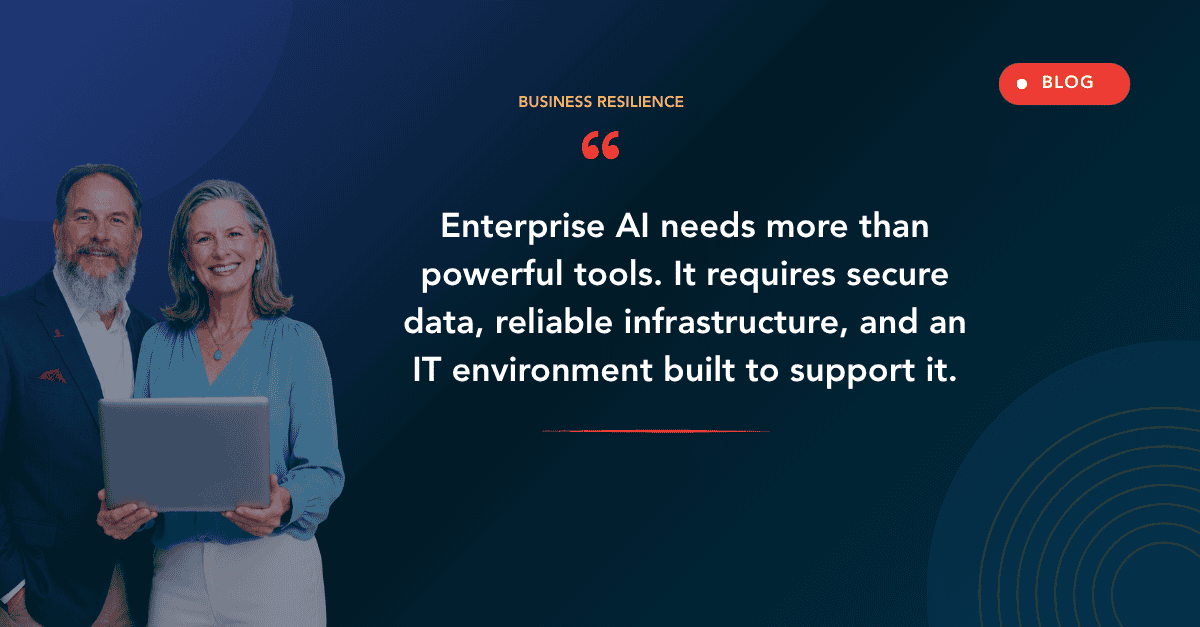
That second question, the “how safely” part, is where many businesses run into trouble. Enterprise AI tools are only as effective, and as secure, as the IT environment they run on. A business with outdated infrastructure, weak data governance, or limited network visibility can end up introducing serious risk the moment AI tools are layered on top of existing systems.
This guide walks through what true AI readiness looks like, the infrastructure and security gaps that most commonly derail adoption, and practical steps businesses can take to prepare their environment before rolling out enterprise AI tools at scale.
Why AI Readiness Matters More Than the AI Tools Themselves
It is tempting to focus entirely on choosing the right AI platform or vendor. But the tool itself is rarely the limiting factor. Readiness comes down to whether the surrounding environment, meaning data quality, network infrastructure, security controls, and employee practices, can actually support what the AI tool is being asked to do.
Businesses that adopt AI without addressing these foundations often experience one of two outcomes. Either the AI tool underperforms because it cannot access clean, well-organized data, or it introduces new security and compliance exposure that was never properly assessed. Neither outcome reflects a problem with the AI itself. Both reflect a readiness gap.
As explored in AI running your business, AI has already embedded itself into daily operations for many companies, whether leadership formally approved it or not. That reality makes proactive readiness planning more urgent, not less.
What “AI Readiness” Actually Means
AI readiness is not a single checkbox. It spans several interconnected areas of the business:
- Data readiness, meaning data is accurate, organized, and accessible without excessive manual cleanup
- Infrastructure readiness, meaning networks, servers, and cloud environments can handle the processing and storage demands AI tools introduce
- Security readiness, meaning access controls, monitoring, and data protection are strong enough to support AI without creating new vulnerabilities
- Compliance readiness, meaning AI use aligns with relevant industry regulations rather than creating unintentional violations
- Organizational readiness, meaning employees understand how to use AI tools appropriately and securely
A business can be strong in one area and weak in another. True readiness means addressing all five before rolling out AI tools broadly.
Common IT Gaps That Undermine AI Adoption
Fragmented or Poor-Quality Data
AI tools are only as good as the data they are trained on or connected to. Businesses with data scattered across disconnected systems, outdated spreadsheets, or inconsistent formats often find that AI outputs are unreliable, incomplete, or simply wrong. Cleaning up and consolidating data before AI adoption pays off significantly more than trying to fix data problems after the fact.
Outdated Network Infrastructure
AI workloads, particularly those involving large datasets or real-time processing, place new demands on network bandwidth and server capacity. Infrastructure that was adequate for basic office applications may struggle under AI-driven workloads, leading to slow performance or unreliable results. Reliable network management services help ensure the underlying network can actually support these new demands.
Weak Access Controls
AI tools often need broad access to internal systems and data to function effectively, which makes strong identity and access management essential. Without clear controls over who can access what, businesses risk AI tools surfacing sensitive information to the wrong people, whether accidentally or through a compromised account.
Limited Visibility Into Shadow AI Usage
Employees frequently adopt AI tools on their own, without formal approval or IT oversight, to solve problems faster. This creates significant blind spots, since sensitive company data may be shared with tools that were never vetted for security or compliance. The risks associated with this trend are detailed in shadow AI risks, which explains how quickly unmanaged tool usage can spread across a workforce.
Insufficient Endpoint Protection
As AI tools become embedded in everyday devices, endpoint security becomes even more critical. A compromised laptop or workstation connected to AI-integrated systems can expose far more than a single device would have in the past. Modern approaches to this challenge are covered in endpoint security trends, which also highlights how AI itself is increasingly used to strengthen device-level protection.

Security Considerations Specific to Enterprise AI
Data Privacy and Exposure
One of the biggest risks with enterprise AI adoption is unintentional data exposure. Feeding sensitive client, financial, or employee information into AI tools without proper safeguards can violate privacy expectations or regulatory requirements, sometimes without anyone realizing it happened. A structured approach to securing business AI systems addresses this directly, covering how to evaluate AI tools before granting them access to company data.
AI-Powered Threats
AI is not only a productivity tool. It is also increasingly used by attackers to craft more convincing phishing attempts, automate reconnaissance, and identify vulnerabilities faster than ever before. Businesses preparing for AI adoption also need to prepare for AI-driven threats, a concern explored in AI powered cyberattacks.
Continuous Monitoring
Traditional security tools were not designed with AI-driven workflows in mind. Businesses adopting AI at scale increasingly rely on more advanced monitoring approaches, discussed in managed detection and response, which actively watches for unusual activity rather than relying solely on known threat signatures.
Distributed Security Models
As AI tools connect across cloud platforms, internal systems, and third-party integrations, a single centralized security perimeter becomes harder to maintain. A more flexible approach, outlined in cybersecurity mesh architecture, allows security policies to travel with data and devices rather than being tied to one fixed boundary.
Compliance Implications of Enterprise AI
Regulated industries face particularly complex challenges when adopting AI. Healthcare organizations must ensure AI tools do not compromise patient data protections, a concern closely tied to broader healthcare cybersecurity mistakes many practices are still working to correct. Law firms face similar pressure, since client confidentiality obligations do not disappear simply because AI tools are involved, a topic addressed in law firm data security.
Businesses working under defense-related contracts face additional scrutiny, particularly as frameworks evolve to address AI-specific risks. Ongoing developments here are covered in CMMC compliance readiness, which underscores why compliance planning cannot be treated as a one-time project.
Across every industry, the shift toward active, ongoing oversight rather than periodic checklists is becoming the standard expectation, a trend explored in continuous compliance monitoring. Businesses can strengthen this posture through dedicated IT compliance solutions designed to evolve alongside changing requirements.
Infrastructure Requirements for Enterprise AI
Cloud and Hybrid Environments
Most enterprise AI tools rely heavily on cloud infrastructure for processing power and scalability. Businesses still operating primarily on legacy, on-site systems often need to modernize before AI adoption can proceed smoothly. Reliable cloud services support provides the flexible foundation most AI tools are built to run on.
Edge Computing for Real-Time Applications
Certain AI applications, particularly those involving real-time decision-making or high-volume sensor data, benefit from processing closer to where data is generated rather than routing everything through a centralized cloud environment. This approach, discussed in edge computing solutions, reduces latency and improves responsiveness for time-sensitive AI use cases.
Backup and Business Continuity
AI-driven systems often become deeply embedded in daily operations, which means losing access to them, even temporarily, can disrupt business continuity significantly. Strong data backup solutions and tested recovery processes ensure that a system failure does not bring AI-dependent workflows to a complete stop. More advanced recovery approaches are covered in AI powered disaster recovery, which uses automation to shrink recovery timelines considerably.
Building AI Readiness Step by Step
- Audit your current data. Identify where key business data lives, how clean it is, and what needs to be consolidated or corrected before AI tools rely on it.
- Assess network and infrastructure capacity. Confirm current systems can support increased processing and storage demands without performance issues.
- Review access controls. Ensure only appropriate employees and systems have access to sensitive data that AI tools might otherwise expose.
- Identify shadow AI usage. Survey departments to understand what AI tools are already being used informally, then bring that usage under proper oversight.
- Evaluate vendor security practices. Before adopting any AI platform, confirm how it handles data storage, encryption, and third-party sharing.
- Update policies and training. Employees need clear guidance on what data can and cannot be shared with AI tools, along with practical examples.
- Pilot before scaling. Test AI tools in a limited, controlled environment before rolling them out organization-wide.
- Monitor continuously after launch. AI readiness is not a one-time project; ongoing monitoring should continue well after initial adoption.
Operational Efficiency Gains Worth Preparing For
Once the foundation is solid, AI adoption can meaningfully reduce operational costs and manual workload. Automation tools are already helping businesses streamline repetitive tasks, a shift covered in AI powered automation, which explains how automated monitoring and workflow tools reduce the burden on internal staff.
Many businesses are also exploring AI-driven security operations centers to strengthen threat detection without expanding internal security teams, a trend detailed in AI powered SOC. These centers combine automated monitoring with human oversight, offering a middle ground between fully manual security operations and complete automation.
Local businesses have also seen firsthand how AI adoption can transform daily operations when approached strategically, as highlighted in the story behind Augur’s AI recognition, which illustrates what thoughtful, well-supported AI adoption can look like in practice.
The Role of Communication and Collaboration
AI adoption often introduces new workflows for how teams share information, request approvals, and collaborate across departments. Modern unified communications platform tools help ensure that AI-driven workflows integrate smoothly with how employees already communicate, rather than creating a disconnected, parallel system.
Businesses also frequently pair AI adoption with broader productivity upgrades. Reliable productivity software solutions ensure that AI tools work alongside existing document, scheduling, and collaboration platforms instead of operating in isolation.
Everything as a Service and the AI Connection
Many enterprise AI platforms are delivered through subscription-based, consumption-driven models rather than traditional software purchases. This mirrors a broader shift across the technology industry, explored in everything as a service, where businesses pay for what they use rather than committing to large upfront investments. Understanding this model helps businesses budget realistically for AI adoption, including the infrastructure and support needed to run it well.
Procurement Considerations for AI Tools
Choosing the right AI platform involves more than comparing features. Businesses need to evaluate integration requirements, data handling practices, licensing structures, and long-term scalability. Structured IT procurement services help avoid costly missteps, particularly when multiple departments are requesting different AI tools independently without a coordinated strategy.
Why Communication Between IT and Leadership Matters
AI adoption decisions often start with leadership or individual departments rather than IT, which can create friction if technical risks are not clearly communicated in business terms. Translating infrastructure and security concerns into practical business language, a theme explored in business speak over tech speak, helps leadership make informed decisions without needing a technical background.
This kind of clear, collaborative communication reflects a broader philosophy shared by many established technology partners, including the approach described in CMIT Greenville’s founding story, where communication is treated as a core part of the service itself rather than an afterthought.

Industry-Specific AI Readiness Considerations
- Nonprofits exploring AI tools for donor management or outreach should first confirm their broader security posture, since assumptions about being a lower-value target remain a persistent myth addressed in nonprofit cybersecurity threats.
- Accounting and financial firms adopting AI for reporting or fraud detection should pair this with heightened monitoring, particularly during high-volume periods discussed in accounting firm threat monitoring.
- Educational institutions experimenting with AI tools should be especially cautious about underlying infrastructure, since many still operate on aging systems described in legacy systems risk.
Avoiding the Most Common AI Adoption Mistakes
- Moving too fast without a data audit, leading to inaccurate or unreliable AI outputs
- Ignoring shadow AI usage already happening informally across departments
- Underestimating infrastructure demands, resulting in slow performance or bottlenecks
- Skipping vendor security reviews, exposing sensitive data to poorly vetted platforms
- Failing to update policies and training, leaving employees unsure of appropriate AI use
- Treating AI adoption as a one-time project rather than an ongoing, monitored process
Building a Long-Term AI Strategy
AI readiness is not something a business achieves once and moves past. As tools evolve and adoption expands, infrastructure, security, and governance all need to evolve alongside them. Businesses that build AI readiness into their broader technology roadmap, rather than treating it as a separate initiative, tend to see far smoother adoption and fewer costly surprises.
Reviewing available IT service packages can help businesses understand what level of ongoing support, monitoring, and infrastructure management makes sense as AI adoption grows. Pairing this with dependable managed IT services team support and reliable IT support ensures that as AI tools become more embedded in daily operations, the underlying environment stays stable, secure, and ready to support them.
Bringing It All Together
Enterprise AI offers real, measurable benefits, from faster decision-making to reduced operational costs to stronger threat detection. But those benefits depend entirely on the environment AI tools are deployed into. A business with clean data, strong security controls, modern infrastructure, and clear policies will see AI adoption go smoothly. A business missing those foundations often ends up managing new risks instead of gaining new efficiency.
CMIT Solutions of Greenville helps local businesses assess where they currently stand and build a realistic path toward AI readiness, addressing data, infrastructure, security, and compliance together rather than as separate afterthoughts. Getting this right from the start prevents the kind of costly rework that comes from rushing AI adoption without a solid foundation in place.
If your business is considering enterprise AI tools, or has already adopted some without a formal readiness review, now is the time to take stock. Schedule a consultation to get a clear, practical assessment of your current environment and a realistic roadmap for adopting AI safely and effectively.
Frequently Asked Questions