
AI automation for businesses is the use of artificial intelligence to run workflows, decisions, and tasks that previously required manual effort.
Unlike traditional automation, which follows fixed rules, AI automation can interpret unstructured information, learn from patterns, and adapt as conditions change. That capability creates real productivity gains, but it also introduces new security and governance considerations that small and mid-sized businesses cannot afford to overlook.
At CMIT Solutions, we help small and mid-sized businesses adopt AI automation safely, with more than 30 years of experience building secure IT environments that protect data, people, and operations.
Curious how secure AI automation fits into your environment? Explore our managed AI services to see how we can help.
How AI automation differs from traditional automation
Traditional automation, including robotic process automation, runs predictable, rules-based tasks such as copying data between systems or routing forms. It works well for repetitive work but breaks down when inputs vary or context shifts. For small and mid-sized businesses, that limitation has historically capped the value of automation to a handful of straightforward workflows.
AI automation adds reasoning to the equation. By combining machine learning, natural language processing, and intelligent document processing with workflow tools, it can read an invoice, summarize a customer message, classify a support ticket, or draft a reply. This means more of the work that previously required human judgment can now be supported, accelerated, or partially handled by software.
For businesses without enterprise-scale IT teams, the practical difference matters. AI automation can deliver gains in areas that were once out of reach, including customer communication, document handling, and internal knowledge retrieval, without requiring custom development for every workflow.
Core components of AI automation
AI automation is not a single product. It is a combination of capabilities that work together inside your IT environment. Understanding the building blocks helps SMB leaders evaluate vendors and avoid overpaying for features they will not use.
- Machine learning models: Algorithms that learn from historical data to make predictions or classifications, such as forecasting customer churn or sorting incoming email by topic.
- Natural language processing: Capabilities that interpret and generate human language, powering chatbots, summarization tools, and document analysis.
- Intelligent document processing: The ability to extract structured information from unstructured sources like PDFs, scanned forms, and emails.
- Workflow orchestration: The connective layer that triggers actions across business systems based on AI outputs, often integrating with platforms such as Microsoft 365, Google Workspace, or Slack.
- Monitoring and governance: The controls that track which AI tools are used, what data flows into them, and whether outputs align with policy. This layer is often missing in SMB deployments.
The strength of an AI automation deployment depends on how well these components are integrated and governed. Without that foundation, even powerful tools can introduce risk faster than they deliver value.
Complete our AI self assessment to evaluate your security, tools, integrations, automation opportunities, productivity, and team readiness.
Common business use cases for AI automation
Small and mid-sized businesses are finding practical value in AI automation across departments, not just IT. The strongest use cases share a pattern: they handle high-volume, repetitive work that benefits from contextual understanding rather than pure rule-following.
- Customer support: AI-assisted ticket routing, response drafting, and knowledge base retrieval that help small support teams respond faster without compromising accuracy.
- Sales and marketing: Lead scoring, content drafting, meeting summarization, and personalized outreach at scale, including for businesses without dedicated marketing operations staff.
- Finance and accounting: Invoice extraction, expense categorization, and anomaly detection that reduce manual data entry while flagging unusual activity for human review.
- Human resources: Resume screening, interview scheduling, and onboarding document preparation that helps lean HR teams handle hiring spikes.
- Operations and IT: Automated incident triage, log analysis, and routine ticket resolution that frees internal staff for higher-value work.
The right starting point depends on where your business is losing the most time and where the data involved is appropriate for AI tools. Choosing badly can create compliance exposure or operational disruption.
Wondering how much downtime is quietly costing your business? Try our IT downtime calculator to see the real impact. Results are illustrative and do not guarantee specific outcomes.
The risks SMBs face when adopting AI automation
The promise of AI automation comes with real risk, and SMBs face a sharper version of it than enterprises do. Most small and mid-sized businesses do not have dedicated AI security staff, formal vendor review processes, or the budget to recover from a major data exposure incident. That makes the consequences of unmanaged AI usage disproportionate to the size of the business.
The biggest risks fall into a few categories:
- Shadow AI: Employees using consumer AI tools without IT approval, often pasting sensitive data into models that retain or train on that input.
- Data exposure: Confidential information, client data, or regulated records leaving controlled environments through AI prompts or integrations.
- Vendor and model risk: Adopting AI tools without verifying how the provider handles data, where it is stored, and what its retention practices are.
- Compliance gaps: AI usage that conflicts with frameworks such as HIPAA, CMMC, PCI-DSS, GDPR, CPRA, or SOX, often without anyone realizing it.
- Output reliability: AI tools produce confident but incorrect information, which can cause issues if outputs are used without review.
These risks do not mean SMBs should avoid AI automation. They mean adoption should be paired with governance, monitoring, and a security-first foundation from day one.

Hypothetical scenario: how shadow AI creates real exposure
Picture a small healthcare practice with around 25 employees. A medical assistant starts using a free consumer AI chatbot to summarize patient notes at the end of each day, copying full visit details into the prompt to save time. The tool produces fast, useful summaries, and within two months several other staff members are doing the same thing.
No one in leadership knows it is happening. The patient information being pasted into the chatbot includes names, conditions, and treatment details, which means protected health information has been leaving the practice’s controlled environment for weeks. A routine HIPAA audit later flags the practice for unauthorized PHI disclosure, and the cost of remediation, notification, and regulatory penalties far exceeds the time the AI tool ever saved.
This scenario is hypothetical, but the pattern is common. Shadow AI rarely starts with bad intent. It starts with employees trying to do good work faster, in environments where no one has told them what is approved, what is prohibited, and what guardrails exist.
Compliance considerations for AI automation
AI automation intersects with nearly every compliance framework SMBs already work under. The intersection is not always obvious, which is why governance has to be built in rather than added later. A managed IT partner with compliance experience can help map AI usage against the rules that apply to your business.
| Compliance framework | Where AI automation creates risk |
| HIPAA and HITECH | Sending PHI into AI tools, including for summarization or drafting |
| CMMC | AI tools processing controlled unclassified information for government contractors |
| PCI-DSS | AI assistants used in customer service workflows that touch payment data |
| GDPR and CPRA | AI tools processing personal data without lawful basis or consent |
| SOX | AI usage in financial reporting workflows without audit trails |
| FISMA | AI in federal information system contexts |
For government contractors, the overlap with CMMC is especially important to address before AI adoption expands. Learn more about our CMMC compliance services for a security-first approach.
Many businesses assume their cyber insurance will cover them after an AI-related incident, but insurers increasingly require specific security controls before approving or renewing coverage. Use our insurance readiness assessment to see whether your environment aligns with modern insurer expectations.
Sanctioned vs. unsanctioned AI automation use
One of the most useful things an SMB can do early in AI adoption is to define which uses are approved, which are conditional, and which are prohibited. This clarity prevents shadow AI before it starts and gives employees a clear path to work productively without creating exposure.
| Category | Approved | Conditional | Prohibited |
| Drafting internal communications | Yes, with approved tools | Yes, if no sensitive data is included | No, when content includes confidential business data |
| Summarizing public documents | Yes | Yes | No, for non-public client materials |
| Customer service drafting | Yes, with approved tools | Yes, if PII is removed | No, with payment or health data |
| Code generation | Yes, with approved tools | Yes, for non-production code | No, for code touching regulated systems |
| Document summarization | Yes, for internal use | Yes, with redaction | No, for documents containing PHI, PII, or CUI |
| Personal AI accounts at work | No | No | Always prohibited |
This kind of structure does not need to be exhaustive. It needs to be clear, communicated, and enforced. Most SMBs benefit from publishing a simple acceptable use policy and reviewing it as new tools enter the workplace.
💡 Additional reading: how to secure AI
What good AI automation adoption looks like for an SMB
Strong AI automation adoption in a small or mid-sized business shares a few traits. It is governed before it is expanded. It starts with one or two high-value use cases rather than a sweeping rollout. It uses business-grade tools with appropriate data handling controls, not consumer-grade tools repurposed for work. And it is reviewed regularly as the AI landscape changes.
A typical strong adoption pattern includes:
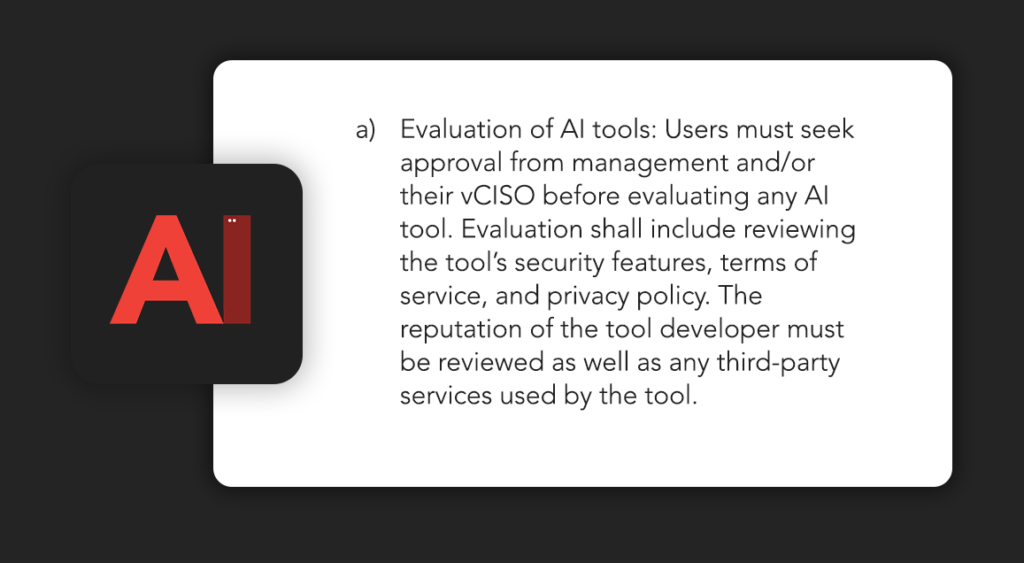
- A short, written acceptable use policy that names approved tools and prohibited inputs.
- A single owner in the business is responsible for AI tools, even if that role is shared with another function.
- Approved tools are integrated with existing IT systems rather than standalone consumer accounts.
- Employee training on what AI can and cannot do, and what data should never be entered.
- Monitoring of AI tool usage and data flow, even at a basic level.
- A clear path for employees to request new tools so they do not feel forced into shadow usage.
Businesses that take this approach get the productivity gains without absorbing the risk. They also build a foundation that scales as they grow and as AI tools evolve.
💡 Additional reading: AI vs automation

A practical AI automation readiness checklist for SMBs
Before expanding AI automation across your business, work through these questions. Most SMBs find at least a few gaps, and addressing them up front is far less expensive than addressing them after an incident.
- Do you know which AI tools your employees are already using?
- Do you have a written acceptable use policy that covers AI?
- Is there a list of approved tools and a process for requesting new ones?
- Have employees been trained on what data should never be entered into AI tools?
- Are your AI tools integrated with your existing IT environment, or are they standalone accounts?
- Do you have visibility into what data is flowing into and out of AI tools?
- Have you mapped AI usage against the compliance frameworks that apply to your business?
- Do your incident response plans address AI-related exposure?
- Is there a single owner accountable for AI governance in your business?
- Have you reviewed your cyber insurance policy against current AI-related expectations?
If you cannot answer yes to most of these, your business is in the same position as the majority of SMBs adopting AI today. The fix is not to slow down adoption. It is to put a security-first foundation in place so adoption can move forward with confidence.
💡 Additional reading: how to use AI to increase productivity
How CMIT Solutions helps SMBs adopt AI automation securely
AI automation is one of the most meaningful productivity opportunities small and mid-sized businesses have seen in years, but it is also one of the most consequential. The right partner makes the difference between productivity that compounds and exposure that compounds.
At CMIT Solutions, our security-first approach to managed IT services is built around continuous monitoring, layered protection, and strategic guidance that adapts as your business grows. With more than 30 years of experience and a nationwide network of 900+ IT and cybersecurity professionals, we help SMBs select, deploy, and govern AI tools that align with their business goals and their regulatory environment.
Reduce shadow AI and help employees understand which tools, data, and workflows are approved. Download our ready-to-use AI acceptable use policy and adapt it to your organization.
FAQs
Is AI automation safe for small businesses to use?
AI automation is safe when paired with the right governance, approved tools, and security controls. Risk comes from unmanaged use, not from AI itself. SMBs that publish a clear acceptable use policy, restrict input of sensitive data, and work with a managed IT partner can adopt AI automation confidently and avoid the most common exposure patterns.
How much does AI automation typically cost for an SMB?
AI automation costs vary widely based on the tools, integrations, and governance work involved. Many business-grade AI tools are priced per user per month, while custom integrations and policy work involve one-time setup. The bigger consideration is total cost of ownership, including security controls, monitoring, and the cost of avoiding an incident through proper governance.
Can AI automation replace employees in a small business?
AI automation rarely replaces employees in SMBs. It more often augments their work by handling repetitive tasks, drafting first versions of content, and surfacing information faster. The businesses that get the most value treat AI as a productivity layer for existing staff, not a substitute, and use the time savings to focus people on higher-value work.
How long does it take to implement AI automation in a business?
A focused AI automation rollout in an SMB can take anywhere from a few weeks to a few months, depending on scope. Starting with one or two well-defined use cases produces faster results than a sweeping rollout. Governance work, tool selection, and integration with existing systems are usually the longest steps, not the AI tools themselves.
What is shadow AI and why is it a problem for SMBs?
Shadow AI is the use of AI tools by employees without IT approval or oversight. It is a problem because it bypasses your security controls, often involves sensitive data being entered into consumer tools, and creates compliance gaps no one is tracking. SMBs are especially exposed because shadow AI usage typically goes undetected until an incident forces it into the open.